
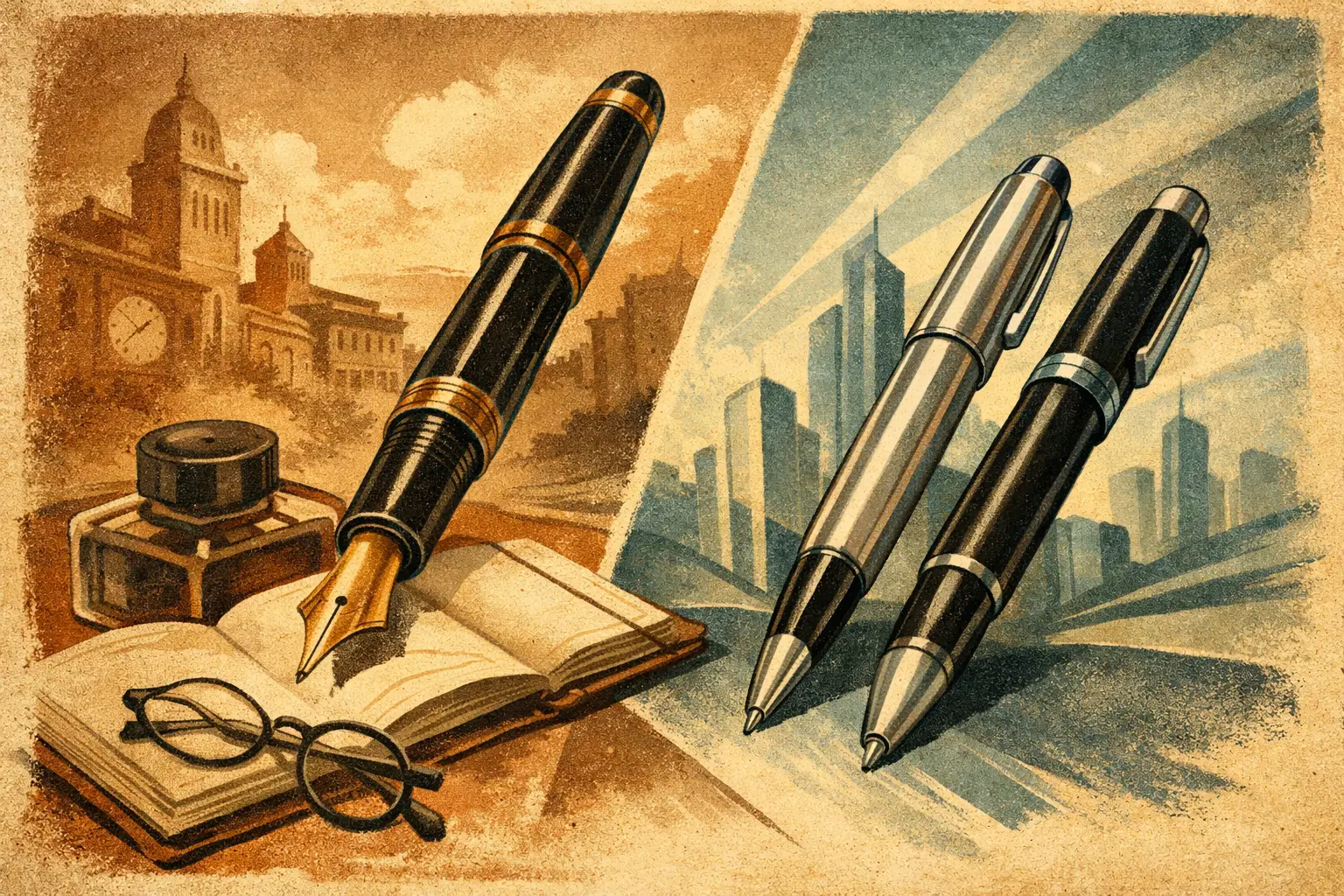
A Parker Vacumatic with its striped celluloid barrel, a lever-filled Conway Stewart in rich marbled colour, or a modern cartridge-converter pen fresh from its box can all put ink on paper. Yet the experience is rarely comparable. The vintage fountain pen versus modern pen question is not simply about old-fashioned charm against modern convenience. It is about how a pen fits the hand, how it fills, how it writes, and whether it becomes an object worth keeping for decades.
For some writers, a contemporary pen is the sensible starting point: dependable, easily serviced and ready for everyday use. For others, the slight warmth of aged material, a responsive gold nib and a design tied to a particular period make a restored vintage pen impossible to replace. The right choice depends less on which is objectively better and more on what you expect from writing.
Vintage fountain pen versus modern pen: the feel in hand
Vintage pens were made in an era when a fountain pen was an everyday tool, often carried from school through professional life. That purpose produced remarkably varied shapes and materials. A 1930s Waterman may feel slender and balanced for long correspondence; a 1950s Parker 51 may sit low and secure in the hand; a Conway Stewart can offer the colour and presence of a proper personal possession.
Many vintage fountain pens are lighter than buyers expect. Celluloid, hard rubber and early plastics have a warmth that metal-bodied modern pens do not always match. Their proportions are often elegant rather than oversized, which suits writers with smaller hands or anyone who finds modern statement pens tiring over a full page.
There are trade-offs. A large modern pen can be more comfortable for those who prefer substantial weight and a wider section. Modern makers also offer a more predictable range of grips, finishes and cap mechanisms. If you write only occasional notes, that consistency may matter more than the individual character of a vintage model.
The nib is where the difference becomes most personal. Vintage gold nibs, particularly those from established makers such as Waterman, Sheaffer, Parker and Pelikan, can have a lively, cushioned response. This does not necessarily mean dramatic flex. Most were intended for ordinary writing, but the nib may give subtle variation and a softer feel as it moves across the page.
Modern nibs are generally designed for consistency. A well-made modern steel nib can be smooth, firm and exceptionally practical, while modern gold nibs often provide controlled softness. They are a good fit for writers who want the same line every morning without needing to adapt their pressure or angle. Vintage nibs reward a lighter touch and a little patience, especially where a pen has an unusual grind or natural feedback.
Filling systems: romance, capacity and routine
One reason collectors are drawn to vintage pens is their filling systems. Lever fillers, button fillers, Vacumatics, snorkels and piston mechanisms are small pieces of engineering history. Filling one is part of the ownership experience. A lever pen draws ink with a satisfying simplicity, while a restored Vacumatic offers generous capacity and an unmistakable mechanism.
A properly restored filling system should be genuinely usable, not merely decorative. The quality of restoration matters greatly here. A pen may look excellent in photographs yet need a new sac, diaphragm, seals or careful adjustment before it can be trusted with ink. Buying from a specialist who understands the particular system is usually far safer than taking a chance on an untouched example.
Modern pens tend to make this easier. Cartridge-converter systems are clean, familiar and straightforward to maintain. Cartridges are particularly useful for travelling or for a gift recipient who wants to begin writing immediately. Modern piston-fillers can also hold a substantial amount of ink without requiring the specialist knowledge associated with certain older mechanisms.
Convenience does not always equal capacity. Many vintage self-fillers hold considerably more ink than a standard converter. For regular letter writers, journal keepers and anyone who dislikes frequent refilling, that can be a real advantage. The sensible question is whether you enjoy the ritual of bottled ink and occasional careful cleaning, or would rather replace a cartridge and carry on.
Maintenance is part of the decision
No fountain pen should be neglected, whatever its age. Modern pens benefit from regular flushing, especially when changing ink colours. Vintage pens require the same basic care, plus an awareness that they are historic objects. Avoid prolonged soaking, harsh chemicals and heavily pigmented inks unless you know the pen and its materials well.
A restored vintage pen need not be fragile. Many are capable daily writers when treated properly. However, it is reasonable to reserve an especially scarce celluloid model or a valuable flexible nib for quieter desk use, while relying on a modern pen for a busy commute, a meeting room or a bag full of keys and cables.
Reliability and repairability over time
A modern pen has the advantage of current production. If a converter cracks or a nib needs replacement, parts are often readily available. Warranties can provide reassurance, and many contemporary pens are deliberately engineered for uncomplicated servicing.
Vintage pens demand a different kind of confidence. The best-known brands have endured because their designs were sound, and many components can still be repaired or remade by skilled specialists. Sacs, seals and diaphragms are service items, rather like tyres on a classic car. Their eventual replacement is not a defect in the pen’s idea, but part of preserving an object built to be used.
Not every vintage pen is equally practical. Some proprietary cartridges are difficult to source. Certain plastics can be prone to discolouration or shrinkage, and a rare cap or clip may be impossible to replace exactly. This is why condition descriptions should be read closely. A responsible description distinguishes between cosmetic wear appropriate to age and faults that affect use.
For a first vintage purchase, choosing a restored pen from a major manufacturer is often wise. Parker 51s, many lever-filled Watermans, selected Sheaffers and Conway Stewarts can offer a fine balance of heritage, reliability and available expertise. Heritage Collectables focuses on this practical side of collecting: presenting vintage instruments that have been restored with writing in mind, rather than treating every old pen as a display piece.
Value: collecting history or buying a tool?
Modern fountain pens vary hugely in price, from modest everyday writers to limited editions with precious-metal fittings. Their value is usually linked to condition, rarity, brand reputation and whether a particular edition remains desirable. Most standard modern pens should be bought to use, not in expectation of future appreciation.
Vintage pens can offer more layers of value. There is the material and craftsmanship, certainly, but also design provenance. A pen may represent a landmark filling system, a distinctive wartime production period or a colour no longer made. Original boxes, instructions and matching pencils can add collector interest, although a complete set is not necessary to enjoy the instrument itself.
That said, age alone does not create value. A common pen in poor condition is not automatically a bargain, particularly if restoration costs exceed its finished worth. Conversely, a well-restored example with honest wear can be an excellent purchase because it has already crossed the difficult bridge from neglected antique to dependable writer.
For gift buyers, vintage has an advantage that specifications cannot fully capture. A restored pen has already had a life before it is given its next one. It can mark a retirement, anniversary, graduation or milestone birthday with more individuality than an anonymous luxury accessory. A modern pen may be the better choice if the recipient wants a known brand-new item, a particular finish or the ease of cartridges.
Choosing the pen you will actually use
Start with your writing habits. If you want a pen for quick notes, travel and minimal thought, a modern cartridge-converter fountain pen may be ideal. If you write letters, keep a journal, enjoy bottled ink and value a pen with a story, vintage is likely to offer more reward.
Then consider size, nib width and upkeep rather than buying purely by appearance. A slender 1940s pen with a fine nib can be glorious for small handwriting, but disappointing if you favour broad, wet lines. Ask about the filling system, restoration work and any material sensitivities. These details are not obstacles; they are what make an informed purchase satisfying.
The most useful pen is the one that invites you to write another page. Whether that turns out to be a precise modern workhorse or a restored vintage fountain pen with eight decades of character, fill it with an ink you enjoy, use it regularly and let the marks on the page make the choice your own.