
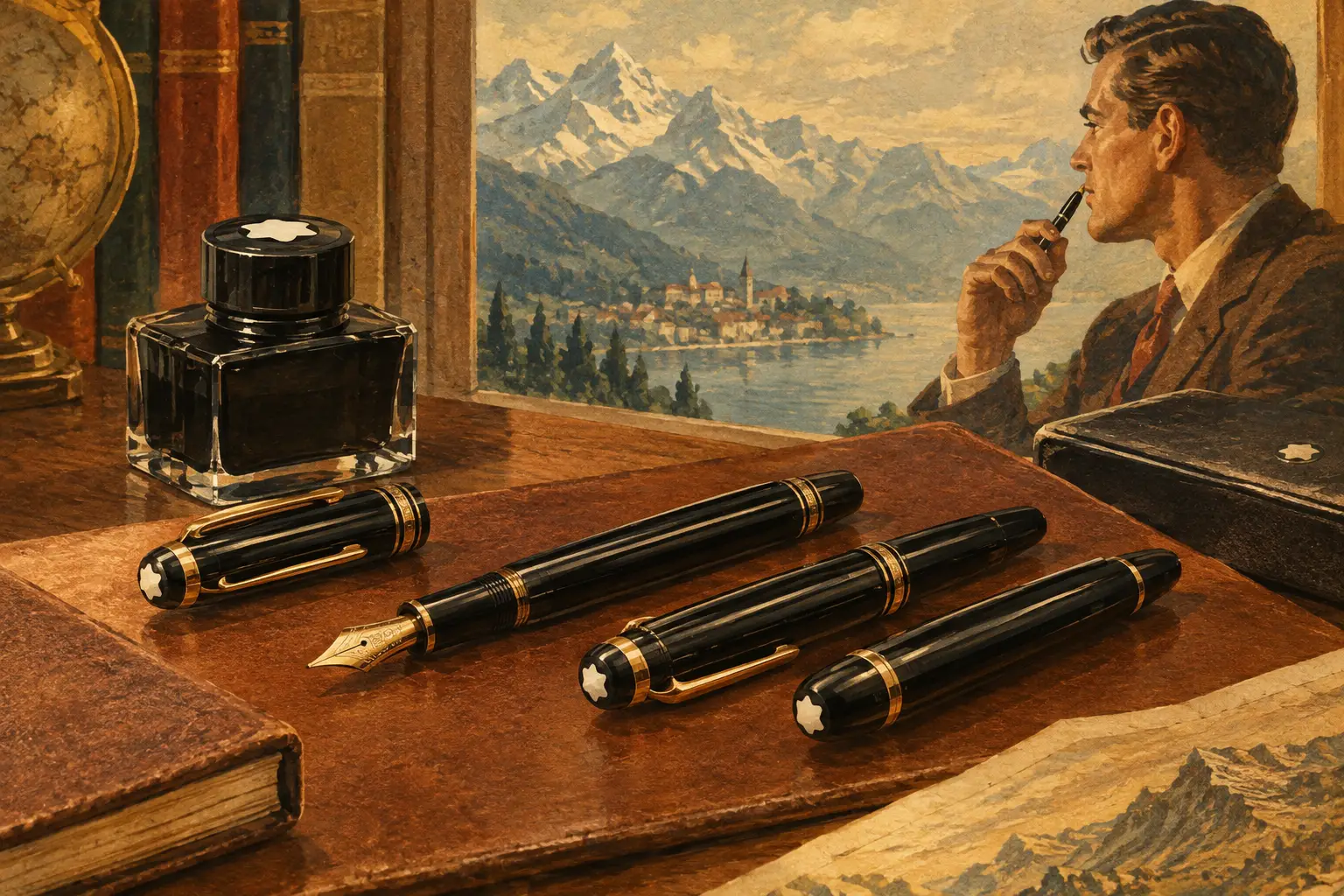
A good vintage Montblanc review begins in the hand, not in the catalogue. The best examples have a distinct combination of balance, controlled ink flow and restrained design that explains why collectors continue to seek them out. Yet the name on the cap alone is no guarantee of a satisfying purchase. Condition, originality and the quality of restoration matter as much as the model number.
For the buyer who wants a pen to use rather than merely display, vintage Montblanc offers genuine range. There are compact post-war piston fillers, elegant mid-century school and office pens, and the substantial Meisterstücks that established the brand’s modern reputation. Each rewards careful selection.
Why vintage Montblanc remains collectable
Montblanc’s earlier pens can feel markedly different from current production. Many have slimmer barrels, more modest proportions and a practical, unfussy character. The 1950s and 1960s models in particular were made for regular writing: their piston mechanisms were intended to be filled from a bottle, their gold nibs were shaped for long correspondence, and their materials were chosen to withstand daily use.
That usability is central to their appeal. A restored Montblanc is not simply a luxury object from a recognised name. It can be a remarkably capable writing instrument with a little history in every mark of the nib and trim.
There is also considerable design variety. Some buyers are drawn to the striped celluloid of earlier pens, others to the black resin, discreet gold-filled cap bands and clear ink windows of later piston fillers. Montblanc did not rely on one silhouette for decades, so a collection can develop around an era, filling system, nib style or size without becoming repetitive.
The trade-off is that desirable branding attracts inflated prices and occasional misdescription. A tidy-looking pen with a frozen piston, heavily polished cap, replacement nib or compromised engraving is not necessarily a collector-grade example. It may still be a sensible user pen, but it should be valued accordingly.
Vintage Montblanc review: the models worth knowing
The most suitable model depends on whether you favour a compact everyday pen, a larger statement piece, or a particular period of German pen-making. Numbers help identify broad model families, but details such as cap bands, ink windows and nib imprints are often needed to date a pen correctly.
The Montblanc 12 and 14
The Montblanc 12 and 14 are among the most approachable vintage piston fillers. Typically associated with the 1950s, they offer a clean, practical appearance and excellent everyday proportions. The 12 is generally the smaller of the two, while the 14 gives a little more length and presence without becoming oversized.
Their appeal lies in proportion and reliability when properly serviced. They sit comfortably in the hand, post neatly for those who prefer more length, and often carry responsive gold nibs that suit ordinary handwriting rather than decorative display. Fine and medium nibs are common, though the actual line can vary with age, wear and previous use.
For a first vintage Montblanc, these models are often more sensible than chasing a prestige piece. They do not have the visual weight of a large Meisterstück, but they represent the brand’s working heritage exceptionally well. Look closely at piston operation, cap lip condition and the clarity of any ink-viewing section before buying.
The Montblanc 22, 24, 32 and 34
The 1960s and early 1970s numbered series introduced a slightly more modern character. Models such as the 22, 24, 32 and 34 remain popular with writers because they are generally light, well balanced and straightforward in design. They also offer meaningful choice in size and trim.
The 22 and 32 are usually favoured by those happy with a slimmer pen, while the 24 and 34 offer a fuller feel. Differences between variants can be subtle, so measurements are worth considering rather than relying on photographs alone. A pen that looks substantial beside a notebook can prove very slender in a larger hand.
These pens make excellent daily companions, especially for buyers who value a controlled fine line and low weight. Their understated appearance can be an advantage: they are recognisably Montblanc without demanding attention across a desk. However, the lighter construction means cracks around the cap lip or barrel threads deserve particular scrutiny.
Vintage Meisterstück models
For many collectors, a vintage Meisterstück is the natural destination. Earlier examples have a presence that later became closely associated with Montblanc, yet they often retain more restrained dimensions than a modern large-format luxury pen. The 146 and 149 are the names most buyers know, but earlier variations and transitional details can make dating and valuation more involved.
A sound vintage Meisterstück can be an outstanding writer. The larger ink capacity, generous section and gold nib make it well suited to long sessions. Broad, oblique and flexible-feeling nibs can be particularly rewarding, although not every old nib is flexible, and flexibility should never be assumed from age alone.
This is also where condition commands the greatest premium. Original nibs, crisp cap-band engraving, correct feeds and sound pistons all matter. A heavily worn example may offer a route into ownership, but buyers should be clear whether they are choosing a restored user pen or a more original collector piece.
What restoration should achieve
Vintage pens are mechanical objects. A piston may have hardened, seals may have failed, old ink may have blocked the feed, and the pen may have been put away for decades without proper cleaning. Restoration should return the instrument to safe, dependable use while respecting its original materials and finish.
A properly restored piston filler should fill smoothly, hold ink without leakage and expel it predictably. The feed should deliver a consistent line after the pen has been filled and rested. The cap should seat securely without being forced, and the nib should be aligned, clean and pleasant on paper.
Cosmetic perfection is a separate question. Light signs of careful use are entirely compatible with a desirable vintage pen. In fact, over-polishing can soften sharp edges, blur imprints and remove the honest character collectors expect. The right standard is not that every pen should look new. It is that its condition should be accurately represented and its restoration sympathetically carried out.
At Heritage Collectables, this distinction is central to selecting restored instruments. A pen should be ready for practical writing, but not stripped of the details that make it a period piece.
How to judge a pen before buying
Photographs are useful, but a serious vintage purchase benefits from clear information about the parts that cannot be judged by shine alone. Ask whether the filling system has been serviced, whether the nib is original to the pen, and whether there are any cracks, repairs or significant plating loss. A trustworthy description should not hide these points behind phrases such as “good condition”.
Pay particular attention to the nib. Montblanc nibs vary in width, shape and feel far more than model numbers suggest. A fine nib may be ideal for annotations and everyday notes, whereas a broader nib can reveal the shading properties of bottled ink. Oblique nibs appeal to some writers but are not automatically better; they suit a particular writing angle and can feel awkward if your hand does not naturally meet the page in the same way.
Also consider the pen’s practical dimensions. Compact vintage models can be delightful, yet a writer with larger hands may prefer a 24, 34 or Meisterstück. Posting the cap changes the balance on many smaller pens, so this is not a trivial detail. A pen that is technically valuable but uncomfortable in your hand is unlikely to earn much writing time.
Finally, distinguish rarity from desirability. An uncommon colour or imprint can be fascinating, but a common model in excellent, correctly restored condition may give greater pleasure and be easier to maintain. Buy the pen you will be pleased to own after the initial excitement has settled.
Is a vintage Montblanc right for daily writing?
For most buyers, yes, provided it has been professionally assessed and is filled with sensible fountain pen ink. Vintage pens do not need to be treated as fragile ornaments, but they do respond well to routine care. Avoid waterproof, heavily pigmented or shimmer inks unless the pen has been chosen and maintained with that use in mind. Flush it when changing ink or when it will not be used for a while, and do not force a stiff piston.
A vintage Montblanc is especially rewarding for someone who enjoys the slower, more deliberate rhythm of writing with a fountain pen. It brings variation that modern pens often smooth away: the personality of an old gold nib, the compactness of an earlier barrel, and the quiet satisfaction of a piston drawing ink from a bottle.
The most satisfying choice is rarely the highest-numbered or most expensive one. It is the sound, correctly described pen whose size, nib and condition suit the way you actually write. Browse with those priorities in mind, and an older Montblanc can become less of a trophy and more of a trusted part of the day.