
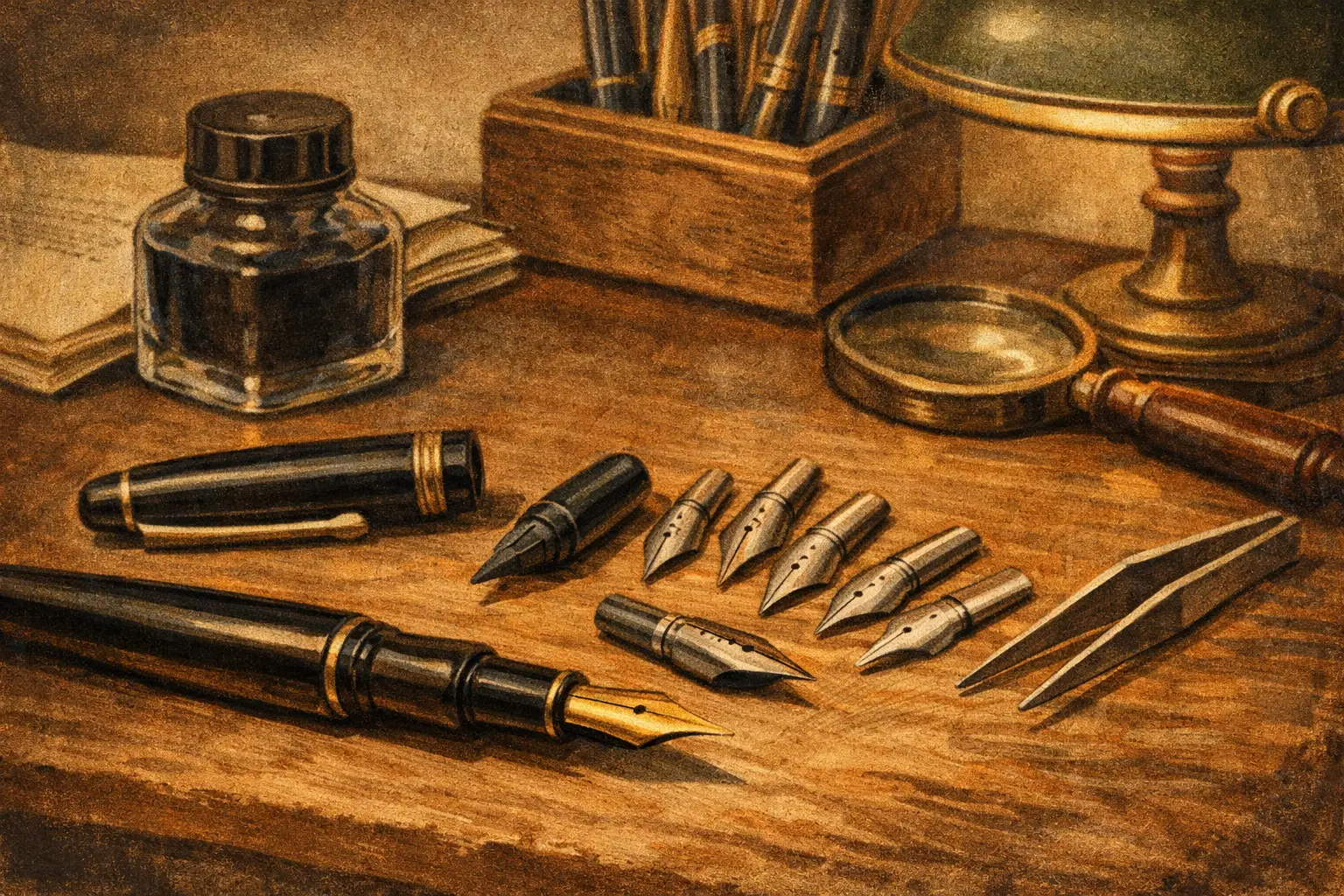
A fountain pen can look immaculate yet feel entirely wrong on paper. It may skip at the start of a line, scratch in one direction, write too broadly, or have a bent tine that catches every time you form a loop. Replacement fountain pen nibs can return a favourite writer to service, but on a vintage pen the right answer is rarely as simple as fitting the first nib that looks similar.
The nib, feed and section were often designed as a working set. Their fit affects ink flow, writing feel and, in some cases, the collector value of the instrument. Before replacing anything, it pays to establish whether the nib is genuinely beyond repair, whether a sympathetic adjustment will solve the problem, and what sort of replacement the pen can actually accept.
Start by identifying the real fault
Many nib problems are not nib problems at all. Old ink lodged in the feed can cause hard starts and weak flow. A converter or filling system may be drawing insufficient ink. Tines that appear misaligned can sometimes be carefully corrected, while a slight roughness at the tipping may respond to professional smoothing rather than replacement.
Look at the pen under good light, ideally with magnification. The tines should meet evenly at the tip, with a narrow, consistent slit between them. If one tine sits higher than the other, the pen may feel scratchy. If the tipping material has worn flat or is missing, the writing point may be difficult to restore. A cracked nib, a badly creased shoulder, corrosion around the slit, or a snapped tine usually presents a more serious case.
It is worth being cautious here. Gold nibs, especially those fitted to earlier Waterman, Parker, Conway Stewart, Sheaffer and Montblanc pens, are often more repairable than their appearance suggests. A specialist can reshape and align material that an owner might assume is irretrievably damaged. Conversely, a seemingly minor crack can worsen quickly with use.
Replacement fountain pen nibs are not universal
Modern pens have made interchangeable nib units familiar, but most vintage fountain pens do not work that way. Some accept a screw-in unit containing nib, feed and collar. Others have a nib and feed friction-fitted directly into the section. On certain models, the original nib may be secured by a distinctive collar, sleeve or breather-tube arrangement that is difficult to reproduce.
The name on the pen is only the beginning. A Parker nib from one model will not necessarily fit another Parker, and the same is true for Waterman and Sheaffer. Production changed over decades, even within a single model line. The profile of the nib, the length of its shoulders, the curvature, the feed channel and the dimensions of the section must all be considered.
Match the fit, not merely the appearance
A replacement that resembles the original may still sit too high, too low or too loosely against the feed. Poor contact between nib and feed causes unreliable ink delivery. Excessive pressure during fitting can split an old section, particularly one made from hard rubber or early plastics.
Measure the original nib where possible, including its exposed length, width at the shoulders and overall curvature. Photographs of the nib in place, the feed and the section interior are useful reference points. If the original is missing, model-specific information and comparison with known examples become even more valuable.
The feed matters as much as the nib
A fine nib paired with a feed intended for a broad, wet writer may produce a generous, uncontrolled line. A broad nib on a narrow feed can starve and skip. The feed also determines how securely the nib is supported when writing.
For this reason, a replacement nib and original feed should be treated as a compatibility question, not a casual swap. Where an intact matching nib-feed assembly can be found, it is often the safer route. It may cost more initially, but it can avoid repeated adjustments and protect a scarce section from unnecessary handling.
When the original nib deserves saving
An original nib carries more than a maker’s stamp. It may be the feature that gives a pen its period character: the soft response of a 1920s gold nib, the firm controlled line of a mid-century Parker, or the distinctive upturned form of a Sheaffer Triumph. Replacing it with a later generic nib can make a pen usable, but it can also alter the experience that made the model desirable.
Collector value is affected differently depending on the pen. A common user-grade pen with a broken nib may be an excellent candidate for a sympathetic replacement. A rare model, an unusual overlay, or a pen with a clearly dated and branded nib requires more care. Even a repaired original can be preferable to a perfect-looking substitute if originality is central to the piece.
That does not mean every original nib must be retained at any cost. A pen intended for regular writing should be reliable and enjoyable. The sensible balance is to preserve original material where practical, document any replacement, and retain the damaged nib with the pen if it has historical relevance.
Choose a writing point for the way you write
Replacing a nib is also an opportunity to improve the pen’s usefulness. A broad italic may suit headings, correspondence and expressive writing, but it can feel impractical for compact notes. A fine nib is often more suitable for diaries, forms and everyday writing, though vintage fines can be noticeably finer than modern equivalents.
Gold does not automatically mean soft, and steel does not automatically mean rigid. Nib behaviour depends on thickness, shape, temper and the way it is supported by the feed. Flex is particularly easy to misunderstand. A vintage nib described as flexible may offer pleasing line variation under a light hand, but it is not necessarily designed for vigorous modern calligraphy. Pressing too hard risks sprung tines or a crack at the base.
If possible, decide whether you want a controlled everyday writer, a smooth medium for letters, or a more characterful line. The replacement should suit both the pen and the hand using it. A technically correct nib that produces an unsuitable line is not a satisfying repair.
Fitting a replacement without creating new damage
Old sections and feeds can be fragile, especially after decades of ink exposure, heat and previous repairs. Never force a nib from a section simply because it appears friction-fitted. Some components have dried together, while others are held by collars that must first be removed in the correct manner.
A proper fitting process begins with cleaning, inspection and confirmation of the feed’s condition. The nib must sit centrally, with even contact along the feed and no stress at the shoulders. Once fitted, the pen should be tested with a well-behaved fountain pen ink. Flow, starting, line consistency and comfort all need checking before the work can be considered complete.
Avoid using pliers, household adhesives or aggressive heat on an uncertain vintage assembly. Adhesive can make future restoration far more difficult, and uncontrolled heat may distort a celluloid section or damage a feed. If a part will not move with sensible, informed handling, that is the point to stop rather than apply more force.
A practical route for vintage pen owners
Begin with clear photographs and the pen’s full identification, including the cap imprint, filling system, nib marking and any model clues. Then assess whether the fault is alignment, flow, tipping wear, structural damage or a missing component. This narrows the search considerably.
For a pen with a sound but imperfect original nib, repair is usually the first option worth exploring. For a pen with an irreparable or missing nib, seek a period-correct replacement or a compatible assembly with matching dimensions. Generic nibs have their place, particularly on modest everyday pens, but they should not be assumed to fit a valuable vintage section.
A specialist seller should be able to describe condition honestly and distinguish an original nib from a later replacement. Ask whether a nib has been tested, whether its tipping is intact, and whether it is supplied as a nib alone or with its feed and housing. Those details determine whether a part is a promising solution or simply an attractive photograph.
Heritage Collectables approaches vintage writing instruments with that distinction in mind: a restored pen should retain its heritage where possible, while still being ready to write. The best replacement is not always the newest, shiniest or easiest to find. It is the one that lets the pen write confidently again without asking it to become something it never was.