
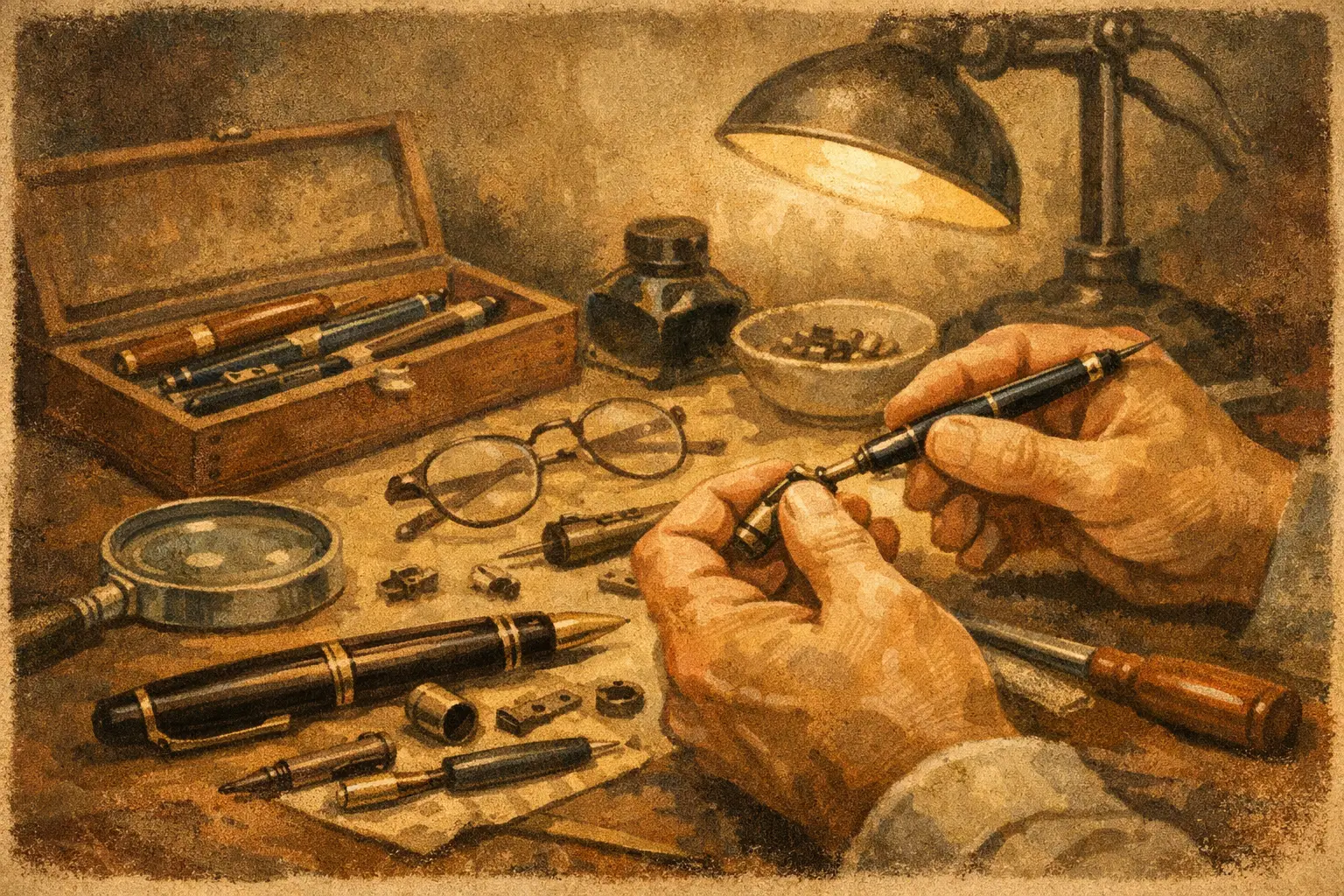
A blackened nib, a lever that will not move, a barrel that smells faintly of old rubber – none of these automatically mean a vintage pen has reached the end of its life. Can old fountain pens be repaired? In many cases, yes. A well-made Parker, Waterman, Conway Stewart, Sheaffer, Pelikan or Montblanc was designed as a serviceable writing instrument, and much of what fails over decades can be carefully renewed.
The more useful question is whether a particular repair is sensible, sympathetic to the pen, and likely to leave it both dependable and collectable. That calls for proper inspection rather than guesswork, especially where rare materials, valuable trim or early filling mechanisms are involved.
Can old fountain pens be repaired without losing their character?
A sound restoration should preserve character, not erase it. Gentle cleaning can lift accumulated ink from a feed; a new sac can return a lever-filled pen to service; careful nib adjustment can transform a scratchy writer. None of those measures needs to make a pen look artificially new.
Collectors often value honest signs of age: light surface wear, a softened imprint, minor brassing on a cap band or the warm patina of celluloid. Attempting to polish every mark away can reduce appeal and, in some cases, value. The aim is usually to stabilise, clean and make the instrument usable while retaining the evidence of its history.
That distinction matters particularly with scarce pens. A common 1950s everyday writer may justify a practical replacement part, whereas an early hard-rubber Waterman, a chased Victorian eyedropper or a limited production Conway Stewart deserves a more conservative approach. Condition, rarity and provenance all affect the decision.
The faults restorers see most often
Dried ink is the usual starting point. Ink left in a fountain pen for years can block the feed channels and cement a piston, button or lever mechanism in place. A patient programme of appropriate soaking and flushing often resolves the problem, but forcing a seized mechanism is one of the quickest ways to create a crack or bend a fragile component.
Rubber sacs are another predictable failure. Many vintage lever-fillers, button-fillers and aerometric designs rely on a sac that eventually hardens, shrinks or breaks down. Replacing it is a standard repair, provided the section can be removed safely and the correct size and material are selected. The wrong sac can restrict ink capacity, interfere with the mechanism or deteriorate prematurely.
Nibs present a more variable case. A nib that feels scratchy may simply have misaligned tines or dried residue between them. A bent tip, a split at the breather hole, severe corrosion or missing iridium requires more specialist work. A good nib technician can often improve flow, alignment and smoothness, but not every damaged nib can be made perfect without compromising its original form.
Cracks and shrinkage are the repairs that demand the greatest caution. Celluloid, casein, early plastics and hard rubber each age differently. Some cracks can be stabilised discreetly; others make a pen unsuitable for regular filling even if it remains an attractive display piece. Shrinkage can distort caps, loosen bands or cause a cap to bind on the barrel. There is no universal repair for these material problems, and a responsible restorer will explain the limits.
What a proper assessment should establish
Before a pen is dismantled, it should be examined as a complete object. The restorer needs to identify the model, filling system, materials and likely age, then check whether all parts are original and compatible. An apparently simple repair can become complicated when a previous owner has fitted an incorrect nib, shellacked a section excessively or used modern adhesive in the wrong place.
A careful assessment also distinguishes a functional issue from a cosmetic one. A pen may write beautifully despite light discolouration or plating wear. Conversely, a highly polished barrel may conceal a compromised thread or a crack beneath a cap band. For a collector, knowing the difference is central to making an informed purchase or restoration decision.
It is also worth considering how the pen will be used. A cherished daily writer needs reliable filling, sound cap threads and stable materials. A rare pen intended for a cabinet may require only cleaning and conservation. Repair is not always about returning an instrument to everyday duty.
Repair or replacement: where judgement matters
Some components are consumable by design. Sacs, seals, corks, gaskets and occasionally pressure bars are normally replaced during a functional restoration. Doing so is not a loss of originality in the same way as replacing a barrel, cap or original nib would be.
Other replacements need more thought. A missing cap, incorrect clip or non-original nib may make a pen complete enough to enjoy, but should be disclosed when the pen is sold. The same applies to substantial recolouring, replating or replacement of patterned celluloid. Such work can be appropriate where the owner wants a usable personal pen, yet it may alter collector value.
A specialist will usually preserve original parts whenever possible, even when they are no longer functional. An original damaged nib may accompany a pen fitted with a suitable period replacement, for example. This protects the pen’s story and gives a future owner the clearest possible record of what has been done.
When not to attempt a repair at home
There is satisfaction in maintaining a fountain pen, and routine care is sensible. Gentle flushing with clean water, sensible ink choices and careful storage prevent many problems. But a vintage pen is not the place for brute force, heat guns, household solvents or improvised pliers.
Stop if a section will not unscrew, a lever is frozen, a piston feels solid, or a nib appears corroded or badly bent. Celluloid can be especially unforgiving, while hard rubber can discolour with unsuitable treatment. Casein must be kept away from prolonged water exposure. Even a small error can turn a repairable pen into a parts pen.
The four warning signs below warrant professional attention:
- a visible crack in the barrel, cap lip or section;
- a stuck filling mechanism that resists gentle pressure;
- a nib with a split, broken tip or severe corrosion; and
- a strong camphor-like smell, distortion or surface crazing in celluloid.
These faults do not always mean the pen is beyond saving. They do mean that diagnosis should come before intervention.
How restoration supports a pen’s value
A properly restored vintage fountain pen can be more appealing than an untouched example that cannot safely be filled. Buyers rightly want confidence that the mechanism has been serviced, the pen has been tested and any limitations are clearly described. For a user, this makes the difference between a handsome object and a writing companion.
Value is not determined by repair alone. Brand, rarity, material, originality, condition and desirability of the particular model remain decisive. A restored Parker Vacumatic with clarity issues, for instance, will still have those issues. A pen with a replaced sac may be more usable, but it does not become a pristine example. Honest condition descriptions are part of good stewardship.
At Heritage Collectables, restoration is approached with this balance in mind: preserving the qualities collectors seek while preparing suitable instruments for the pleasure of writing. A vintage pen should be represented for what it is, including its strengths, sympathetic repairs and any remaining signs of age.
Caring for a repaired vintage fountain pen
Once repaired, a pen benefits from straightforward habits. Use a fountain-pen-friendly ink rather than heavily pigmented, waterproof or shimmer formulations unless the particular pen has been assessed for them. Flush it when changing colour and before storing it for a long period. Keep it away from direct sun, radiators and damp conditions, particularly if it is made from celluloid, hard rubber or casein.
Do not overtighten a cap, post a cap if it puts strain on the barrel, or leave ink inside for months. If the filling action changes, ink begins to seep, or the nib becomes suddenly dry, stop using the pen and have it checked. Early attention is usually kinder to both the mechanism and the finish.
An old fountain pen is more than a survivor. With the right repair, it can still put a distinctive, living line on paper – exactly as its maker intended.
One thought on “Can Old Fountain Pens Be Repaired? A Specialist View”