
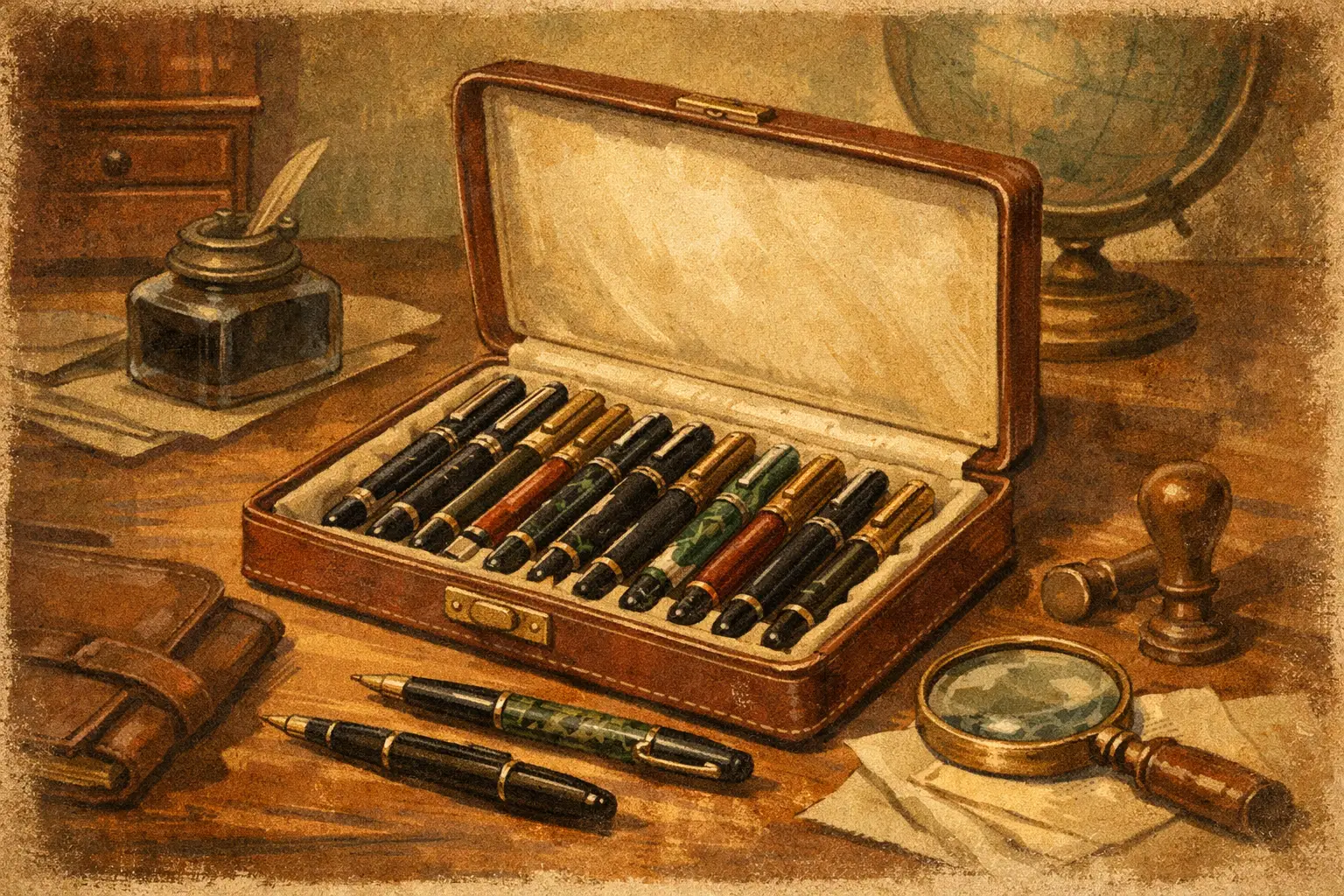
A fine pen rarely suffers from dramatic neglect. More often, it is slow wear that does the damage – a cap rubbed against another barrel, a clip pressed into celluloid, a sac lever catching on a tray lining, or sunlight quietly dulling a once-rich finish. That is why a good fountain pen storage case matters. It is not merely a tidy way to keep a collection together. It is part of how you preserve condition, protect restoration work, and keep pens ready to use.
For collectors and daily users alike, storage sits somewhere between maintenance and presentation. The right case should shield a pen from knocks and abrasion, but it should also suit the way you actually live with your collection. A single treasured Waterman used at a desk needs something different from a dozen restored Parkers rotated through the week, and different again from a travelling selection carried to meetings or pen shows.
What a fountain pen storage case should do
At its simplest, a fountain pen storage case should prevent movement, reduce contact between pens, and keep dust, moisture, and stray impacts at bay. That sounds straightforward, but the details matter. A loose slot can allow a pen to shift and wear at the high points. A rough interior can mark delicate chased hard rubber. A case that looks handsome on a shelf may be rather poor for travel if the contents jostle when carried upright.
For vintage pens, materials and fit deserve even closer attention. Many older pens have finishes that are less forgiving than modern injection-moulded resins. Casein, celluloid, chased rubber, rolled gold fittings, and plated trim can all react badly to pressure, damp, or friction over time. A storage case should protect the pen you have, not the average pen imagined by a generic manufacturer.
There is also the practical matter of accessibility. If a case is awkward to open, overpacked, or too precious for ordinary use, pens tend to end up elsewhere – in drawers, coat pockets, glove compartments, and the bottom of bags. That is where avoidable damage begins.
Case, tray, box, or roll?
Not every collector needs the same format, and this is where many buyers go wrong. They look for the most attractive option rather than the most suitable one.
A rigid hinged case is often the best all-round choice for a small to medium grouping. It protects well, travels reasonably if well made, and gives each pen a defined place. If you keep restored pens in rotation and want them close at hand, this format offers a sensible balance of security and convenience.
A display box or glazed case suits a study, writing desk, or cabinet where visibility matters. These are appealing if you enjoy seeing your collection rather than keeping it shut away. The trade-off is that display-friendly storage is not always ideal for transport, and if the box is left in direct light it can do more harm than good. Vintage materials in particular prefer stable conditions and shade.
A pen roll has obvious appeal for travelling, especially if you carry a changing selection. It can be compact and elegant, and a well-made example keeps pens separate without adding much bulk. The drawback is pressure. If the roll is overfilled or packed into a crowded bag, clips and barrels can still be stressed.
Desk trays and drawer inserts are excellent for larger collections, particularly when paired with a cabinet. They make browsing easy and suit collectors who like to group by maker, era, or filling system. They are less useful if you need something portable or if your household storage is exposed to dust and fluctuating temperatures.
Materials matter more than many buyers realise
The outer covering of a case is largely a matter of taste, but the interior is critical. Soft linings are generally kinder to polished barrels and plated trim, provided they are clean, colourfast, and not overly abrasive. A plush lining may look luxurious, but if fibres shed or seams sit against the pen body, it is not doing the job properly.
Leather cases are a classic choice and often wear beautifully, but the quality varies enormously. Good leather gives structure and ages well. Poor leather can dry, crack, or transfer finish. If the interior is also leather, it must be smooth and well finished. For many pens, especially those with more delicate surfaces, a softer lined compartment is preferable.
Wooden boxes can be handsome and collector-friendly, particularly for home storage. They feel substantial and suit the character of vintage pens. What matters is how the interior is built. Bare wood, hard dividers, or rough-cut slots are all risks. A well-lined wooden case can be excellent. A badly finished one is simply a smart-looking source of scratches.
Synthetic materials are not automatically inferior. A well-made modern case can offer stability, lightness, and good impact resistance. What matters is not whether the material sounds traditional, but whether it protects the pens without introducing new hazards.
Sizing and fit for vintage and modern pens
One common mistake is assuming all fountain pens fit all cases. They do not. Vintage pens in particular vary enormously. A slender 1930s lever filler has different needs from an oversized modern piston filler, and both differ again from a safety pen or a model with an unusually prominent clip.
A proper fit means the pen sits securely without being pinched. Too much room invites movement. Too little can stress cap bands, clips, and barrel ends. If a pen must be pushed into place, the slot is too tight. If it rattles about, it is too loose.
Collectors with mixed holdings should think carefully before buying a fixed-format case in large numbers. A case designed around six broad modern pens may swallow smaller vintage models in a way that offers little real protection. Conversely, narrow loops or partitions can be unsuitable for larger pens from Montblanc, Pelikan, or later Parker lines.
Storage for inked pens and pens at rest
A fountain pen storage case also needs to suit how the pen is used. Pens kept inked and in regular rotation benefit from quick access and stable positioning. For most modern and restored vintage fountain pens, horizontal storage is a sensible default when the pen is not in use. It reduces the chance of ink concentrating unevenly at one end over extended periods.
That said, it depends on the pen, the ink, and the length of storage. A pen filled for daily writing can rest in a case between uses without much concern if it is sound and properly maintained. A pen being stored long term is another matter. It should generally be cleaned, dried, and put away empty in a stable environment.
Cases are not a cure for poor pen hygiene. Even the finest storage will not compensate for ink left to dry in a feed or a sac stored half full for months.
Choosing by purpose, not impulse
If you are buying a case for one or two prized pens, presentation and finish may take priority. If you are storing a working rotation, convenience matters more. If you travel frequently, secure closure and compact dimensions become essential. For a larger collection, consistency across several cases or trays can make organisation much easier.
It is also worth thinking ahead. Many collectors begin by needing storage for three pens and find themselves, before long, looking for room for twelve. Buying a case with a little sensible capacity can save replacing it too soon, though buying one vastly larger than required can leave pens under-supported if the design is poor.
Those who collect restored vintage pens often do well to separate categories. Everyday users can sit in a practical desk case, while rarer or more delicate examples are kept in more protective home storage. There is no rule that one case must do everything.
Signs of a poor fountain pen storage case
A disappointing case usually reveals itself quickly. The lid presses against clips. Pens touch when closed. Stitching sits proud inside the compartment. The lining smells strongly of adhesive or dye. Dividers flex or bend. The closure feels insecure. None of these are trivial faults.
For collectible pens, especially examples with original finish and crisp chasing, a mediocre case is often worse than careful open-shelf storage in a controlled room. Good storage should reduce risk, not merely disguise it behind polished leather or a velvet lid.
If you buy remotely, study dimensions closely and be realistic about the pens you intend to store. Generic descriptions such as suitable for fountain pens can be misleading. A specialist seller with real familiarity in vintage instruments will usually understand why barrel girth, clip height, and material sensitivity all matter.
A case should support the pleasure of ownership
The best storage has a quiet quality to it. It keeps a pen safe, presents it well, and makes you more likely to reach for it. That may sound simple, but it is exactly right. A fountain pen should not feel like an object you are forever rescuing from unsuitable storage.
Whether your interest lies in restored daily writers or carefully chosen collector pieces, the right case is part of responsible ownership. Choose with the pen in mind, not just the appearance of the box, and you will protect both condition and enjoyment for years to come. If you are building a collection with care, it is worth giving the same care to where those pens rest between pages.