
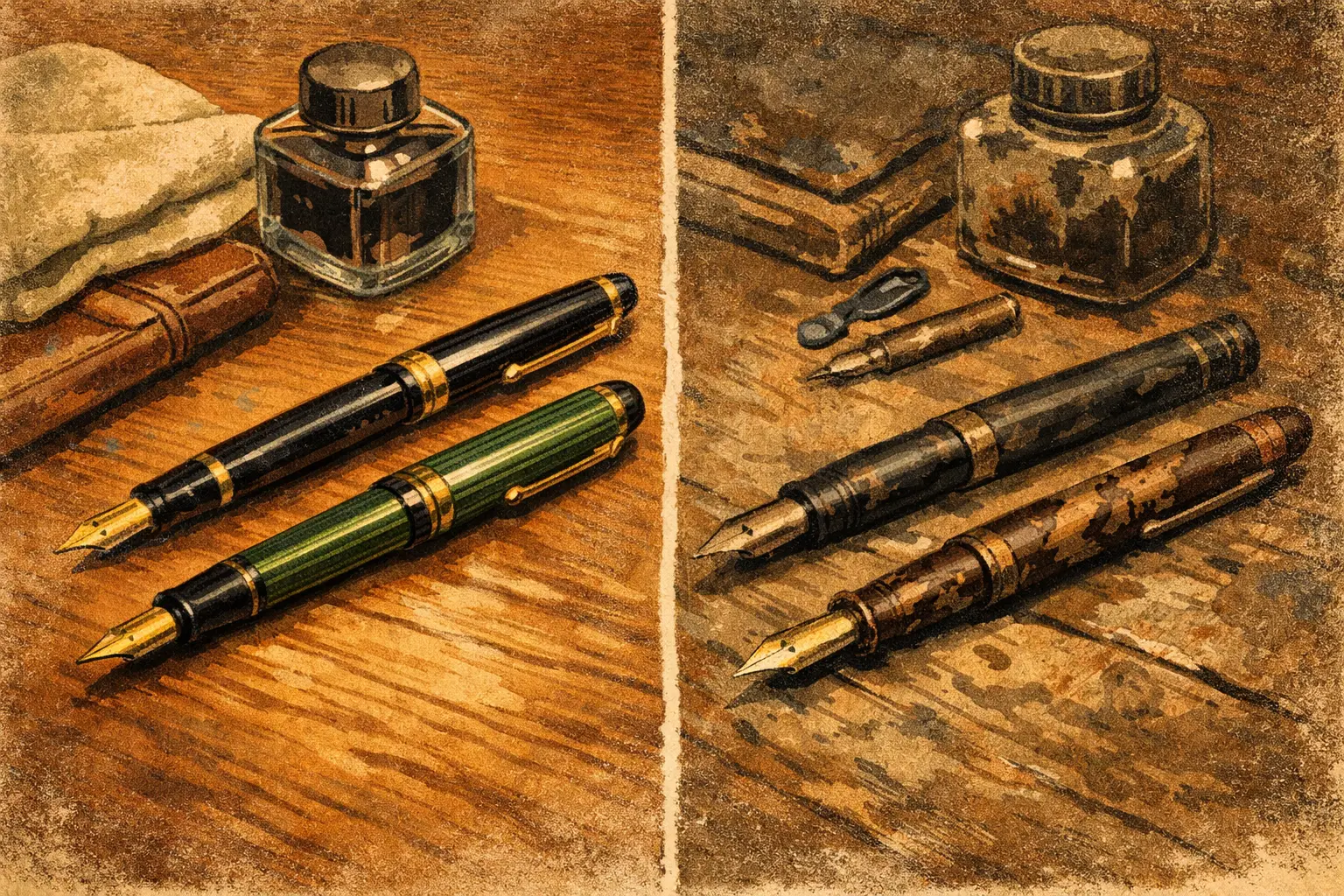
A 1950s Parker may look immaculate in a cabinet yet have a hardened diaphragm, a seized filling mechanism or a nib that has not touched ink for decades. Another may carry a few honest marks but write beautifully after careful specialist work. That is the real question behind restored pens versus unrestored pens: are you buying an object to preserve exactly as found, or an instrument to enjoy as its maker intended?
For many collectors, the best answer is not one or the other. It depends on the model, its rarity, its condition, the quality of any previous work and what you expect from ownership. A good vintage pen should never be reduced to a simple choice between shiny and original.
What a proper restoration should achieve
Restoration is not merely polishing a barrel and fitting a new sac. It is a considered process intended to return a vintage writing instrument to reliable working order while retaining its period character. On a lever-filling Waterman or Conway Stewart, that may mean replacing a perished ink sac, cleaning the feed, checking the lever and pressure bar, and ensuring the nib and cap fit correctly. A Parker Vacumatic, Sheaffer touchdown or piston-filling Pelikan brings its own mechanical considerations.
A well-restored pen should fill, hold ink and write as it should. The cap should secure properly, the section should be sound, and the nib should be aligned, clean and capable of delivering a controlled line. Cosmetic cleaning can be part of the work, but it should not erase the evidence of age or disguise a crack, a repaired part or excessive wear.
The finest restorations are often discreet. They respect original materials, preserve engravings and imprints, and replace consumable internal components only where necessary. A new sac is not a loss of authenticity in the way an incorrect cap, replacement barrel or over-polished chased pattern may be. Vintage pens were made to be filled and used; their wearable internal parts were always expected to require attention over a long working life.
Restored pens versus unrestored pens: the practical difference
The immediate advantage of a restored pen is confidence. If you are buying a fountain pen to write letters, keep a journal or carry to work, reliable filling and predictable performance matter. A professionally restored instrument removes much of the uncertainty around old rubber, dried ink, clogged feeds and tired mechanisms.
This is especially valuable for first-time vintage buyers. A beautiful pen can be intimidating if its filling system is unfamiliar, and an unrestored example may require work before it can safely be inked. Starting with a restored Parker Duofold, Waterman, Sheaffer or Conway Stewart lets the owner experience the character of vintage writing without first becoming a repairer.
An unrestored pen, by contrast, is usually sold on potential, originality or price. It may be perfectly sound, but it should be assumed untested unless a seller states otherwise. A lever that lifts is not proof that the pen fills. A nib that looks straight may still be misaligned. A piston that moves can have failed seals. Old ink may also conceal problems until the pen is dismantled and cleaned.
That uncertainty is not automatically a disadvantage. For an experienced restorer, an unrestored pen can be a rewarding project and a more economical route into a desired model. It can also retain parts, finishes and surface details that an over-zealous refurbishment might have altered. The key is to buy with open eyes and allow for the cost, availability and risk of the work required.
Originality is more nuanced than ‘untouched’
Collectors rightly value originality, particularly with scarce models, unusual colours, limited editions and early examples. Yet untouched is not always synonymous with better. A pen left in a drawer for seventy years can be wonderfully original on the outside while being unusable internally. Conversely, a sensitively restored pen may remain highly original in every visible and historically significant respect.
The distinction lies in what has been changed and how honestly it is described. A replacement sac, cork seal or O-ring is normal conservation work. Replating trim, recolouring faded celluloid, recutting an imprint or fitting non-original external components requires much more scrutiny. These interventions can affect collector value, especially where a pen is rare or where originality is central to its appeal.
Look closely at the details that tell the story of a pen. Are the barrel and cap correct to one another? Is the clip appropriate for the model and period? Are the imprints legible? Has black hard rubber oxidised naturally to a warm brown, or has it been aggressively polished? Does the nib match the pen, and does its tipping appear original? Honest wear is often preferable to artificial perfection.
When restoration adds value
For common and desirable user-grade pens, professional restoration often adds meaningful value because it makes the instrument usable and reduces risk for the buyer. A fully serviced 1940s lever filler with a sound nib and clear condition description is easier to own than a similar example marked ‘as found’. This is not simply convenience. Correct restoration requires knowledge of materials, mechanisms and model-specific weaknesses.
It also protects the pen. Attempting to force a stuck piston, lever or cap can turn a straightforward service into a cracked barrel or damaged section. Vintage celluloid, hard rubber and early plastics do not always tolerate modern assumptions or brute force. The right tools and patience matter.
There are exceptions. A museum-grade, boxed and scarcely used pen may be more valuable left exactly as found, particularly if its internal components are stable and it is intended for display rather than daily writing. Equally, a rare model with fragile or irreplaceable parts may deserve conservation rather than a full return to use. The more unusual the pen, the more sensible it is to consider restoration case by case.
The risks of poor restoration
Not every restored pen has been restored well. Poor work can be worse than no work because it can hide faults and make later correction difficult. Heavy buffing can soften crisp barrel edges and remove plating. Incorrect adhesives can stain, crack or permanently bond parts that should remain serviceable. A wrongly sized sac may impair filling, while careless nib work can ruin an otherwise excellent original point.
Ask sensible questions before buying. What work has been carried out? Does the pen fill and write? Have cracks, repairs, replacements or plating loss been disclosed? Is the nib original, and has it been adjusted or reground? Clear answers are a sign of a seller who understands the instrument rather than merely its appearance.
Photographs should support the description, not replace it. Look for close views of the nib, imprints, cap lip, barrel threads, trim and any areas prone to cracking. On a restored pen, a clear condition report is part of the value. It allows you to judge the instrument on its merits rather than guesswork.
Choosing according to how you will use it
If your intention is regular writing, a restored pen is usually the sensible starting point. You gain the pleasure of vintage materials, design and nib character with the reassurance that the mechanism has been attended to. You should still treat it with care: use suitable fountain pen ink, avoid leaving ink in it for long periods of disuse, and never force a cap or filler.
If you enjoy mechanical work, research and the satisfaction of bringing an old object back to life, an unrestored pen may suit you better. Build restoration costs into your budget and be realistic about your skills. Some repairs are straightforward; others demand specialist tools, replacement parts or experience with brittle materials.
For gifts, restored pens are generally the stronger choice. A recipient should be able to fill and use a vintage fountain pen rather than receive a beautiful uncertainty. A classic Parker 51, Sheaffer Balance or Conway Stewart can make a memorable present when it arrives ready for its next chapter.
Buy condition, disclosure and confidence
The most satisfying vintage pen is rarely the most polished one or the most untouched one. It is the one whose condition is accurately understood, whose history has been respected and whose future suits your plans. At Heritage Collectables, fully restored instruments are selected for precisely that balance: collector appeal with practical confidence.
Whether you choose a serviced daily writer or an unrestored project, let the pen’s materials, rarity and intended use guide you. A vintage pen earns its place not only by surviving the past, but by giving its next owner a reason to pick it up.
2 thoughts on “Restored Pens Versus Unrestored Pens Compared”