
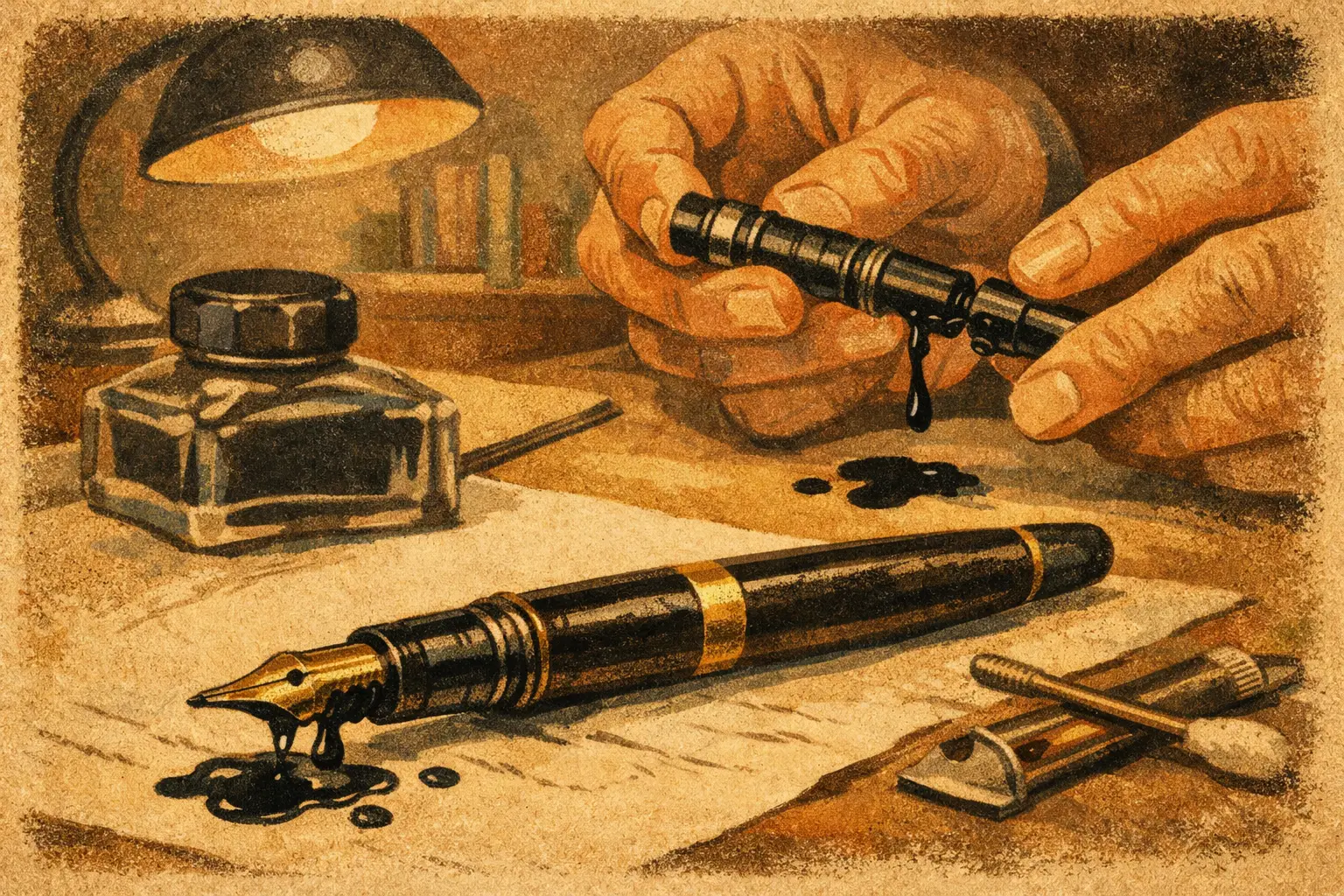
A damp patch beneath a treasured Parker 51 or a drop of ink appearing at the section can feel alarming, particularly when the pen has just arrived or is about to be used for the first time. So, why do vintage pens leak? Usually, the answer is not that the pen is beyond saving. It is that a component designed to remain flexible, airtight or precisely fitted has changed over decades of use, storage and temperature changes.
A vintage fountain pen is a small engineering system: reservoir, feed, section, nib, cap and filling mechanism must all work together. Many were made exceptionally well, but even the finest materials have limits. Understanding where ink is escaping helps distinguish a straightforward service issue from a more serious fault – and helps you use a restored pen with confidence.
Why do vintage pens leak after so many years?
Ink follows the smallest available path. In a sound fountain pen, the feed controls that movement through fine capillary channels, delivering ink to the nib while allowing air back into the reservoir. If a seal hardens, a sac perishes, a collar loosens or a crack develops, ink can bypass the intended route.
Age is only part of the picture. A pen stored empty in a drawer for fifty years may need more attention than one used carefully and serviced at regular intervals. Old ink deposits can obstruct feeds, while repeated heating and cooling can make materials expand and contract. Poor earlier repairs are another frequent cause. An attractive vintage pen may have been polished, fitted with an unsuitable sac, or reassembled with a part that is fractionally the wrong size.
The encouraging point is that leakage is often a restoration matter, not a reason to retire a pen. The correct repair depends entirely on the model and filling system.
The usual places a vintage fountain pen leaks
The ink sac or diaphragm
Many lever-fillers, button-fillers and aerometric pens rely on a rubber or synthetic sac to hold ink. Traditional rubber sacs naturally oxidise and harden with time. Eventually they may split, turn sticky, or crumble. Ink can then collect inside the barrel and emerge around the lever box, barrel threads or section.
A diaphragm performs a comparable job in certain vacumatic-style systems, although its shape and installation are more specialised. Replacing it is skilled work: the material must be correct, the fit secure and the mechanism tested without risking the pen’s celluloid or internal components.
A newly restored sac should provide years of service, but no flexible component is permanent. If a sac-filled pen has been unused for a long period, inspect it before filling rather than assuming it is ready simply because it looks immaculate externally.
The section joint
The section is the grip portion that holds the nib and feed, and it is commonly secured to the barrel by friction, threads or a carefully chosen sealant. If that joint has loosened, ink may appear where the barrel meets the section, often after the pen has been carried nib-down.
This is especially common where old shellac or sealant has failed, or where somebody has previously pulled the section out without using appropriate heat and support. It is not a job for excessive force. Celluloid, casein and early plastics can be damaged by unsuitable solvents, overheating or twisting pressure.
Cracks in the barrel, cap or section
Hairline cracks are among the more frustrating faults because they can be hard to see when a pen is dry. A barrel crack near the threads may only reveal itself after filling. A split lip on a cap can allow ink transferred from the nib to spread onto fingers or a pocket. Cracks around lever boxes, blind caps and threaded areas deserve particular caution because these are points of stress.
Some cracks can be stabilised sympathetically; others make a pen unsuitable for regular filling. A trustworthy description should be clear about such limitations. Collector value and daily usability do not always point in the same direction, and it is better to know that before a pen is put into service.
The filling mechanism
A leaking pen may appear to have a fault at the nib when the real problem lies at the opposite end. Piston pens can leak through worn piston seals. Plunger fillers may have deteriorated packing units. Safety pens have their own specialised sealing arrangements, while eyedroppers rely heavily on good threads and suitable sealing practice.
Parker Vacumatics, Sheaffer Touchdown and Snorkel models, Waterman lever-fillers and early Conway Stewart pens each have construction details that call for model-specific knowledge. A replacement part that works in one pen may be entirely wrong in another. This is why restoration is more than fitting a new sac and hoping for the best.
Nib and feed fit
If ink is appearing at the base of the nib or flooding into the cap, the feed and nib may not be seated correctly. Dried ink in the feed channels can upset the ink-air balance, causing a sudden wet flow. A loose feed may allow ink to escape around it rather than through the channels beneath the nib.
The remedy may be a thorough clean and reset, but it can also involve careful heat-setting on pens designed for it. Not every material tolerates this treatment. Hard rubber, ebonite, celluloid and certain early plastics each require an informed approach.
Leaks are not always a broken part
Not every inky cap or wet nib indicates a mechanical failure. Temperature and handling can make a perfectly serviceable fountain pen behave badly. A pen carried in a warm trouser pocket, left in a hot car or taken on an aeroplane can experience pressure changes inside its ink chamber. Air expands, ink is forced towards the feed, and the cap may collect excess ink.
Overfilling can have a similar effect. Many pens benefit from leaving a small air space in the reservoir, particularly when they will be carried. Carrying a fountain pen nib-up also reduces the chance of gravity feeding ink into the cap.
Ink choice matters. Vintage pens generally perform best with well-behaved fountain pen inks rather than heavily pigmented, shimmer or waterproof formulations. Saturated inks can be beautiful, but they may dry in feeds, stain sacs or make a pen run wetter than expected. The right choice depends on the pen’s condition, its filling system and how frequently it is used.
What to do when you find a leak
First, stop using the pen and empty it if you can do so without forcing the mechanism. Wipe ink away with a soft, lint-free cloth and note exactly where it reappears. Does it emerge at the section, through the lever area, around the piston knob, or only in the cap? That observation is useful when assessing the likely fault.
Do not apply glue, tape, silicone sealant or household adhesive. These products can make a later professional repair harder, obscure a crack and damage original material. Equally, resist the temptation to pull a stubborn section or dismantle a piston with improvised tools. A small leak can become a broken barrel remarkably quickly.
For a recently restored pen, follow the care guidance supplied and contact the seller if a fault develops. At Heritage Collectables, restored pens are assessed for practical use, but a vintage instrument still deserves sensible handling and the right ink. A pen that leaks after transit may simply need to settle upright and be cleaned, although it should always be checked if the problem persists.
Buying a vintage pen with confidence
The safest route is to buy from a specialist who identifies the filling system, states the condition clearly and understands the difference between cosmetic cleaning and a proper service. Ask whether the sac, diaphragm, seals or piston components have been replaced where appropriate, and whether the pen has been ink-tested. For rarer or fragile pieces, ask whether it is recommended for daily writing or better kept as a display and occasional-use item.
A fully restored vintage fountain pen should not be treated as fragile merely because it is old. Many can provide a wonderfully dependable writing experience. But it should be treated as a precision instrument with an individual history. Fill it thoughtfully, use it regularly enough to keep ink moving, clean it before long storage, and let a specialist investigate the first sign of a recurring leak. That care keeps the pleasure of writing with a piece of history exactly where it belongs: on the page, not on your hands.