
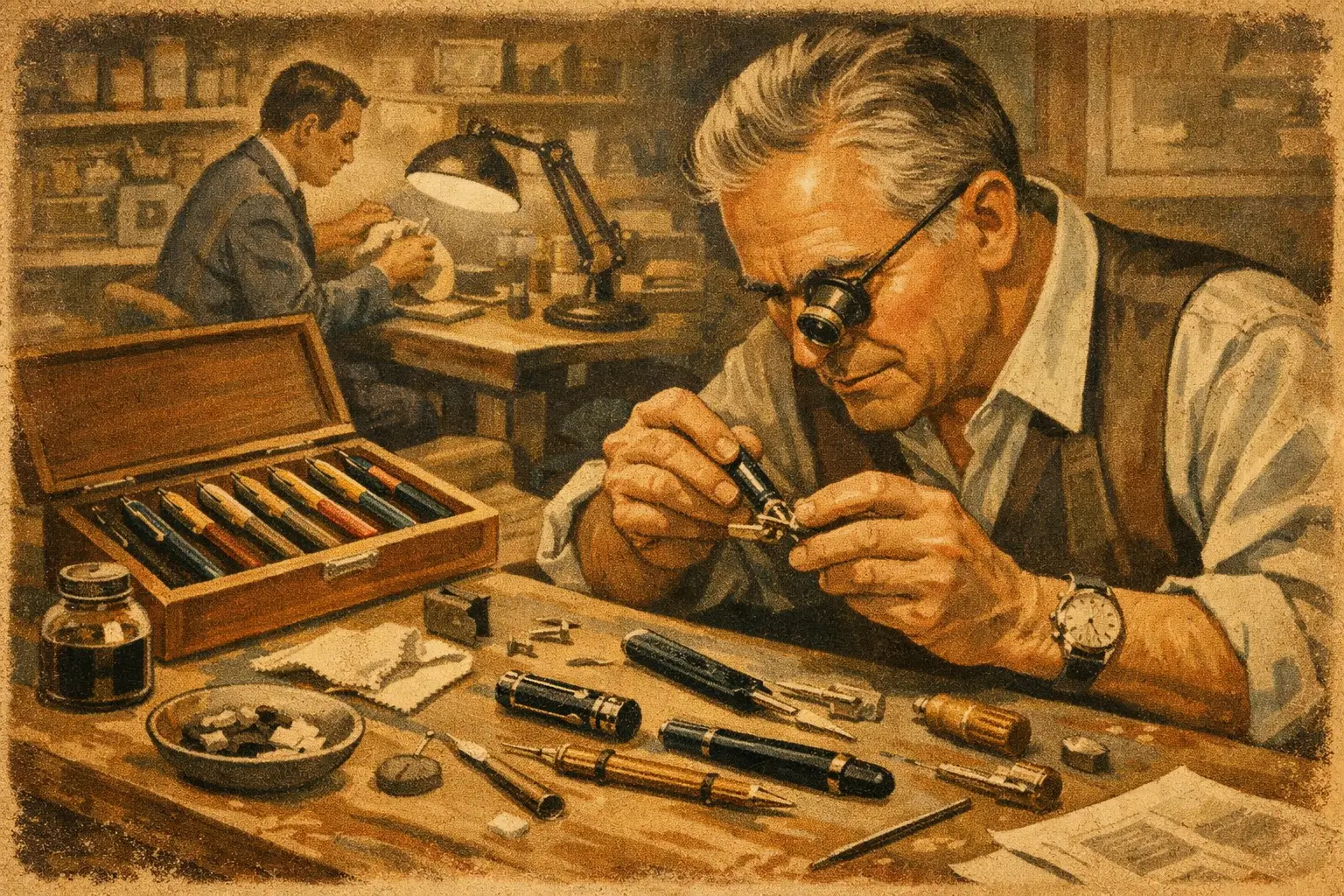
A lever filler that feels stiff, a piston that will not move, a cracked section hidden under old polish – these are the moments when a vintage pen restoration service proves its worth. To a collector, they are warning signs. To a daily writer, they are the difference between a treasured instrument and an ornament left in a drawer. The right restoration does not merely make an old pen look smarter. It returns function, preserves character, and protects value.
Vintage pens are mechanical objects with ageing materials at their core. Rubber sacs harden. Cork seals dry out. Celluloid can shrink or discolour. Feeds clog with decades of dried ink. Nibs suffer from misalignment, poor smoothing, amateur bending and, in some cases, hairline cracks that only become apparent under magnification. None of this is unusual. It is simply what time does.
That is why restoration has to be approached as specialist work rather than light cosmetic tidying. A proper service balances usability with originality. Too little intervention and the pen remains unreliable. Too much and you lose the details that make the piece historically and commercially interesting in the first place.
Why a vintage pen restoration service matters
Collectors and writers often come to the same conclusion from different directions. The collector wants the pen to be correct for its period, with sympathetic repairs and no careless replacement parts. The writer wants confidence that the pen can be inked, carried and used without leaks, skipping or mechanical trouble. A serious vintage pen restoration service should satisfy both.
That means understanding brand-specific construction and material behaviour. A Parker Vacumatic, a Conway Stewart lever filler, a Waterman safety pen and a Pelikan piston filler do not age in the same way and should not be treated in the same way. Even within one maker, design changes across decades affect how a repair ought to be handled.
It also means knowing when not to chase perfection. Surface marks, light chasing wear or gentle brassing may be entirely acceptable on an honest vintage pen. Removing every sign of age can flatten the appeal of the piece. Patina, when genuine and moderate, often belongs to the object.
What happens during vintage pen restoration
The process usually begins with assessment rather than repair. This is where experience tells. A pen may appear complete but hide problems in the filler, feed or cap lip. Another may look rough but need only straightforward internal work. Good restoration starts with diagnosis, not guesswork.
A typical restoration may involve dismantling the pen, ultrasonic cleaning where appropriate, clearing old ink deposits, replacing sacs, seals or diaphragms, servicing piston mechanisms, cleaning and setting the feed, aligning the nib tines, and testing ink flow. If the pen has a gold nib, careful adjustment can transform the writing experience without altering the original character of the point.
Cosmetic work is where restraint matters most. A light polish can revive hard rubber or celluloid, but aggressive polishing can blur imprints, remove chasing and create an unnaturally glossy finish. Re-blackening hard rubber, replacing missing trim or rebuilding damaged threads all require judgement. The question is not whether it can be done, but whether it should be done.
A good restorer also pressure-tests where relevant and writes with the pen after repair. A pen that fills but floods is not restored. Nor is one that looks attractive in a case but dries out after a few lines. Function must be proven, not assumed.
Restoration versus repair
These terms are often used interchangeably, but there is a useful distinction. Repair deals with a fault. Restoration considers the whole pen.
If a pressure bar has failed, replacing it is a repair. If the same pen also needs its sac renewed, nib aligned, barrel cleaned internally, trim stabilised and writing performance checked, you are in restoration territory. For buyers, this distinction matters. Many pens offered as “working” have only had the minimum done to get ink through them once.
For that reason, it pays to ask what work has actually been carried out. Has the filling system been rebuilt? Has the nib been checked under magnification? Have cracks been disclosed? Are replacement parts period-correct or modern substitutes? Serious sellers and restorers answer these questions clearly because the details affect both use and value.
What to expect from a quality vintage pen restoration service
The best services are transparent. They explain condition honestly, describe what has been restored, and recognise that not every pen should be refinished to the same degree. A rare pen with light wear may need conservation more than intervention. A common user-grade model may justify more extensive work if the goal is reliable everyday writing.
You should also expect familiarity with recognised makers. Pens from Parker, Sheaffer, Waterman, Conway Stewart, Onoto, Montblanc and Pelikan each bring their own restoration considerations. Threads, plastics, nib geometry and filling systems vary too widely for a one-size-fits-all approach.
Another mark of quality is consistency. One expertly restored pen is encouraging. A regularly refreshed stock of restored vintage writing instruments, with clear descriptions and buyer reassurance, suggests a business built around the discipline rather than treating it as a side line. That matters when you are buying at a distance, especially online.
Common problems that should never be ignored
Some faults are obvious. Others are easy to overlook until they become expensive. Cap lip cracks, barrel splits near the threads, loose clips, stress marks around lever boxes, shrunken celluloid, and hardened ink deep in the collector can all compromise a pen over time. So can nib issues that inexperienced sellers dismiss as “a little scratchy”.
There is also the matter of previous restoration. Not all old repairs are good ones. Shellacked sections forced into place, incorrect sacs fitted too tightly, over-polished barrels, modern parts used where originals matter – these are common enough in the vintage market. Undoing poor work can be more involved than starting with an untouched pen.
This is where specialist stock has an advantage. When a pen has already been restored, tested and described by a knowledgeable retailer, the buyer avoids much of the uncertainty that surrounds auction finds and general antiques listings.
When restoration adds value, and when it does not
In most cases, a properly restored vintage pen becomes more useful and more saleable. A filling system that works, a nib that writes well and a body that has been sympathetically cleaned make a strong difference to buyer confidence. For many pens, especially those bought to use, that confidence is worth paying for.
But restoration is not always a simple value multiplier. Heavy cosmetic intervention can reduce collector appeal if it removes originality. Replaced clips, incorrect cap bands or recut imprints may make a pen look tidier while making it less desirable to informed buyers. Rarity changes the equation as well. On an uncommon model, conservative restoration is often the wiser route.
This is why provenance of work matters almost as much as the work itself. Buyers want to know not only that the pen functions, but that the restoration has respected the pen as an historical object.
Choosing a vintage pen restoration service or restored pen
If you are sending in a pen or buying one already restored, look for evidence of specialism rather than broad antiques knowledge. Writing instruments are their own field. Materials, tolerances and nib behaviour demand close familiarity.
Ask how the pen has been tested. Ask what parts were replaced. Ask whether the finish has been polished, re-coloured or otherwise altered. Ask whether any faults remain for the sake of originality. These are not fussy questions. They are the questions that separate an informed purchase from a hopeful one.
For many buyers, the simplest route is to buy from a specialist retailer whose stock is already restored, catalogued and checked. That is particularly true if you want a pen to write with straight away, give as a gift, or add to a collection without taking on restoration risk yourself. Businesses such as Heritage Collectables have built their reputation on exactly that reassurance – restored pieces, specialist knowledge and stock chosen with both collectors and users in mind.
The pleasure of a vintage pen lies partly in its age, but mostly in its continued life. A pen made ninety years ago should not be admired only for surviving. It should still have the chance to write. When restoration is done properly, that chance becomes a certainty worth seeking out.