
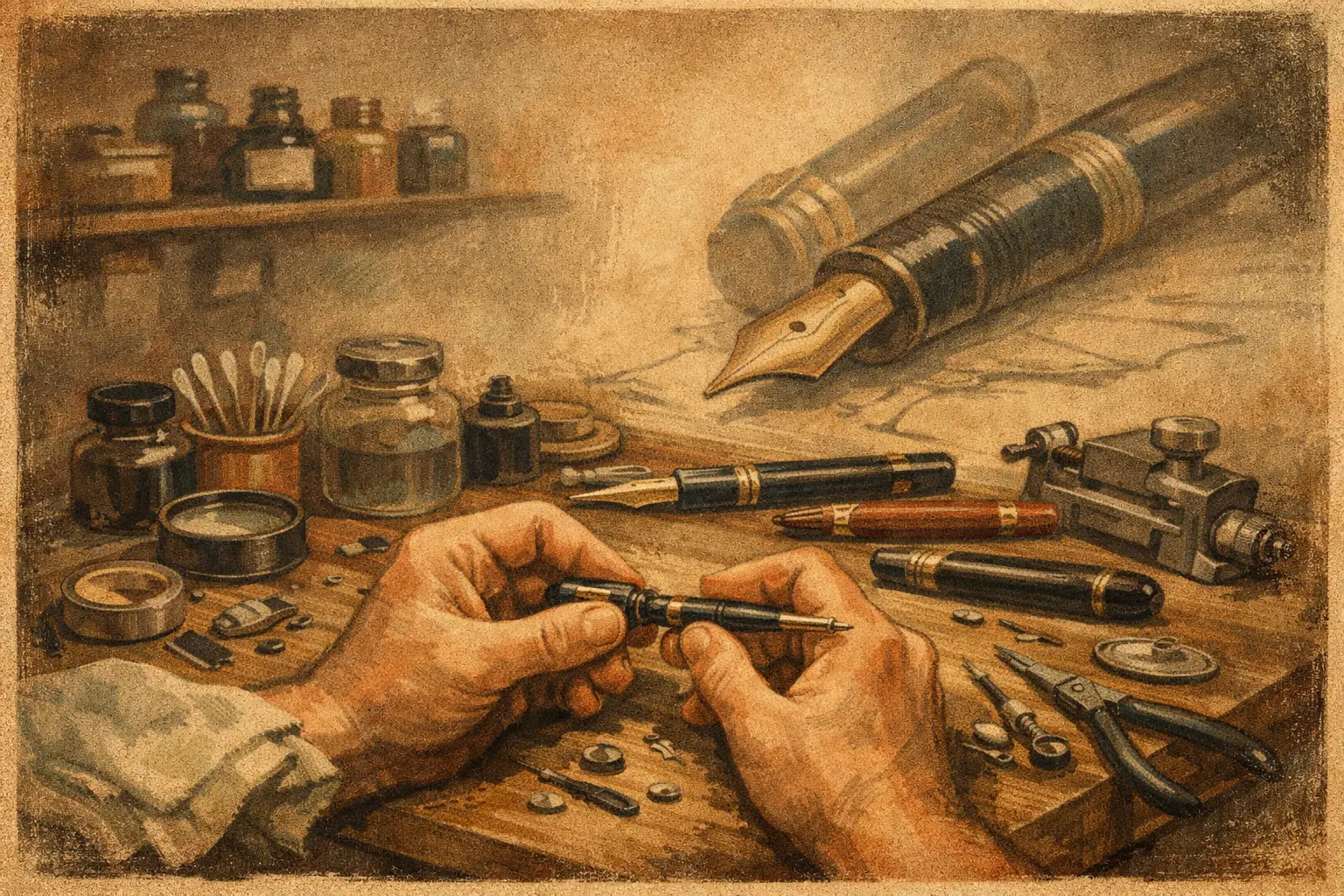
The first time you open a vintage fountain pen and find a perished sac, a seized section or a nib that looks straight until ink proves otherwise, you realise very quickly that restoration is not a hobby for guesswork. If you want to learn fountain pen restoration, the best place to begin is not with a rare Parker or a cherished family pen, but with an honest understanding of what the work involves, what can go wrong and why careful technique matters.
For many collectors and users, restoration starts as curiosity. A pen with a handsome barrel and dead filling system seems recoverable. Sometimes it is. Sometimes the trouble sits deeper – hairline cap cracks, brittle celluloid, a distorted feed, old shellac in all the wrong places, corrosion hidden under a pressure bar. The attraction of vintage pens is partly this complexity. They are practical objects, but they are also pieces of design and manufacturing history. Restoring them well means respecting both.
Why learn fountain pen restoration at all?
There is a practical answer and a collector’s answer. Practically, learning basic restoration gives you more confidence when buying vintage pens. You begin to recognise what is straightforward, what is expensive to put right and what is better left alone. That judgement alone can save a great deal of money and disappointment.
From a collector’s point of view, restoration deepens appreciation. You stop seeing only trim, colour and model name, and start noticing lever geometry, feed design, cap thread wear and nib compatibility. A Conway Stewart, a Sheaffer vacuum-filler and a Pelikan piston-filler may all be fountain pens, but they ask for very different knowledge. That is why restoration should be learned as a craft rather than picked up as a handful of tricks.
Start with the pens that forgive mistakes
Beginners often imagine they should learn on the pens they most admire. In practice, you should learn on the pens you can afford to spoil. A modest lever-filler in average cosmetic condition is usually a better teacher than a scarce first-year model with desirable imprinting.
Simple sac-filled pens tend to offer the clearest route in. They teach disassembly, section removal, cleaning, sac sizing, shellac use and reassembly without introducing every complication at once. Piston fillers, snorkels, Vacumatics and other more involved systems are fascinating, but they reward patience and punish haste. There is no shame in postponing them.
The same goes for nib work. Basic cleaning and alignment checks are one thing. Regrinding, crack repair and serious tine correction are another. Many damaged nibs look easier than they are. Gold is forgiving to a point, then suddenly not at all.
The skills you actually need first
When people say they want to learn restoration, they often mean they want to replace sacs and make old pens usable. That is a sensible starting point. The core beginner skills are simple in description but take repetition to perform reliably.
You need to learn how materials behave. Hard rubber reacts differently to heat than modern plastic. Celluloid can be beautiful and temperamental. Cork seals, latex sacs, metal pressure bars and casein parts each have their own limits. If you do not know what a pen is made from, you should not be applying heat, soaking parts or forcing threads.
You also need observational discipline. Good restorers spend a surprising amount of time looking. Is the section already cracked? Are the cap lip and barrel mouth round? Has someone previously shellacked the wrong joint? Is the nib original to the pen? Restoration often goes wrong because a beginner starts working before understanding what they are holding.
Then there is cleanliness. Old ink residue, sac debris and oxidation can disguise faults and interfere with reassembly. A pen should be cleaned carefully and assessed in stages. Rushing from disassembly to repair usually creates new faults.
Tools matter, but restraint matters more
A small, sensible tool kit is enough at the beginning. You do not need a bench full of specialist kit before you have restored your first few pens properly. You do, however, need the right basics and the discipline to use them lightly.
Section pliers, shellac, talc, suitable sacs, soft cloths, a loupe, brass shims and a reliable source of controlled dry heat will take you surprisingly far. Beyond that, tools should follow need rather than ambition. Buying every gadget available is easier than learning touch.
The trade-off is that the wrong improvised tool can cause expensive damage. Household pliers, sharp metal picks and excessive heat are responsible for many cracked sections and scarred trim bands. Vintage pens were not built with modern repair assumptions in mind. Some will separate with a little warmth and patience. Others need careful soaking, a different grip or the decision not to proceed.
Learn fountain pen restoration by system, not by brand alone
Brand knowledge is valuable, especially if you collect Parker, Waterman, Sheaffer, Conway Stewart or Montblanc. But if you want to learn fountain pen restoration efficiently, it helps to think first in terms of filling systems and construction methods.
A lever-filler teaches one set of habits. A button-filler adds another. Piston-fillers bring seal condition, threaded mechanisms and lubrication into view. Vacuum systems require more specialised understanding still. Once you begin grouping pens by how they function, unfamiliar models become less intimidating.
That said, brand-specific quirks remain important. Some sections are tighter than they look. Some feeds are more delicate. Some trim is more easily marked. There is always a balance between general principles and model-level detail. The best learners hold both in mind.
What beginners get wrong most often
The commonest mistake is force. If a part does not move, there is a reason. Dried ink, old sealant, shrinkage, previous repair work or hidden damage may all be involved. Force feels efficient for five seconds and regrettable for years.
The second mistake is over-cleaning. Not every mark should be polished away. Heavy polishing can soften chasing, blur imprints and reduce collector appeal. A restored pen should be sound, presentable and honest. It should not look as though its history has been sanded off.
Another frequent error is replacing parts too casually. An incorrect clip screw, feed or nib may make a pen functional, but it can also reduce authenticity and value. Sometimes usability is the priority, especially for a personal writer. Sometimes originality matters more. It depends on the pen, its rarity and your purpose.
Finally, many beginners underestimate how much poor earlier repair work they will encounter. A pen advertised as restored may contain the wrong sac, loose trim, misaligned nib work or adhesives that should never have been used. Learning restoration also means learning to recognise restoration done badly.
When to stop and send it to a specialist
This is one of the most useful restoration skills of all. Not every pen should be your lesson piece. If a pen is rare, sentimental, structurally compromised or unusually valuable, professional work is often the wiser route.
Cracked nibs, warped celluloid, complex filling systems, serious cap lip damage and advanced piston issues can all justify specialist attention. The same applies if originality is central to value. A competent repair that preserves collectability is not the same as a home fix that merely gets ink flowing.
For many collectors, the most satisfying approach is mixed. Learn the jobs you can do safely, such as straightforward sac replacement and routine cleaning, then leave advanced repair to experienced hands. That balance protects both the pen and your enthusiasm.
How to build real confidence
Confidence in restoration should come from repetition, not optimism. Work on several low-risk pens of similar type. Take notes. Photograph parts before and during disassembly. Record sac sizes, materials, faults and results. Patterns emerge quickly when you do this, and your judgement sharpens.
It also helps to compare restored pens against properly restored examples from trusted specialists. That calibrates your standards. A pen that merely fills is not necessarily well restored. The lever should operate correctly, the nib should be set properly, the cap should seat as it should, and the whole instrument should feel dependable in use.
If you are serious about improving, structured tuition can shorten the learning curve considerably. A good course does more than show procedures. It teaches decision-making, material awareness and the habits that prevent damage before it happens. For enthusiasts who want to move beyond trial and error, that is often the difference between dabbling and developing real competence.
There is also pleasure in learning at the right pace. Vintage fountain pens reward patience. Each successful repair makes the next mystery a little less mysterious, and each careful decision preserves one more object that still deserves to write. If you approach restoration with respect rather than bravado, the pens will teach you plenty.
2 thoughts on “How to Learn Fountain Pen Restoration”