
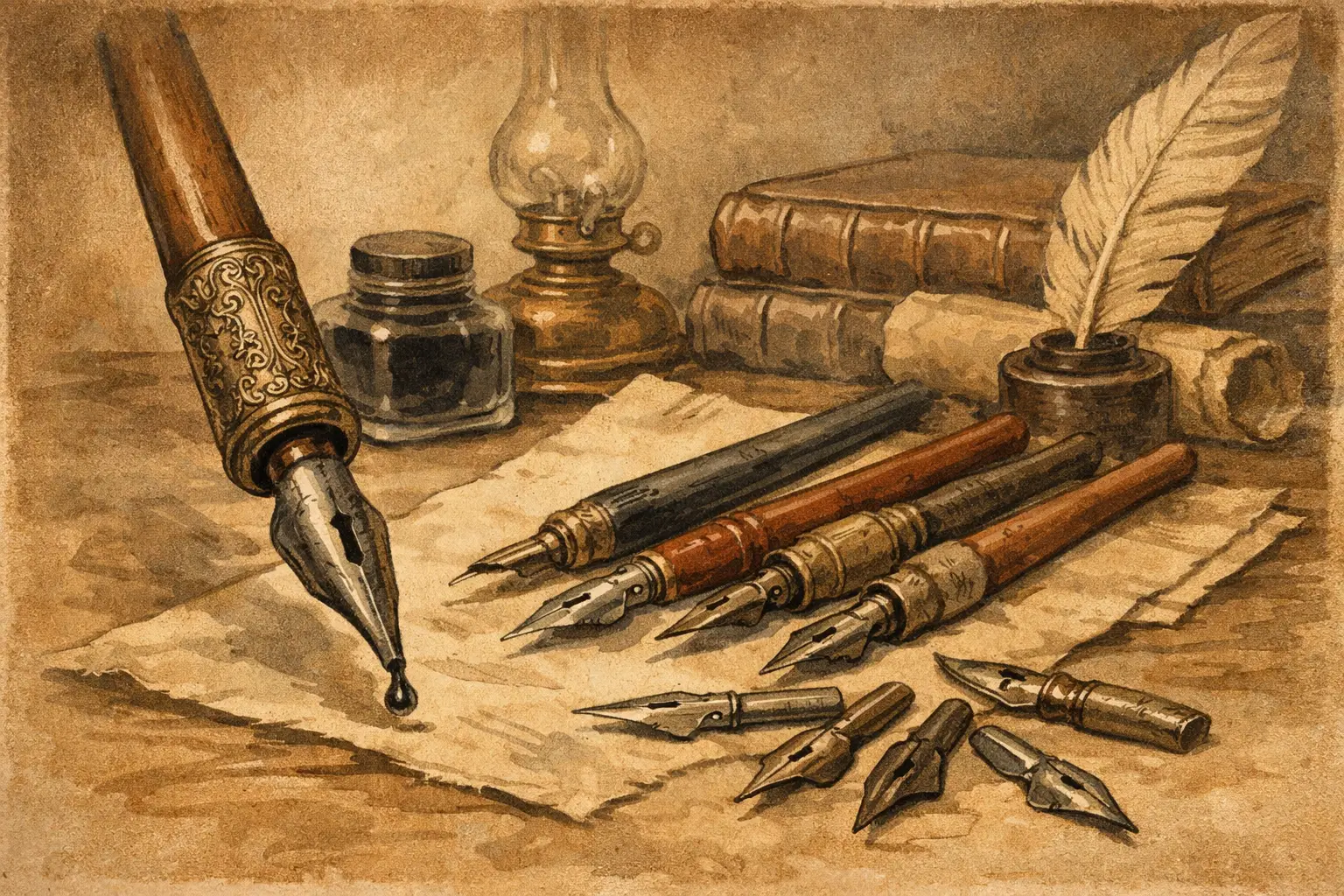
A good Victorian dip pen tells you almost everything before it touches ink. The balance sits differently in the hand, the holder material has a distinct feel, and the nib – if original and sound – offers a writing character that modern mass-produced steel rarely matches. For collectors and everyday users alike, Victorian dip pens and nibs occupy a particularly rewarding corner of the writing world because they sit at the meeting point of history, design and practical use.
Unlike many antiques that end up as display pieces, a well-chosen Victorian dip pen can still do exactly what it was made to do. That is part of the attraction. These are objects from an age when handwriting was not a hobby or a luxury affectation, but a daily necessity in business, correspondence and education. The result is a category with real depth: decorative holders, highly specialised nibs, precious materials, everyday school examples and finely made desk pieces all survive, often in surprising variety.
What makes Victorian dip pens and nibs distinctive
The Victorian period saw enormous development in writing technology. Earlier quills and rudimentary metal pens gave way to more refined, machine-made steel nibs that were affordable, reliable and widely distributed. That shift matters because it turned dip writing from a relatively inconsistent experience into something more standardised, while still allowing a remarkable range of writing styles.
Victorian dip pens and nibs are distinctive not simply because they are old, but because they reflect a period of experimentation and specialisation. Makers produced nibs for copperplate, book-keeping, school work, legal writing and ornamental hands. Holders ranged from plain turned wood to ivory, mother-of-pearl, silver, gutta-percha and elaborate novelty forms. Some were made for regular office use. Others were clearly intended as presentation pieces or genteel desk accessories.
For the collector, that variety creates scope. For the writer, it means there is no single Victorian dip pen experience. One nib may feel springy and expressive, another controlled and firm. One holder may suit occasional use, while another remains comfortable enough for longer writing sessions.
Why collectors still seek Victorian dip pens and nibs
Part of the appeal is visual. Victorian penmakers understood ornament, and even utilitarian examples can show impressive detail. Engine-turned metalwork, carved holders and shaped nibs all have obvious display value. Yet appearance alone is not the whole story.
Collectors are also drawn to maker history, manufacturing quality and rarity. Certain nib boxes, holder materials or patented fittings are harder to find than others. Some enthusiasts concentrate on a single manufacturer, while others build around themes such as novelty dip pens, travelling pens, desk sets or figural holders. There is also a strong crossover appeal for those who collect inkwells, pen trays and writing boxes, since Victorian dip pens rarely existed in isolation.
Usability adds another layer. A restored and carefully assessed piece can still provide a direct connection to nineteenth-century writing practice. That matters to buyers who do not want a cabinet object alone, but something with life left in it. As with vintage fountain pens, condition and correct description are crucial. A decorative holder is one thing. A decorative holder with a sound fitting and a suitable nib is another altogether.
How Victorian nibs write in practice
There is a persistent assumption that older nibs are always softer, finer and better. Sometimes they are. Sometimes they are simply different. Much depends on the maker, the intended purpose of the nib, the steel quality and how it has survived.
Many Victorian nibs offer a pleasing responsiveness that modern writers notice straight away. Fine pointed examples can produce elegant line variation with a light hand, especially for copperplate-style writing. Broader or firmer nibs can feel more stable and forgiving, which may suit note-taking or general correspondence better. Flex is often prized, but excessive softness is not automatically ideal. A very flexible nib can be delightful for a skilled user and frustrating for someone with a heavier touch.
Ink flow also depends on setup. Dip nibs need the right ink, sensible loading and a little patience. A genuine Victorian nib may write beautifully, but it may also need cleaning, careful inspection and realistic expectations. Corrosion, metal fatigue and tip wear can all affect performance. This is one reason specialist sourcing matters. In this field, the difference between original old stock, lightly used vintage stock and damaged period material is significant.
The holder matters as much as the nib
Buyers often focus on the nib alone, but the holder plays a major role in comfort and control. Shorter holders can feel nimble but may not suit every hand. Heavier silver or metal-mounted examples can feel wonderfully substantial, though not everyone wants that weight for longer use. Wooden and ebonised holders are often the most practical for regular writing, while more delicate materials may be better appreciated with careful, occasional use.
Fittings deserve close attention too. A loose or damaged ferrule can make a pen frustrating or unusable. Since many antique dip pens have had nibs swapped over the decades, the current pairing may or may not be original. That is not always a problem, but it should be understood when buying.
What to look for when buying Victorian dip pens and nibs
Condition should come before romance. A pen may be attractive, rare or unusually ornate, but if the holder has splits, the mount is unstable or the nib is badly rusted, its practical value changes sharply. For a display collector that may be acceptable. For a writer, it usually is not.
Originality matters, but so does honesty of description. An original nib is appealing, yet a period holder fitted with a compatible replacement nib can still be a very satisfying purchase if it is represented correctly. Likewise, gentle age-related wear is normal and often desirable, while active corrosion, crude repairs or over-polishing should prompt caution.
Material identification is another area where expertise counts. Victorian sellers and later dealers were not always precise, and modern assumptions can be misleading. Bone, ivory, pearl, silver plate and solid silver all need careful distinction. The same applies to decorative finishes that may look more luxurious than they are. There is nothing wrong with a modest material if it is priced and described correctly.
If you are buying to write, ask a simple question: has the piece been checked for function, not merely appearance? In our view, that is one of the most important distinctions in the vintage writing trade. A pen that looks respectable in a photograph can still disappoint badly in hand.
Using and caring for Victorian dip pens and nibs
Victorian dip pens and nibs are not difficult to enjoy, but they do reward sensible handling. A steel nib should be cleaned and dried after use, especially if it is genuinely old. Leaving ink to sit on a vintage nib invites corrosion, and corrosion is rarely reversible in any meaningful way.
The holder should be treated according to its material. Wood, hard rubber, silver and mother-of-pearl all age differently. Over-cleaning is a common mistake. Collectors sometimes damage patina in the attempt to make an object look newer than it is. With antique writing instruments, sympathetic care nearly always serves better than aggressive polishing.
Storage matters too. Damp conditions are the enemy of steel nibs and metal mounts. If a dip pen comes in a case, that is a bonus, but old linings can trap moisture if kept in poor conditions. A stable, dry environment is the safer option.
Writing with them today
Many people assume dip pens are awkward for modern use, but that depends on expectations. They are not replacements for fountain pens if you want pages of uninterrupted writing. They excel in a slower, more deliberate mode – letters, journal entries, calligraphic work, signatures and moments when the process matters as much as the result.
That pace is part of their appeal. Dipping the nib, controlling the ink load and working with a tool that asks for attention changes the rhythm of writing. Some buyers come to Victorian dip pens through collecting and end up using them regularly. Others begin with the writing experience and only later start noticing maker marks, materials and variations.
Why specialist sourcing makes the difference
Victorian writing instruments reward knowledge. There are too many variables in age, material, condition and originality for this to be an area where guesswork serves buyers well. A trustworthy specialist can identify problems before they become disappointments and can also recognise merit in pieces that general antiques sellers might overlook.
That matters whether you are buying a single working dip pen, building a collection of nineteenth-century nibs, or looking for a gift with genuine historical interest. Heritage Collectables approaches this field from the perspective that vintage writing instruments should be understood properly and, where appropriate, made ready for practical enjoyment rather than treated as anonymous curios.
The best Victorian dip pens are not merely old pens. They are well-made survivors from a period that cared deeply about handwriting, materials and the small mechanics of everyday communication. Choose carefully, buy from someone who knows what they are handling, and you may end up with an antique that still earns its place on the desk rather than simply sitting in a case.
2 thoughts on “Victorian Dip Pens and Nibs Explained”