
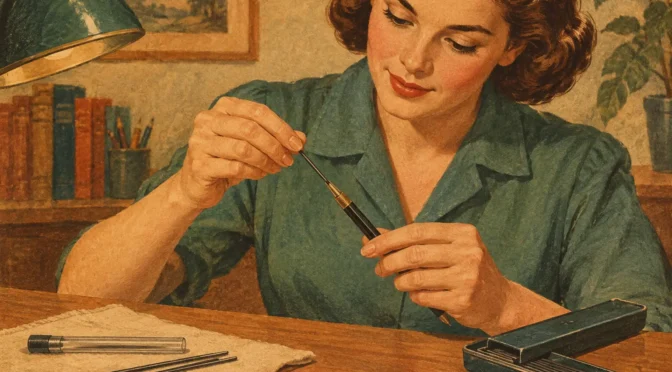
A well-made pencil should not be forced. Whether it is a modern mechanical pencil or a restored vintage example, the small mechanism inside is designed to feed a precise diameter of graphite with very little pressure. When the lead runs out, fitting the wrong size – or trying to cure a jam with a pin – can turn a simple refill into an avoidable repair.
Knowing how to replace pencil lead correctly begins with identifying the pencil type. Most modern propelling pencils use a simple rear-loading mechanism, while many vintage pencils have more varied arrangements: a removable cap, a sliding sleeve, a nose cone that unscrews, or a clutch operated by a button. The principle is straightforward, but the details matter greatly where an older mechanism is concerned.
First, identify your pencil and its lead size
Before opening anything, look for a lead-size marking. Modern pencils commonly state 0.3 mm, 0.5 mm, 0.7 mm, 0.9 mm or 2.0 mm on the barrel, clip, cap or nose. Vintage examples may instead be marked with a fraction, such as 1.18 mm, or may give no indication at all. Older propelling pencils often use thicker 1.18 mm, 1.4 mm, 1.5 mm or 2 mm leads, which are not interchangeable with the fine polymer leads used in a contemporary drafting pencil.
Do not assume that a lead which appears to fit is correct. A 0.5 mm refill pushed into a 0.7 mm pencil may slip, fail to advance properly or break within the tip. A lead that is even slightly too thick can damage the clutch jaws or become firmly wedged in the feed tube.
If you have acquired a vintage pencil without its original instructions, measure an unused piece of lead with callipers where possible. If the pencil is still holding a short length of old lead, it can also provide a useful guide. Take care not to judge the size solely from the width of the exposed tip, as the metal sleeve around it can make a fine lead appear larger than it is.
A note on hardness and material
Lead is a traditional name, not a description of the material. Pencil refills are graphite mixed with clay and binders. HB is generally the most useful everyday grade, offering a balanced line and reasonable strength. B grades are softer and darker, while H grades are harder and lighter.
For a vintage pencil intended for regular writing, a good-quality HB or B refill of the right diameter is usually the sensible choice. Very hard leads can feel scratchy and may put unnecessary strain on a fine mechanism. Conversely, extremely soft leads can snap repeatedly in narrow 0.3 mm or 0.5 mm pencils. The best choice depends on the pencil, the paper and the way you write.
How to replace pencil lead in a rear-loading pencil
Most push-button mechanical pencils are filled from the rear. Start by extending the existing lead slightly, if any remains, then remove the eraser or end cap. In many pencils, the eraser simply pulls out. Others have a cap that unscrews or lifts away.
Hold the pencil vertically with the opening uppermost. This prevents loose lead fragments from falling into the mechanism. Insert the new leads one at a time, unless the manufacturer specifically indicates that several may be loaded together. Fine leads are fragile, so do not press them down with a fingernail, another lead or a pointed object. Let gravity do the work.
Replace the eraser or cap, then click the button gently until the lead emerges from the point. It may take several presses for the first refill to reach the tip, especially if the reservoir was empty. Advance only a small amount – around 1 to 2 mm for fine lead – before writing.
If the pencil has a long, removable eraser with a small clearing rod beneath it, reserve that rod for clearing a blockage at the tip. It is not intended to push new lead through the whole barrel.
Replacing lead in a clutch or vintage propelling pencil
A clutch pencil holds a thicker lead between small gripping jaws. The button, often at the top of the pencil, opens these jaws. Press and hold it while gently sliding the lead through the nose. Release the button and the clutch should grip the lead securely.
To refill an empty clutch pencil, hold down the button and insert a single correct-size lead through the tip. Some designs load from the rear instead, particularly certain vintage pencils with a removable cap or a lead compartment. If the route is not obvious, do not force the nose cone or twist the button. Older pencils vary considerably, and a threaded component may be made from hard rubber, celluloid, gold-filled metal or early plastic that deserves careful handling.
Many twist-action vintage pencils advance lead by rotating the barrel. These may have a small internal magazine or a chamber beneath the cap. Unscrew only parts that are clearly intended to come apart. A resistance that feels unusual may indicate dried residue, cross-threading, a seized mechanism or a component that was never designed for routine removal.
For collector-grade pencils, preserving originality matters as much as restoring function. A worn but correct cap, nose cone or mechanism is preferable to damage caused by enthusiastic dismantling.
When the lead will not advance
A pencil that will not feed lead is not always broken. The most common cause is a tiny fragment lodged in the tip. First remove the remaining leads from the reservoir. Then hold down the push button or clutch button, depending on the design, and use the appropriate clearing rod very gently from the front or rear as the mechanism permits.
Never use a sewing needle, paper clip, drill bit or a length of wire. These improvised tools can score the feed tube, spread the clutch jaws or snap off inside the nose. Fine pencil mechanisms rely on close tolerances, particularly in vintage models where replacement parts may be difficult to source.
If a jam remains after a light, correct attempt, stop. The obstruction may be compacted graphite, a bent internal tube or an incorrect refill that has been forced into place. This is the point at which specialist attention is usually more economical than further experimentation.
Signs that the problem is more than a jam
A loose tip, a button that does not return, a barrel that turns without advancing, or a clutch that no longer grips are mechanical faults rather than routine refill issues. Likewise, if lead falls straight through the pencil, the internal jaws may be worn or displaced. These faults can often be repaired, but they should not be tackled with glue or excessive force.
Vintage pencils can contain delicate springs, tiny screws and proprietary fittings. Their value is not confined to precious metal content or a recognisable maker’s name. Original engineering, period details and reliable operation all contribute to their appeal.
Habits that protect the mechanism
Good lead replacement is only part of pencil care. Store refills in their original tubes or cases, rather than loose in a drawer or pocket. Fine leads readily chip, and fragments introduced into the barrel are a frequent cause of blockage.
Avoid dropping a pencil point-first. The exposed sleeve can bend almost imperceptibly, leaving the lead unable to pass cleanly. When writing, use a light hand and keep only a short length of lead extended. This reduces breakage and gives a more controlled line.
For a vintage pencil with plated, sterling silver or gold-filled surfaces, use a soft dry cloth after handling. Do not immerse it in water or apply household metal polish around seams and moving parts. Residue can migrate into the mechanism, while aggressive polishing may remove desirable patina and soften crisp engraved detail.
Choosing refills for a pencil you value
The correct refill should make a pencil feel effortless. It should advance cleanly, remain secure while writing and produce a line suited to its purpose. A slender 0.5 mm pencil may be ideal for notes and correspondence, while a 1.18 mm or 2 mm vintage clutch pencil gives a generous, expressive line that suits sketching, marking and everyday use.
If you are uncertain about the size, do not turn the pencil into a test bed for assorted refills. Establish the specification first, particularly with a scarce or sentimental piece. Heritage Collectables regularly handles restored pencils whose mechanisms have survived for decades precisely because they have been treated with patience.
A pencil is one of the few everyday tools whose working parts can be both beautifully engineered and genuinely practical. Fit the right lead, use a gentle touch, and it can continue to write exactly as its maker intended.