
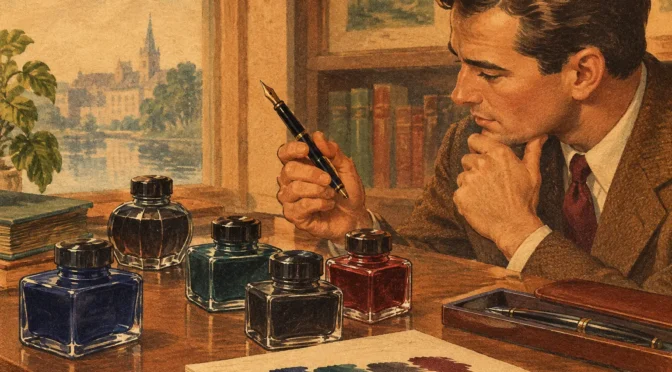
A freshly restored lever-filler deserves better than the nearest bottle of brightly coloured ink. The question of which ink suits lever fillers is really a question of preserving a working piece of pen history while enjoying it on the page. A sound vintage Waterman, Conway Stewart, Swan or Parker can be an excellent daily writer, but its filling system asks for sensible ink choices and regular, unhurried care.
The reassuring answer is that most restored lever fillers are not difficult to ink. Choose a conventional fountain pen ink with a good reputation for easy cleaning, avoid specialist formulations that leave deposits, and do not allow ink to dry in the pen for months. That modest routine will do more for a vintage pen than chasing a fashionable colour ever will.
How a lever filler affects ink choice
A lever filler stores ink in a flexible sac inside the barrel. Raising the lever compresses the pressure bar against that sac; releasing it allows the sac to reinflate and draw ink through the feed. Unlike a modern cartridge-converter pen, the ink sits directly against the sac for as long as the pen remains filled.
Many properly restored pens have a new latex sac, chosen because it is appropriate to the original design and gives dependable service. Latex is a remarkably capable material, but it should not be treated as indestructible. It is wise to avoid inks with unusually aggressive chemistry, heavy particulate content or a tendency to dry into stubborn residue. A pen may appear to tolerate such an ink at first, yet the real test comes when it has been left in a drawer or used only occasionally.
The feed matters too. Vintage ebonite feeds, narrow ink channels and older capillary systems were designed around traditional, washable dye inks. They generally reward an ink that flows freely without being excessively wet or heavily saturated. A clean, conventional ink lets the filling system and feed show what they can do.
Which ink suits lever fillers best?
For most collectors and regular users, a well-behaved dye-based fountain pen ink is the best starting point. The familiar blue, blue-black, black and washable colours from established fountain pen ink makers are usually the sensible choice. They offer reliable lubrication, good flow and, crucially, straightforward flushing when it is time to change colour or put the pen away.
Waterman Serenity Blue has long been a popular benchmark because it is consistent, gentle and easy to clean. Parker Quink remains a practical choice for many vintage pens, particularly in its more traditional colours. Diamine’s standard range gives the user a broad selection of attractive shades, though it is still worth favouring the less intensely saturated colours for a pen that will be used infrequently. Pelikan 4001 can be useful in a pen that writes very wet, as it tends to feel drier than some alternatives.
That is not to say every safe ink will suit every pen in precisely the same way. A broad, wet Conway Stewart nib may benefit from a slightly drier ink, while a fine, firm Waterman nib can feel more generous with an ink that has better flow. The right pairing is partly mechanical and partly personal. Begin with a conservative ink, write several pages, then judge the line, drying time and ease of starting after the pen has rested overnight.
Choose easy cleaning over dramatic colour
Highly saturated inks can be glorious in a modern demonstrator, but they are not always the best companion for a vintage lever filler. Deep reds, vivid purples, intense blues and sheen-heavy formulations may stain a sac, cling to the feed or require more persistent flushing. None of that automatically makes them unusable, but they demand a more disciplined owner.
If you enjoy these colours, reserve them for a pen you use frequently and clean thoroughly. Do not fill a newly acquired vintage pen with a difficult ink, write a few lines, then leave it unused for a season. Start with washable blue or black while you learn the pen’s behaviour. Once you know that its cap seals well, its feed is healthy and its flow is stable, experimentation becomes much safer.
Be cautious with permanent, pigmented and iron gall inks
A vintage lever filler is usually not the ideal place for pigmented, carbon or acrylic inks. These formulations can contain particles or binders that settle in fine feed channels, and dried deposits can be difficult to remove without dismantling work. India ink and calligraphy ink should never be used in a fountain pen, regardless of the filling system.
Permanent dye inks also deserve caution. Some are perfectly manageable for attentive users, but their resistance to water often comes with greater cleaning demands. If archival permanence is essential, use the pen regularly, flush it carefully before any period of storage and accept that the service interval may be shorter.
Iron gall fountain pen inks occupy a more nuanced position. Modern versions are considerably more civilised than historic iron gall recipes, and some enthusiasts use them successfully in vintage pens. Even so, they are best approached as a considered choice rather than a default. Their chemistry, potential for residue and need for regular cleaning make a conventional dye ink the more reassuring option for a cherished lever filler, especially one with an older or delicate feed.
Match the ink to the pen’s condition and your habits
The best advice changes if the pen has just been restored, if it is an original survivor, or if it is used every day. A professionally restored lever filler with a sound sac and clean feed is ready to write, but it still benefits from an initial fill of a simple, easily flushed ink. This gives you a clear view of how the nib, feed and filling system perform without introducing another variable.
An unrestored pen should not be inked merely to see whether it works. A hardened sac can split, and old ink residues can obstruct the feed. If the lever is stiff, the barrel has discoloration around the lever area, or there is no evidence of recent restoration, seek specialist advice before filling. The cost of patience is small compared with the damage caused by forcing a compromised mechanism.
Your writing pattern is equally relevant. A pen used daily can cope with a wider choice of ink because it is regularly refreshed through the feed. A pen used for Sunday correspondence or occasional signatures should contain an ink that remains cooperative after a pause. In that case, plain blue, blue-black or black is usually more rewarding than an exotic, demanding colour.
A practical care routine for lever-filled pens
Good ink selection works best alongside a simple maintenance routine. Do not overfill the pen to the very brim of the sac. After filling, wipe the section and nib carefully, then allow the pen a moment for the feed to settle before writing. Store it horizontally or nib-up when not in use, rather than leaving it nib-down in a pot where ink can collect in the cap.
When changing ink, flush with cool, clean water until it runs clear. Lever fillers should be filled and emptied gently; repeated hard pumping of the lever is unnecessary and can place avoidable strain on an old pressure bar or newly fitted sac. If the pen has been filled with a more saturated ink, allow additional time for soaking and flushing rather than resorting immediately to strong cleaning solutions.
For long-term storage, empty and flush the pen. This is particularly worthwhile before a holiday, a house move or any period when a collection will not be used. Leaving ink in a working pen for a week or two is normally unremarkable. Leaving it for many months is where dried ink, staining and difficult starts become much more likely.
When a different ink is worth trying
If a pen feels dry or skips despite being clean and correctly filled, do not assume it needs repair straight away. Try one alternative conventional ink first. Flow varies from ink to ink, and a modestly wetter formulation can transform a fine nib. Conversely, if a flexible or broad nib lays down an overly wet line, a drier ink may improve control and reduce smudging on everyday paper.
If changing inks does not improve a persistent problem, stop experimenting. A lever filler that will not draw ink properly, leaks near the lever, writes only when shaken or dries out unusually quickly may need inspection rather than another bottle. Specialist restoration is about preserving the original instrument while making it dependable enough to enjoy.
The finest answer to which ink suits lever fillers is therefore rarely the most exotic bottle on the shelf. Choose an ink that respects the pen’s age, suits its individual flow and fits the way you actually write. A well-restored vintage fountain pen should be used with confidence, and a clean, dependable ink leaves you free to enjoy the nib, the craftsmanship and the quiet pleasure of putting it to paper.