
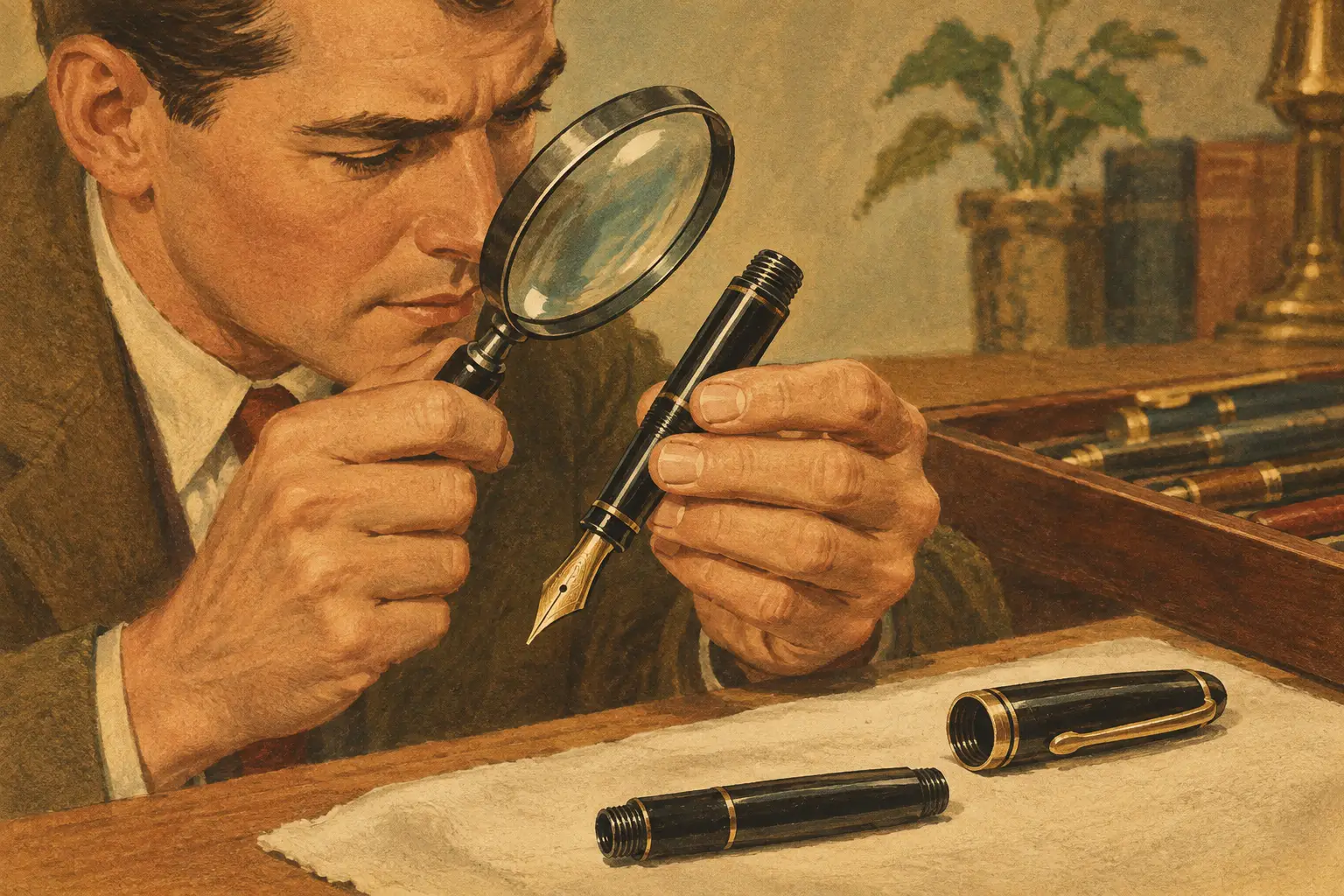
A beautiful vintage fountain pen can look immaculate until its cap is removed. Threads are easy to overlook in photographs, yet they govern one of the most frequent actions an owner performs: closing the pen. Knowing how to inspect pen threads is therefore not a minor detail for collectors. It is a sensible safeguard against cracked caps, stripped barrels and a pen that cannot be used with confidence.
On a restored pen, clean and correctly engaging threads are a quiet sign of careful work. On an untouched example, they can reveal both its history and the level of attention it may need. The aim is not to expect every decades-old pen to look factory fresh, but to distinguish honest age from damage that will worsen with use.
How to inspect pen threads on a vintage pen
Begin with good light and clean, dry hands. Daylight near a window is ideal, although a small LED torch can help show damage within a dark cap. Do not start by screwing and unscrewing the cap repeatedly. A thread problem can be made much worse by testing it impatiently.
First, look at both sides of the connection: the external threads, usually on the barrel or section, and the internal threads inside the cap. Rotate the pen slowly under the light. Healthy threads should have a consistent spiral form, with no flattened areas, missing ridges or rough-looking patches.
A jeweller’s loupe is useful, especially for fine threads on Parker, Waterman and Conway Stewart pens, but it is not essential. Magnification can also make harmless moulding marks look alarming. What matters is whether the thread profile is complete and whether the cap engages cleanly in normal use.
Before replacing the cap, check that there is no dried ink, old polish, grit or loose debris in the threads. Dried ink can make sound threads feel tight. Conversely, wax or silicone applied to disguise a fault can make damaged threads feel deceptively smooth. A pen should not need force, lubricant or repeated adjustment merely to cap securely.
Test engagement gently
Place the cap squarely against the barrel and turn it backwards very slightly until you feel the threads settle into their starting point. Then turn forwards with only light finger pressure. The cap should begin to engage without wobbling, catching or needing to be pushed sideways.
There may be a little variation in feel between manufacturers. A large Parker Duofold, for example, often has a positive, substantial engagement, while finer threads on a slender Waterman or a celluloid Italian pen can feel more delicate. The relevant question is consistency. A sound cap screws on evenly from start to finish.
Stop immediately if you feel a sudden tight spot, hear a faint crack, or find that the cap sits at an angle. Never attempt to prove that a resistant cap will eventually go on. Cross-threading can remove material from old plastic or hard rubber in a single attempt, and a split cap may be difficult or uneconomical to restore properly.
What healthy pen threads should look and feel like
Wear is not automatically a reason to reject a vintage pen. A pen used regularly for seventy years may show softening at the opening of the cap, slight polish on the first thread or a little looseness once closed. If the cap still aligns properly, engages smoothly and stays secure, that may simply be honest evidence of a well-loved writing instrument.
More concerning signs include visibly rounded or shaved thread peaks, gaps where part of a thread is missing, and a cap that turns without advancing. Look closely at the first one or two threads, as these receive the most stress and are often where cross-threading begins.
A cap that feels loose when fully tightened deserves further attention. Some models were designed with a small amount of end play, and a loose inner cap can be mistaken for a loose threaded connection. Hold the pen by the barrel and gently try to rock the cap. Movement at the joint, rather than inside the cap, suggests worn threads or a crack around the cap lip.
Thread colour can also tell a story. Whitish stress marks in black plastic, a dark line radiating from the cap mouth, or an area that looks oddly matt compared with the rest of the pen may indicate a previous split or repair. A neatly repaired cap can remain serviceable, but it should be described accurately and priced accordingly.
Material makes a difference
Thread inspection is never entirely one-size-fits-all. Vintage materials age differently, and the same apparent defect may carry a different risk depending on the pen.
Hard rubber can become brittle and discoloured after long exposure to light. Its threads may look duller than those on modern acrylic, yet still be sound. Celluloid is attractive and often beautifully patterned, but it can shrink or distort over time. A cap that was once a perfect fit may become tight, particularly if it has been stored in heat or damp conditions.
Injection-moulded plastics used on many mid-century pens can be remarkably durable, although cap lips and fine threads are still vulnerable to impact. Metal-threaded pens may feel more substantial, but metal against plastic should be treated with care. If a metal cap is binding on a plastic barrel, forcing it risks damaging the softer component.
The presence of a metal thread insert is not automatically better or worse. It can add strength, but it also creates another joint that may loosen. Look for an insert that sits flush and does not rotate independently when the cap is turned.
Separate dirt from damage
A dirty thread is often easier to remedy than a damaged one, but cleaning must be conservative. For an ink-stained modern resin pen, a soft cloth and a lightly dampened cotton bud may be enough. For vintage hard rubber, celluloid and plated trim, avoid soaking, aggressive polishing compounds and household cleaners.
If dried ink is lodged in the cap threads, it is wiser to have the pen assessed before attempting a deep clean. Moisture can affect old components, and a cap with a concealed crack may fail as dirt is removed. This is particularly relevant where the cap has become tight after years in storage.
Do not use thread tape, glue, varnish or abrasive paper as a home remedy for a loose or rough-fitting cap. These solutions can obscure the original fault and reduce the pen’s value. Proper repairs may involve rebuilding a damaged thread, stabilising a cap lip or fitting a suitable replacement component, but the correct approach depends on the model, material and condition of the pen.
Questions to ask when buying remotely
Photographs cannot always show the condition of pen threads, even when an item is honestly presented. A sensible buyer should ask whether the cap screws on smoothly, whether there are any cracks to the cap lip or barrel threads, and whether the cap closes securely without excessive force.
It is also reasonable to ask for close photographs of both thread sets if the pen is high value, rare or made from a fragile material. Request views in natural light, including the cap opening and the start of the barrel threads. For a pen intended for daily writing, a short description of the capping action can be more useful than an extra glamour photograph.
With restored vintage pens, the key distinction is between a thread that has been sympathetically cleaned and tested, and one that has merely been made to look presentable. At Heritage Collectables, restoration is approached with the understanding that a collectable pen should remain a pleasure to handle, not a fragile display object that makes its owner nervous each time the cap is replaced.
When a fault is acceptable
A thread issue does not always make a pen a poor purchase. A scarce early Waterman, a rare colourway or a historically significant pen may still be worthwhile with a disclosed cap crack or worn thread, particularly for a collector who values originality over regular use. The price should reflect the limitation, and the buyer should know whether the pen is best kept for occasional handling, display or careful writing.
For a first vintage fountain pen or a dependable everyday writer, it is usually better to choose clean, properly engaging threads over a more dramatic but compromised example. A pen that caps securely protects the nib, travels more safely and encourages the regular use that these instruments were made for.
The best inspection is a patient one. Look closely, test lightly and trust any resistance that feels wrong. A sound threaded joint may be one of the least glamorous parts of a vintage pen, but it is often what allows its craftsmanship to be enjoyed for many more years.