
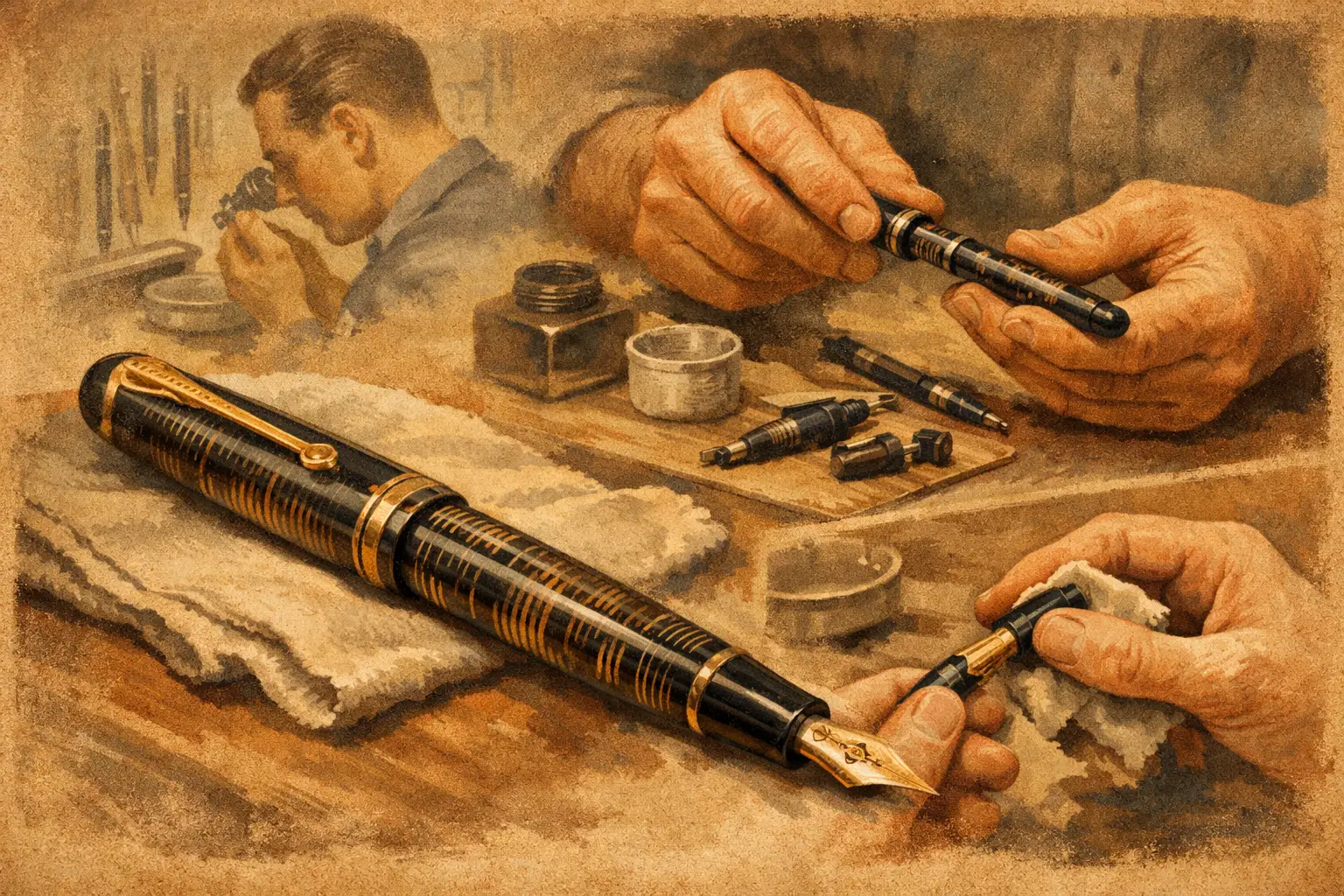
A good Parker Vacumatic restoration example begins before a tool touches the pen. A striped Vacumatic may look handsome even when its filling system has failed, but its value lies in more than the celluloid pattern. The condition of the barrel, clarity of the imprint, originality of the nib and integrity of the filling mechanism all deserve careful attention. Restoring one properly is not simply a matter of making it write again. It is about returning a remarkable 1930s or 1940s fountain pen to dependable use while preserving the evidence of its age.
The Vacumatic remains one of Parker’s most recognisable designs. Its laminated celluloid barrel, pearlescent striped finish and distinctive filling system gave it a technical and visual confidence that still feels special in the hand. For collectors, the appeal is partly historical. For writers, it is the generous ink capacity and balanced feel that often make the difference.
What arrives on the bench
Consider a representative example: a Pearl and Black Parker Vacumatic Major from the 1940s. The barrel has retained good colour, with a little expected darkening around the cap lip. Its cap bands are present and secure, the clip has not been distorted, and the imprint remains readable. The gold nib is original, though it has dried ink beneath the feed and writes with a hesitant, scratchy line.
The obvious fault is at the blind cap. The plunger moves with little resistance, and the pen will not draw water when tested. This is a familiar symptom of a perished diaphragm. The diaphragm is the flexible rubber sac within the Vacumatic’s filling unit. When it has hardened, split or turned to fragments, the impressive pump mechanism cannot do its job.
That diagnosis is only the starting point. Before restoration, the pen should be examined for barrel cracks, cap lip damage, loose trim, corrosion around the filler, damaged threads and signs that a previous repair has altered the original construction. A Vacumatic can survive decades in a drawer, but it can also have been opened incorrectly once and weakened for good.
A Parker Vacumatic restoration example, step by step
The first stage is a gentle external clean. Dust, old ink and surface grime can disguise both condition and faults. The celluloid is cleaned cautiously, avoiding aggressive polishing that can round crisp edges, blur an imprint or leave a deceptively bright but unnatural finish. Light wear is part of a vintage pen’s character. Deep scratches and serious discolouration are different matters, but neither should be hidden behind a hurried cosmetic treatment.
The filling unit is then removed using the correct method for the particular Vacumatic version. Parker produced several variations, including Lockdown, Speedline and later plastic plunger fillers. Their details differ, and forcing the wrong component in the wrong direction is an expensive mistake. The striped celluloid barrel is attractive but not indestructible, particularly around threads and thinner sections.
Once the unit is out, the old diaphragm is assessed and cleared away. In many unrestored pens, it has become a brittle black residue. The filler assembly must be cleaned carefully so that old material does not obstruct movement or compromise the new diaphragm. Any corrosion, bent components or damaged seals must be dealt with before reassembly, rather than being concealed by a replacement part.
A correctly sized diaphragm is fitted to the pellet cup and secured with appropriate materials. This is the heart of the repair. Too large, too small, twisted or poorly seated, and it may fill weakly, fail early or leave the mechanism under strain. A small amount of pure talc is traditionally used to prevent the diaphragm from sticking to itself during operation. It is a detail that cannot be seen once the pen is assembled, but it affects whether the pen works as Parker intended.
The filler is reinstalled only after the diaphragm has been allowed to settle correctly. The plunger should move smoothly and positively, not loosely and not with excessive force. A professional restoration favours patience here. A pen that needs persuading is telling the restorer something.
The breather tube and why filling capacity matters
The Vacumatic is not merely a sac pen with an unusual button. Its pump filling system works with a breather tube at the feed. This arrangement allows air to escape while ink is drawn into the barrel, enabling repeated strokes to produce an unusually full fill.
A damaged or shortened breather tube may leave a Vacumatic apparently functional while reducing its capacity considerably. It may take in a little ink, then appear to stop. That is not always a diaphragm problem. On a worthwhile restoration, the breather tube should be checked for blockage, splitting and correct length, then replaced where necessary with a suitable component.
This is one reason a pen should be tested repeatedly rather than dipped once and declared restored. A Vacumatic should demonstrate a meaningful fill, a clean release of pressure and consistent ink delivery afterwards. A satisfying repair is measurable at the writing desk, not just at the workbench.
Restoring the nib without erasing its character
With the filling system working, attention turns to the writing end. Decades of dried ink can restrict flow, especially in the collector’s favourite finer grades. The nib and feed are cleaned thoroughly but sympathetically. The aim is to remove old ink from the channels, not to overwork hard rubber or disturb a sound original fit.
The nib in this example has slightly misaligned tines and a small rough point on the right tine. It does not need replacing, nor does it need to be ground into a modern broad nib. Careful alignment and minimal smoothing return it to a controlled fine-medium line with gentle feedback. That is often the better outcome for a period Parker nib: pleasant, reliable writing that still feels like the pen it has always been.
Nib work is where restoration and alteration can become confused. A specialist may adjust flow, alignment and smoothness, but a highly original nib should not be reshaped casually for fashion. A custom italic or extra-fine grind can be enjoyable, yet it changes the instrument and may reduce its appeal to a future collector. The right choice depends on whether the pen is being bought primarily to write with, collect or give as a meaningful gift.
Testing is part of the restoration, not an afterthought
The restored Vacumatic is filled with a fountain pen-safe ink and left to stand nib down for a short period, then nib up. It is tested for seepage around the filler, section and nib unit. It is also written with over several pages to confirm flow, starting behaviour and consistency after pauses.
The blind cap should operate securely, the cap should post without stressing the barrel, and the clip should remain firm enough for a jacket pocket or pen case. These practical checks matter. A vintage pen can be beautiful in a display tray, but a properly restored example should also earn the confidence of someone who intends to use it.
It is worth being realistic about what restoration does not mean. It does not make a pen factory-new, remove every mark or guarantee that seventy-year-old celluloid will be immune to future damage. It does mean that known mechanical faults have been addressed properly, the writing performance has been evaluated and the pen is ready for sensible ownership.
What to look for when buying a restored Vacumatic
A seller’s description should distinguish between cosmetic condition and mechanical restoration. Phrases such as restored filler, new diaphragm, tested filling system and tuned nib give useful reassurance when they are supported by accurate photographs and clear condition notes. Equally, collectors should ask whether trim, nib and major components are original, especially where a particular date code, colour or size is important.
Do not assume that the shiniest pen is the best buy. A lightly worn Vacumatic with a clear imprint, original nib and correctly rebuilt filling system can be far more desirable than an over-polished example with uncertain repairs. The best choice also depends on how it will be used. A larger Major or Maxima suits many regular writers, while a smaller Debutante may appeal to those who value compact proportions and an elegant handbag or pocket pen.
At Heritage Collectables, restored vintage pens are selected with that balance in mind: collector interest, honest condition and practical usability. A Vacumatic deserves to be described as an individual piece, not treated as another generic vintage fountain pen.
For a new owner, the most helpful habit is simple. Use a well-behaved fountain pen ink, avoid leaving ink in the pen for months, and flush it with cool water before putting it away. A Parker Vacumatic that has been restored with care can bring its striped celluloid, clever engineering and distinctive writing character back to everyday life – exactly where a fine vintage pen is most rewarding.