
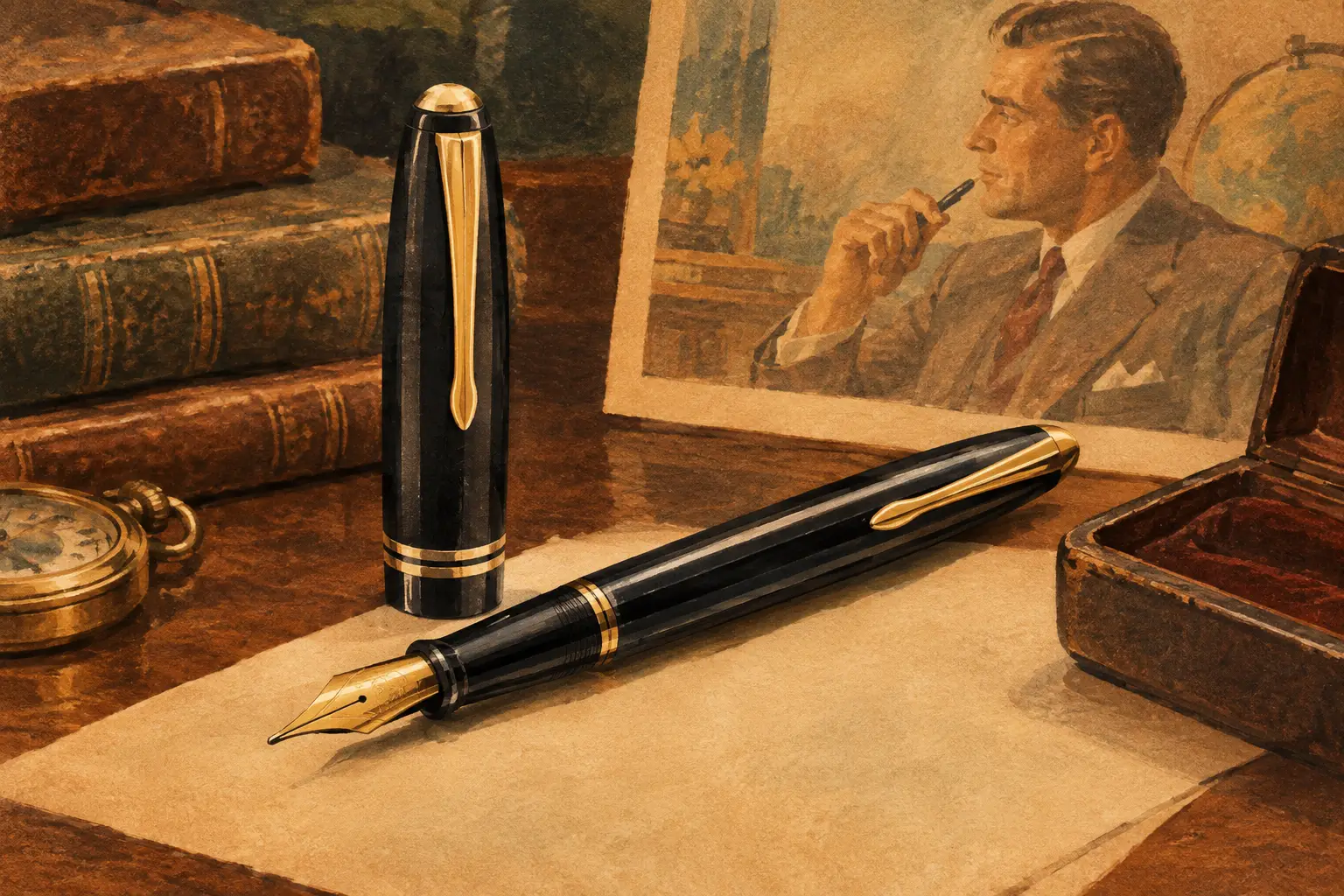
The Sheaffer Balance review begins with a simple point: few vintage pens look as convincingly modern nearly a century after their introduction. Its long, tapered barrel replaced the squat, flat-ended silhouette common in the 1920s, and gave Sheaffer a design language that would influence the industry for years. For collectors, it is a landmark model. For writers, a properly restored example can still be an exceptionally satisfying everyday fountain pen.
That combination is the Balance’s enduring appeal. It has genuine design history, but it is not merely a pen to keep behind glass. The right example offers a light, well-proportioned body, a characterful gold nib and a filling system that can be made dependable with knowledgeable restoration.
Why the Sheaffer Balance still matters
Introduced at the end of the 1920s, the Balance arrived when fountain pens were becoming more streamlined and less overtly ornamental. Sheaffer’s interpretation was elegant rather than severe: gently rounded ends, a comfortable taper and enough material around the cap band and clip to retain a sense of luxury.
The model was produced through much of the 1930s and into the 1940s in a remarkable range of sizes, colours and trims. This breadth is a major advantage for collectors. A modest standard Balance in black or marine green can be an accessible entry into vintage Sheaffer, while oversize examples, rarer celluloids, higher trim levels and unusually flexible nibs command much stronger interest.
It also explains why no useful assessment can treat every Balance as identical. A slender ladies’ pen with a firm fine nib will feel entirely different from an early oversize lever-filler fitted with a broad, expressive point. Condition, period and restoration quality matter as much as the name on the barrel.
Sheaffer Balance review: design and handling
The Balance is at its best in the hand. Its taper is not a decorative flourish – it creates a pen that sits naturally between the fingers and does not feel clumsy even in its larger formats. Many writers find the standard and long versions especially agreeable for extended notes or correspondence, while the oversize model offers a more substantial presence without becoming excessively heavy.
Most examples are made from celluloid, a material with depth and warmth that modern plastics rarely match. The familiar striated finishes can look superb when well preserved, with colour that seems to move beneath the surface. Black, jade, marine green, grey pearl and various striped patterns each have their own following. The exact finish is often a matter of collector preference, but clarity of colour and freedom from discolouration should always influence value.
There are trade-offs. Celluloid demands respect. It can darken, craze, shrink or become distorted after poor storage, and chasing the lowest-priced example can be false economy if the material is compromised. A handsome, stable pen with honest light wear is usually a better purchase than a glossy specimen hiding cap lip cracks, pronounced staining or deterioration around trim.
The clip and cap bands are recognisably Sheaffer, but the design remains restrained. This is not a pen that relies on elaborate chasing or excessive gold overlay to make its case. Its confidence lies in proportion. For a collector who values the transition from ornate early fountain pens to the streamlined forms of the 1930s, the Balance is one of the essential models.
Filling systems and what restoration involves
Early Balance pens commonly use Sheaffer’s lever-filling arrangement with a rubber sac. Later examples may be found with the company’s vacuum filling system. Both can provide excellent service when restored correctly, but they should be assessed differently.
A lever-filler is comparatively straightforward in principle, though replacing a sac properly involves more than simply fitting new rubber. The sac must be correctly sized, the pressure bar must function, the section and barrel threads must be sound, and the pen must be reassembled without damaging aged celluloid. A good restoration should leave the lever operating smoothly and the pen filling without drips or hesitation.
Vacuum-fill models are more involved. Their sealing components and packing arrangement require specialist attention, and a pen described merely as “working” tells a buyer very little. It should fill effectively, retain ink and operate without excessive force. For a first Balance, a professionally restored lever-filler is often the more reassuring choice. For the experienced Sheaffer enthusiast, a properly restored vacuum-filler can be a particularly rewarding acquisition.
It is worth being cautious with pens that have been left inked for decades, especially if the condition of the filling system is unclear. Dried ink can cause trouble in the feed and section, while an old sac may be brittle or already failing. Restoration is not an optional detail on a vintage fountain pen – it is the difference between a display object and a writing instrument.
The nib is where the personality lives
Sheaffer made excellent gold nibs, and the Balance offers a wide range of writing experiences. Many are firm, precise and controlled, ideal for everyday writing on ordinary paper. Others have a modest spring that gives handwriting a little life without requiring the deliberate technique associated with true flex nibs.
Flexible examples do exist, but they should not be assumed. A gold nib is not automatically soft, and a nib described as flexible should show genuine line variation under light, sensible pressure. Over-flexing an old nib in search of dramatic calligraphy is one of the quickest ways to damage it. The Balance is better appreciated for its responsive, practical vintage writing character than for exaggerated performance.
When examining a pen, look for aligned tines, a sound tipping surface and an even ink flow. A fine point can be wonderfully crisp, though it may feel less forgiving on textured paper. Medium and broad points often reveal the warmth of Sheaffer’s nibs more readily. If buying remotely, clear close photographs and an honest writing description are far more useful than a vague claim that the nib is “smooth”.
Which Sheaffer Balance should you buy?
The answer depends on whether you are buying to write, collect or give. A writer should prioritise a restored filling system, a nib width suited to their handwriting and stable celluloid over rarity. A collector may reasonably place greater emphasis on unusual colour, large size, trim variation, original presentation or a particularly desirable nib.
For a first purchase, a standard-sized lever-filling Balance in a well-preserved common finish is often the sensible route. It captures the model’s design at a more approachable price and is usually practical enough for regular use. Choose a larger pen if you prefer a fuller grip or have larger hands, but do not assume that oversize is automatically better. The standard pen is often beautifully balanced, as its name promises.
Gift buyers should favour condition and usability over obscure variant details. A restored Balance with a clean cap, attractive colour and a medium nib makes a far more memorable present than a scarce but temperamental example. Original boxes, paperwork and matching pencils can add collector interest, although they should not distract from the condition of the pen itself.
What to check before buying
A worthwhile Sheaffer Balance should be judged as a complete object, not just by its colour or its nib imprint. Check the cap lip carefully for cracks, inspect the barrel for discolouration or shrinkage, and make sure the clip and cap bands sit securely. Celluloid can disguise faults in photographs, so condition descriptions need to be specific.
Ask whether the pen has been restored, what work was carried out and whether it has been tested with ink. If it is a lever-filler, the lever should sit neatly and operate without strain. If it is a vacuum-filler, the filling mechanism deserves particular scrutiny. The nib should be original where possible, though a well-matched replacement may still make an excellent writing pen if disclosed clearly.
This is where a specialist seller earns their place. At Heritage Collectables, restored vintage pens are selected with practical use as well as collector appeal in mind, because the pleasure of a Balance is lost if it cannot be trusted on the page.
The Sheaffer Balance remains an excellent choice because it rewards both kinds of ownership: careful collecting and regular writing. Choose the example whose size, finish and nib invite you to reach for it, then give it the measured care that a fine celluloid pen deserves.