
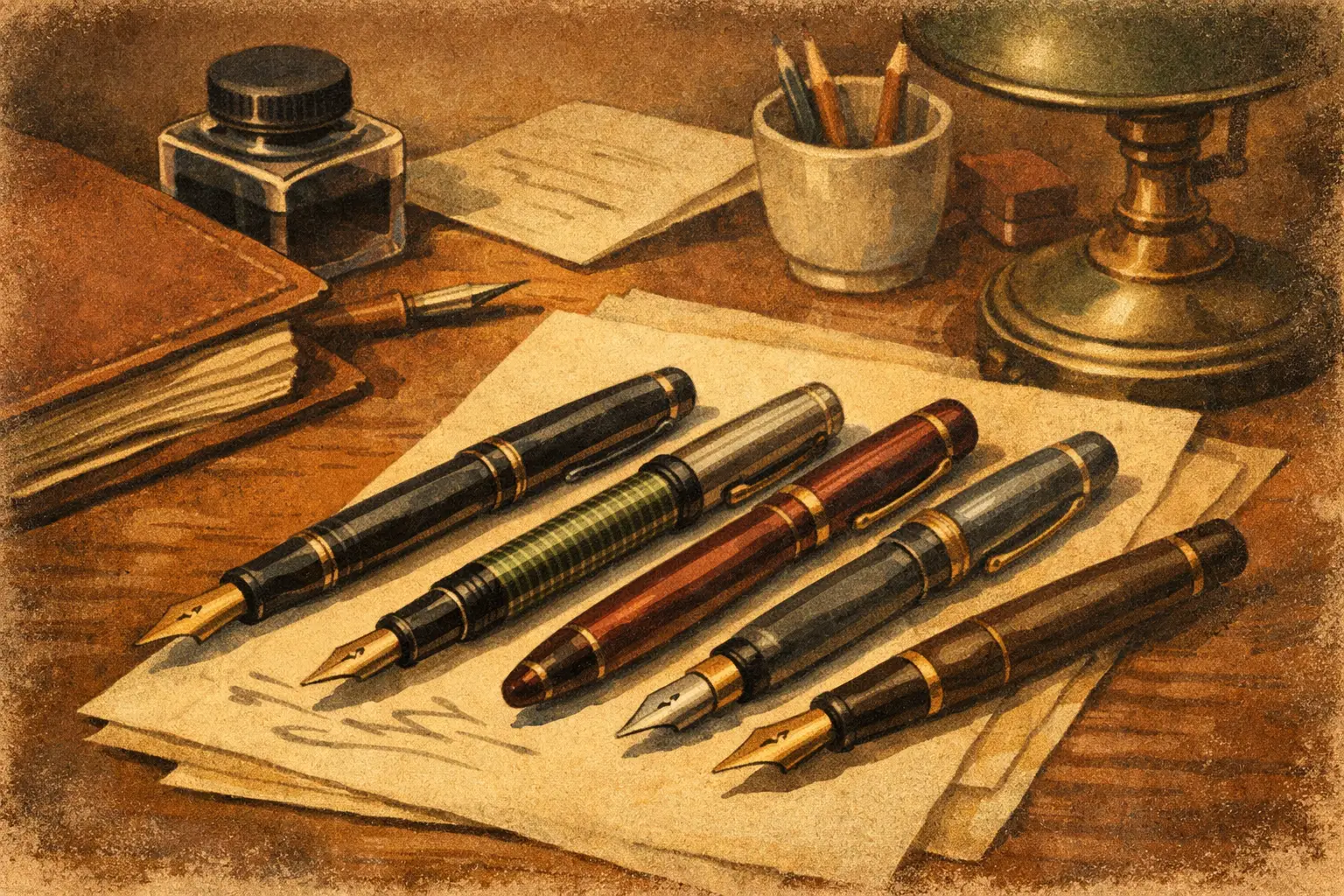
A beautiful vintage pen should not be condemned to a display case. The best vintage pens for daily writing combine a comfortable balance, a dependable filling system and a nib that is pleasant across page after page. Age alone is not a recommendation: a 1930s flex pen may be a thrilling specialist tool, while a well-restored 1950s workhorse can become the pen that leaves the desk with you every morning.
For regular use, condition matters as much as the model. Fresh sacs, sound seals, correctly adjusted feeds and a properly aligned nib turn a historic instrument into a practical companion. The following pens have earned their reputations not only through design and collectability, but because they can still make ordinary handwriting feel rather special.
What makes a vintage pen suitable for daily writing?
A daily writer needs to be easy to fill, comfortable to hold and tolerant of normal modern inks. It should start promptly after a capped pause, put down a consistent line and have a cap that seals well enough to prevent the nib drying out during the working day. A firm or moderately soft fine, medium or broad nib is generally more useful for notes, correspondence and journals than a highly flexible nib designed for deliberate copperplate work.
Filling systems deserve careful consideration. Lever-fillers are straightforward once fitted with a new sac, while piston-fillers offer generous ink capacity and are satisfying to use. Aerometric systems are famously forgiving. More elaborate mechanisms can be excellent, but they add parts and servicing considerations. For a first vintage daily pen, simplicity is often an advantage.
It also pays to buy from a specialist who describes restoration clearly. A pen can look immaculate while concealing a hardened sac, worn seals or a nib that has been poorly straightened. Heritage Collectables focuses on restored instruments because usability is central to the pleasure of owning them.
7 best vintage pens for daily writing
Parker 51
The Parker 51 is the obvious starting point, and for good reason. Introduced in the 1940s, its hooded nib, collector feed and durable construction were conceived for practical, frequent use. It remains one of the least fussy vintage fountain pens to carry, particularly in its aerometric form.
The nib is usually firm and smooth, making it well suited to quick notes and business writing. Its understated styling is another advantage: a black, burgundy or grey Parker 51 looks entirely at home in a modern meeting room. The trade-off is character. Writers seeking dramatic line variation may find it restrained, but as a dependable everyday pen it is exceptionally hard to surpass.
Pelikan 400 and 400NN
Vintage Pelikan 400 and 400NN models bring a different sort of pleasure. Their piston filling systems hold a useful amount of ink, their green-striped barrels are instantly recognisable, and their screw-in nib units make them especially appealing to enthusiasts who enjoy changing writing widths.
Many examples have responsive semi-flexible nibs. This does not mean they demand calligraphic technique; a fine or medium Pelikan nib can be a delightful everyday writer with a little natural expression. Choose with care if you write heavily or press firmly, as a softer nib rewards a lighter hand. A properly serviced piston is essential, and should operate smoothly without stiffness or leakage.
Sheaffer Balance
The Sheaffer Balance is one of the great pre-war writing pens. Its rounded, tapered silhouette sits comfortably in the hand, and its lever-filling mechanism is uncomplicated when restored with a good sac. Balances were made in a wide range of sizes and materials, from modest black celluloid to wonderfully patterned striped finishes.
For daily use, seek a sound example with a firm Lifetime-style nib or a conventional Sheaffer fine or medium. These nibs often offer a controlled, slightly yielding feel rather than dramatic flex. The main consideration is cap condition: celluloid can shrink over decades, so the cap should fit securely and the threads should be inspected before purchase.
Waterman 52
A Waterman 52 is a landmark choice for anyone who wants handwriting with personality. Its lever-filling system is familiar, and its hard-rubber construction has a tactile warmth that later plastics rarely match. Many carry flexible gold nibs capable of moving from a fine line to something much broader.
That flexibility is also why the 52 is not automatically the right daily pen for every writer. It is superb for letters, journalling and expressive notes, but a wet flex nib can be less convenient on cheap office paper or when writing at speed. Select a firmer example if you want a Waterman for routine use, and keep a gentle touch. A faded or oxidised hard-rubber finish is a cosmetic question, not necessarily a functional one, but it should be honestly reflected in the price.
Conway Stewart 58
For a distinctly British daily writer, the Conway Stewart 58 deserves close attention. Made in the post-war period, it has a well-proportioned body, attractive marbled finishes and a practical lever-fill arrangement. Its broad cap band and classic shape give it presence without making it cumbersome.
The 58 is an especially good choice for someone who enjoys a slightly larger pen. Nibs vary, so it is worth choosing the writing grade rather than buying solely for the colour of the celluloid. A restored medium nib offers an agreeable balance for everyday correspondence, while a fine nib is better for smaller handwriting. As with any celluloid pen, avoid prolonged heat and direct sunlight.
Aurora 88
The original Aurora 88 is one of the most capable vintage pens for serious daily mileage. Its hooded gold nib and piston mechanism place it in the same practical conversation as the Parker 51, yet its Italian design has a character all its own. The metal cap and streamlined body make it feel purposeful rather than precious.
An 88 can be ideal for writers who need a fine, controlled line and a substantial ink supply. It is not as straightforward to service as a simple lever-filler, so the quality of restoration is particularly important. Once correctly overhauled, however, it is a refined and unusually capable vintage work pen.
Montblanc 24 and 32
Vintage Montblanc need not mean choosing only the most expensive collectible models. The 24 and 32 series from the 1950s and 1960s offer a more restrained route into the marque, with piston filling, practical hooded or semi-hooded nibs, and elegant but unfussy styling.
These pens often suit daily writers who prefer a lighter instrument and a clean, precise line. Their appeal lies in discretion rather than ornament. Check the piston operation, cap fit and clarity of the ink window where present. A well-restored example is a capable pen for everyday notes, particularly for those who prefer a European fine or medium nib.
Choosing the right nib and condition
The model name can guide a purchase, but the individual nib should make the final decision. Fine nibs suit diaries, margin notes and compact handwriting. Medium nibs are the most versatile choice for letters and general work. Broad and italic nibs offer visual flair, although they use more ink and can expose the limitations of inexpensive paper.
Ask whether the nib is firm, soft or flexible, and whether it has been tested with ink. A nib that feels pleasantly smooth should not be so highly polished that it skips or loses control. Equally, a little feedback is not a fault. Many vintage nibs provide a light, communicative sensation that gives handwriting its rhythm.
Restoration should extend beyond cosmetic cleaning. A trustworthy daily pen needs a sound ink system, secure cap, usable threads, correct nib alignment and a feed that delivers ink consistently. Originality has value to collectors, but a replacement sac or renewed seal is not a compromise when it allows the pen to function as intended.
Keep a vintage daily writer in good order
Use a fountain pen ink that is straightforward to clean, rather than heavily saturated, permanent or shimmering ink. Flush the pen when changing colours and whenever it will be left unused for a while. If a pen is a lever-filler or piston-filler, do not force the mechanism. Resistance is a reason to seek professional attention, not an invitation to apply more pressure.
A pen case is useful when travelling, especially for celluloid models and pens with gold-filled trim. Keep hard-rubber pens away from sunlight, and never soak a vintage pen indiscriminately: water can damage old plating, casein, ink windows and internal components. Sensible care is modest, but it protects both writing performance and long-term value.
The right vintage pen becomes more familiar with use. Choose one whose nib suits your hand, whose mechanism has been properly restored and whose history you enjoy carrying. Then fill it, write with it often and allow a fine old instrument to do the job it was made for.
Looking for one? Browse our fully restored vintage fountain pens – all restored in our workshop and ready to write.
One thought on “Best Vintage Pens for Daily Writing Reviewed”