
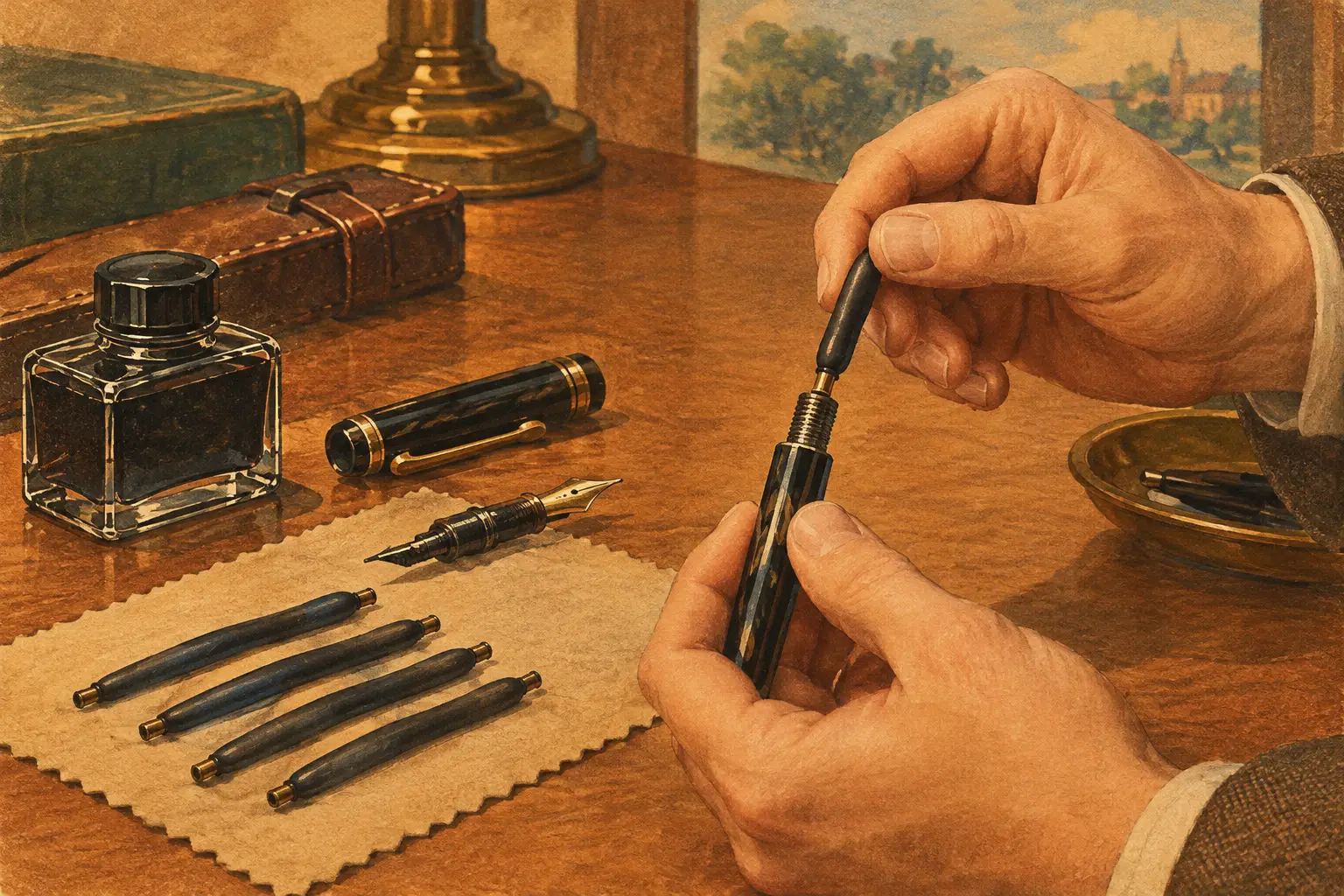
A vintage fountain pen can look immaculate, have a fine original nib and still be unusable because of one small, hidden component. Fountain pen sacs replacement is often the key to returning a lever-filler, button-filler or similar classic pen to dependable service. Done properly, it preserves the pleasure of using a historic instrument. Done carelessly, it can lead to leaks, poor filling, damaged trim or a sac that fails far sooner than it should.
For collectors, the aim is not merely to fit a new rubber tube. It is to respect the pen’s filling system, select the right material and size, and leave the instrument clean, sound and ready to write.
When does a fountain pen need a new sac?
Most original sacs were made from rubber. Rubber ages even when a pen spends decades in a drawer: it hardens, becomes brittle, shrinks or turns into a sticky deposit inside the barrel. A pen may have been kept carefully and still require attention after many years.
The clearest sign is a pen that will not draw ink, or which draws a little ink and immediately loses it. Ink appearing around the section joint or lever area is another warning. Sometimes a lever feels unusually stiff because the old sac has set hard around the pressure bar. Forcing it is never wise. A bent pressure bar or cracked barrel can turn a straightforward restoration into a much more involved repair.
A loose rattle from inside the barrel may be fragments of a perished sac. Equally, a pen may appear to fill but write dry after a few lines because the sac cannot hold a proper supply. These symptoms are common in vintage Conway Stewart, Waterman, Swan, Esterbrook, Burnham and many other sac-filled pens, although the precise construction varies between makes and periods.
Not every vintage fountain pen uses a sac. A Parker Vacumatic, for example, has a diaphragm rather than a conventional sac, while piston-fillers such as many Pelikans have a different mechanism entirely. Before any work begins, the filling system must be identified. The wrong approach can damage original parts and compromise both value and usability.
Fountain pen sacs replacement begins with diagnosis
A proper assessment starts at the section, where the sac is attached to the nipple inside the barrel. On many pens the section is friction-fit; on others it may be threaded, sealed with old shellac, or held in a way that makes removal risky. Heat, patience and experience are often more useful than force.
Once the section is safely removed, the restorer can inspect the old sac, pressure bar, lever box and interior of the barrel. Old rubber residue needs to be removed thoroughly. Leaving fragments behind can obstruct the new sac, interfere with the pressure bar or contaminate fresh ink.
This is also the moment to inspect for faults that a new sac alone cannot cure. A corroded pressure bar may need replacement. A loose lever box, worn button mechanism, cracked section nipple or barrel fracture needs separate attention. A fresh sac in a pen with an underlying mechanical fault may give a brief impression of success, then leak or fail during ordinary use.
There is a collector consideration here, too. Original internal components are worth retaining where they remain functional and safe. Where replacement is necessary, the part should suit the pen rather than simply be convenient. Good restoration supports originality where possible, but it should never leave a pen unreliable for the sake of claiming that every hidden part is untouched.
Choosing the correct sac material and size
Latex remains the traditional choice for many vintage pens. It is flexible, widely suitable and gives an authentic feel to the filling action. For a regularly used vintage pen, a quality latex sac is often the sensible option, provided the owner avoids inks that are known to be troublesome with natural rubber.
Silicone sacs offer useful resistance to some inks and can be a good choice in appropriate pens. However, they are not an automatic upgrade. Silicone behaves differently from latex and may not work well with every pressure-bar arrangement or internal profile. It can also be more difficult to secure in certain applications. The right material depends on the individual pen, its filling system and how it will be used.
Size matters just as much. A sac that is too narrow will hold little ink and may not respond efficiently to the pressure bar. One that is too wide can bunch inside the barrel, rub against internal parts or split when compressed. The ideal sac fits securely over the section nipple and sits comfortably in the barrel without strain.
This is why measuring the barrel alone is not enough. The nipple diameter, the available barrel space and the design of the filling mechanism all influence the choice. On a slender vintage pen, a fraction of a millimetre can make a meaningful difference. A restorer also considers sac length: it should maximise capacity without fouling a button, pressure bar or blind cap mechanism.
The restoration process: care before speed
After cleaning and inspection, the new sac is test-fitted and trimmed. It is then attached to the section nipple using an appropriate adhesive, traditionally shellac for many conventional latex-sac repairs. The adhesive must be used sparingly and allowed to cure properly. Too much can make future servicing unnecessarily difficult; too little can allow the sac to detach in use.
The pen is then reassembled with care. This stage can expose problems that were not obvious during disassembly, especially on pens with delicate celluloid barrels, plated trim or aged hard rubber components. Vintage materials can be unforgiving, and a repair should never be rushed to meet an arbitrary timetable.
Testing is more than filling the pen once. A restored sac-filled pen should be filled and emptied repeatedly, checked for leakage around the section and lever, and left inked long enough to confirm that the seal remains sound. The nib and feed should also be assessed. A pen that fills perfectly but has a blocked feed, misaligned nib or poor cap seal has not yet been fully returned to useful condition.
At Heritage Collectables, this attention to the complete writing instrument is central to restoration. A vintage pen should be more than attractive in a display case. It should offer the confidence to be filled, carried and enjoyed.
Can you replace a fountain pen sac yourself?
For an enthusiast with a sound understanding of basic lever-fillers, the correct tools and a willingness to practise on modest pens, sac replacement can be a rewarding part of the hobby. It encourages a closer appreciation of how these elegant mechanisms were made. It also teaches an important lesson: even apparently simple pens can conceal awkward repairs.
A straightforward pen with an accessible section and no structural faults is very different from a scarce early Waterman, a delicate chased hard-rubber model or a valuable celluloid Conway Stewart. If the section will not move easily, the barrel shows cracking, the lever is loose, or the pen has unusual filling hardware, professional attention is usually the better investment.
The trade-off is clear. Home repair may save money on a common user-grade pen, but an incorrect repair can reduce the value of a collectible example or make a later restoration more difficult. Specialist work costs more because it includes diagnosis, careful disassembly, suitable materials and testing, not just the fitting of a sac.
Looking after a newly sacced pen
Once restored, a sac-filled pen benefits from regular, sensible use. Do not leave old ink to dry inside it for years, and flush the pen with clean water when changing colours or before storing it. Choose fountain pen ink rather than drawing ink, calligraphy ink or pigmented products not intended for conventional fountain pens.
If a pen will be stored for a prolonged period, empty and clean it first. Keep it away from strong heat and direct sunlight, both of which can be hard on vintage plastics, rubber and finishes. Should the filling action become stiff or the pen begin to lose ink unexpectedly, stop using it until the cause is understood.
A correctly chosen sac is a discreet repair, but its effect is immediate: a historic pen becomes a living writing instrument again. Whether the pen is a cherished family piece or a newly acquired collectible, give the restoration the care it deserves, then let the nib do what it was made to do.