
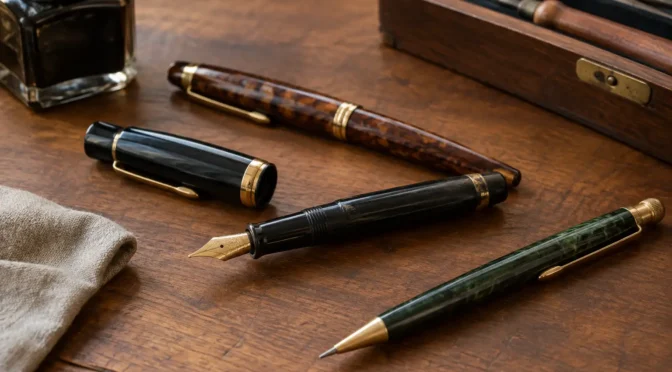
A vintage fountain pen can look immaculate and still be unfit to write with. A sac may have hardened inside the barrel, a diaphragm may have failed without leaving an obvious trace, or old ink may have quietly blocked the feed. Proper pen repairs are not a cosmetic exercise. They return a historic instrument to dependable use while preserving the materials, proportions and character that made it worth keeping.
For collectors, this distinction matters. A bright new plating job, an incorrect replacement part or an aggressively polished barrel may make a pen appear tidier at first glance, yet reduce its originality and appeal. The best restoration is often the least conspicuous one: a pen that fills properly, writes confidently and still looks unmistakably like the survivor of its own period.
Why vintage pen repairs need specialist judgement
Vintage pens are not one mechanical category. A 1930s Parker Vacumatic, a Waterman lever-filler, a Conway Stewart button-filler and a Sheaffer snorkel each use a different filling system, different materials and different practical solutions. Treating them all as a straightforward clean-and-replace job risks damage that cannot easily be undone.
Celluloid, early plastics, hard rubber, plated trim and ebonite feeds all age differently. Celluloid can discolour or become brittle. Hard rubber oxidises when exposed to unsuitable polishing methods. Old plated furniture can be thinned by over-cleaning. Even a cap lip that appears sound may be under strain after decades of use. A specialist assesses the pen as an object before deciding what work is appropriate.
There is also a question of purpose. A collector may want a scarce model stabilised and sympathetically serviced, with original components retained wherever possible. Someone buying a pen to use every day may reasonably prioritise a reliable filling system and a smooth, correctly adjusted nib. Neither approach is inherently better, but the repair should match the pen and its next owner.
Pen repairs begin with the filling system
The filling mechanism is usually where a vintage fountain pen reveals its true condition. It is also the area where the wrong repair can cause the greatest disappointment.
Lever-fillers and button-fillers
Waterman, Conway Stewart and many other classic makers used rubber ink sacs. These components have a limited life, even when a pen has spent years unused in a drawer. A perished sac can turn hard, split, or adhere to the inside of the barrel. Replacing it involves more than selecting a similar-looking piece of rubber. The sac must be correctly sized for the barrel and pressure bar, fitted cleanly and tested without putting stress on fragile parts.
In a button-filler, the pressure bar and button assembly also deserve attention. Corrosion, distortion or a loose button can prevent a new sac from working as intended. A proper service considers the mechanism as a whole, rather than treating the sac as an isolated consumable.
Parker Vacumatics and other diaphragm pens
Parker Vacumatics are admired for their striped celluloid and ingenious filling system, but their repair demands precision. The diaphragm must be installed correctly, the breather tube checked and the filling unit reassembled without compromising the barrel or thread area. A Vacumatic that fills only partially, releases ink unpredictably or shows residue around the filler needs investigation rather than force.
The same principle applies to pens using diaphragms, pistons and other internal seals. Parts may be obtainable, but availability does not make installation routine. A repair is successful only when the pen fills, retains ink and empties as it should.
Sheaffer Touchdown, Snorkel and plunger mechanisms
Sheaffer developed several excellent but more complex filling systems. Touchdown and Snorkel pens combine seals, sacs and metal tubing in a compact arrangement. A Snorkel that will not extend, or one that draws little ink, may have multiple age-related faults rather than one obvious failure.
These are rewarding pens to put back into service, but they are not sensible candidates for improvised work. An incorrectly fitted seal or damaged tube can turn a serviceable pen into a much larger restoration project. For desirable examples, careful specialist pen repairs protect both usability and collector confidence.
The nib and feed are a writing system
A beautiful barrel means little if the pen will not write well. Yet nib work should never start with the assumption that every vintage nib ought to feel like a modern, rigid fine point.
Many older Waterman, Parker, Swan and Conway Stewart nibs were made to offer spring, line variation or a softer response than a contemporary everyday pen. Their character is part of the appeal. A skilled adjustment can address misaligned tines, restricted flow, poor starting or an uncomfortable writing angle while retaining that original feel.
Feeds require equally careful attention. Dried ink can obstruct the channels that regulate flow, and a feed that has been distorted or wrongly seated can make a sound nib seem faulty. Cleaning, alignment and flow adjustment must work together. Simply smoothing the tipping without identifying the cause of poor ink delivery may disguise the problem for only a few lines of writing.
There are limits. Cracked nibs, missing tipping material and serious corrosion may call for a more involved repair or an honest decision to preserve the pen rather than return it to daily use. A replacement nib can be appropriate, particularly on a user-grade pen, but an original matched nib is normally preferable where condition allows.
Originality, replacement parts and honest restoration
Vintage pen restoration is often a balance between originality and practical function. A new sac or diaphragm is expected, because these are service components. A replacement clip, cap band or nib raises a different question: is the substitute period-correct, correctly fitted and clearly represented?
For a common working pen, a sympathetic replacement part can make the difference between a drawer ornament and a useful writing instrument. For a scarce model, originality may carry more weight, even if that means accepting some cosmetic wear. Collectors generally value accurate description and intelligent restraint over a misleadingly pristine finish.
This is why provenance within a repair matters. A properly restored pen should not be presented as untouched. It should be described as serviced or restored, with its working condition and notable replacement components made clear. That transparency lets buyers judge the piece on its real merits.
When a pen should be repaired, not merely cleaned
A flush can remove old ink, but it cannot cure a degraded sac, a loose section, a failing piston seal or a misaligned nib. Warning signs include a pen that will not draw ink, ink appearing around the lever or section, an uneven or scratchy writing line, persistent hard starts and a cap that no longer secures properly.
Equally, do not assume every mark needs intervention. Light brassing, small surface marks and a little patina often belong to a pen’s story. Attempting to erase them can do more harm than good. The aim is not to make every vintage pen look new. It is to make informed choices about what should be preserved, what must be repaired and what should be left alone.
At Heritage Collectables, restored writing instruments are selected for people who want both history and dependable use. That means respecting the practical details hidden inside the barrel as much as the colour, pattern and maker’s imprint visible on the outside.
Choosing a restored vintage pen with confidence
When considering a restored pen, ask what work has been carried out and whether the filling system has been tested. Look for clear information about the nib, the material condition and any replacement components. A seller who can identify the model, explain its mechanism and describe its restoration gives you a much sounder basis for buying than one relying on polished photographs alone.
It is also worth matching the instrument to how you write. A flexible Waterman may suit deliberate correspondence and expressive handwriting. A Parker 51 may be the more practical choice for regular notes. A slim Conway Stewart can be charming, but not ideal for every hand. Restoration can make a pen functional; it cannot change the essential design that defines its writing experience.
The reward for choosing carefully is a pen with a second working life. Fill it with a suitable fountain pen ink, use it with reasonable care, and let the restored mechanism do what it was designed to do: turn a small piece of writing history into a personal instrument once again.