
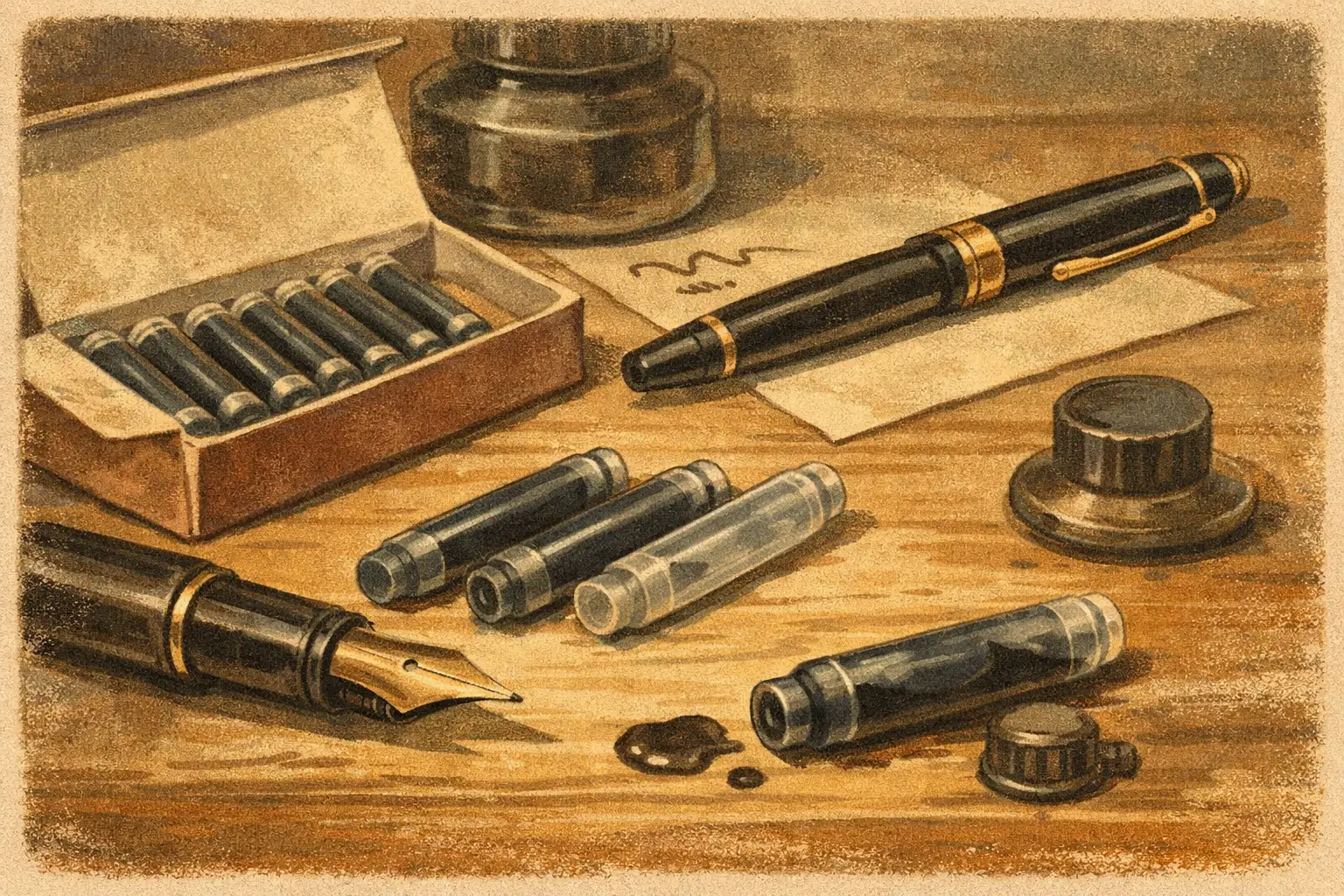
A fountain pen that refuses the wrong cartridge can be every bit as frustrating as a misaligned nib. One looks simple enough, yet there is a surprising amount to know before you press a cartridge into the section and hope for the best. If you have ever wondered why one cartridge fits perfectly while another will not seat at all, this guide to fountain pen cartridges explained will save guesswork, protect good pens, and make buying ink rather easier.
For many writers, cartridges are the quickest route to getting a pen on the page. For collectors and vintage pen enthusiasts, the subject is a little more nuanced. Some pens were designed long before disposable cartridges became common, some later models take proprietary fittings, and some modern pens offer both cartridge and converter filling. The detail matters because the wrong choice can lead to leaks, poor flow, or needless strain on an older pen.
Fountain pen cartridges explained: what they actually are
At heart, a fountain pen cartridge is a sealed plastic tube containing ink. One end is closed by a small membrane or ball that is pierced when the cartridge is pushed into the pen’s feed assembly. Once opened, ink travels through the feed to the nib by capillary action.
That sounds straightforward, and in principle it is. The complication lies in size, opening shape, length, and brand-specific design. Unlike a pencil lead or a standard notebook refill, fountain pen cartridges are not universally interchangeable. Two cartridges may look broadly similar on a desk yet differ just enough to make them incompatible.
Cartridges became popular because they offered convenience. They are clean, portable, and easy to replace when travelling or at work. They also remove some of the hesitation newer users feel around bottled ink. For regular writers, that convenience is real. For collectors, the trade-off is that cartridge systems often reflect a specific era of pen design rather than the broader, repairable engineering seen in earlier lever-fillers, button-fillers or piston-fillers.
The main cartridge types you will encounter
The most common modern format is the international cartridge, often called standard international. This design is used by many manufacturers, particularly across Europe, and it comes in short and long versions. A pen that accepts standard international cartridges will usually also accept a compatible converter, which makes it flexible for everyday use.
Then there are proprietary cartridges. Parker, Sheaffer, Lamy, Pilot, Platinum and Sailor are among the brands known for using their own cartridge shapes or fittings. In practical terms, this means you should buy by pen brand and model, not by visual similarity. A cartridge that almost fits is not good enough.
Length matters too. Some pens will take only short cartridges because the barrel is not long enough for a full-length version. Others will accept either one long cartridge or two short ones, depending on the design. This is particularly relevant when buying for slim pens, compact pens, or certain vintage cartridge models where internal space is limited.
Why compatibility is where most mistakes happen
The biggest misunderstanding is assuming that all cartridges are more or less standard. They are not. Even among modern pens, tolerances can vary, and with vintage pens there is an added layer of uncertainty because older cartridge systems may have been discontinued entirely.
If you are dealing with a vintage fountain pen, caution is sensible. Some vintage cartridge pens were built around now-obsolete formats that are no longer manufactured. Others may have been adapted over the years, especially if previous owners have replaced sections or nib units. A collector-grade pen deserves a proper identification before anything is forced into place.
This is one reason specialist sellers matter. With restored pens, especially from established makers, it helps enormously to know whether a pen is a true cartridge model, a cartridge-converter pen, or something designed for a completely different filling system. Guessing from photographs alone is not always enough.
Standard international versus proprietary
Standard international cartridges are convenient because they are widely available in a good range of colours and brands. If your pen accepts them, you have options. Proprietary cartridges can still be excellent, but they narrow the field. That is not necessarily a problem if you like a brand’s own inks. It becomes a problem when availability is patchy or when you are trying to match an older pen to a modern supply.
Vintage pens and obsolete cartridges
This is where fountain pen cartridges explained becomes especially useful for collectors. Some vintage cartridge pens were made during transitional periods when manufacturers were experimenting with convenience filling. Those cartridges may now be scarce, expensive, or absent from the market altogether. In some cases a converter or modern substitute exists. In other cases, it does not. That is not a flaw in the pen – it is simply part of the historical reality of collecting.
Cartridges versus bottled ink
For practical use, cartridges win on simplicity. You pop one in, wait for the feed to saturate, and start writing. There is no bottle to spill on a hotel desk and no filling routine to master. If you carry a pen for meetings, correspondence, or everyday notes, that ease has obvious appeal.
Bottled ink, however, gives you a far wider choice of colours and often better value over time. It also feels more in keeping with many vintage pens, most of which were never meant to use cartridges at all. If your pen accepts a converter, bottled ink may offer the best balance: the convenience of a cartridge-compatible pen with the versatility of traditional ink filling.
The choice depends on how you use the pen. A daily writer who values speed and cleanliness may prefer cartridges. A collector or enthusiast interested in period-correct use, broader ink selection, or the ritual of filling may prefer bottles. Neither is inherently superior. The right answer is usually the one that suits the pen and its owner.
Are cartridges suitable for vintage fountain pens?
Often, no – and this is worth stating plainly. Many of the finest vintage fountain pens from Parker, Waterman, Conway Stewart, Sheaffer, Pelikan and others pre-date cartridge systems or use entirely different filling mechanisms. Lever-fillers, piston-fillers, vacumatic systems and button-fillers all require bottled ink.
Where a vintage pen does take cartridges, the next question is whether it should be used regularly with them. If the pen was designed for cartridges and has been properly restored, there is usually no issue in principle. The concern is compatibility, age of materials, and availability of the correct cartridge. A brittle section or an uncertain fit is not something to test by force.
This is where expert restoration and accurate cataloguing become especially valuable. At Heritage Collectables, we see first-hand that buyers want pens which are not only attractive and historically interesting, but ready to use with confidence. That confidence starts with understanding the filling system.
How to identify the right cartridge for your pen
Start with the brand and exact model, then the approximate era. If you know a pen is modern and takes cartridges, the answer is often straightforward. If it is vintage, identification becomes more important.
Look at the section where the cartridge connects. The opening shape and diameter are clues, but they should support identification, not replace it. If the pen came with an old empty cartridge or converter, that can help, though older plastics may have changed shape slightly with age.
If you are buying for a pen not yet in hand, ask the seller directly what the pen takes. A proper specialist should be able to tell you whether it uses standard international cartridges, a proprietary fitting, a converter, or bottled ink only. That is far better than ordering several packs and hoping one works.
Common cartridge problems
A new cartridge may seem dry at first. That is usually normal. Ink needs a little time to move through the feed, particularly if the pen has been cleaned and dried beforehand. Gentle patience is better than shaking the pen aggressively.
Leaks are more often caused by poor fit than by a faulty cartridge. If the cartridge is loose, not fully seated, or simply the wrong type, ink can escape into the barrel or section. The same applies if the pen is damaged.
Poor flow can also come from ink choice, old residue in the feed, or an air exchange problem rather than the cartridge itself. This is why cartridge diagnosis should never be isolated from the condition of the pen as a whole.
When cartridges make the most sense
Cartridges are especially useful for modern pens used on the move, for occasional writers who do not want an open ink bottle on the desk, and for anyone easing into fountain pens for the first time. They are also practical as a backup even if you normally use bottled ink and a converter.
For collectors, cartridges make sense when they are correct for the model and easy to source. They make less sense when they push you towards improvised solutions for a pen that was never designed around them. Good collecting is partly about restraint. Not every pen needs to be made to fit modern convenience.
The best approach is simple: match the filling method to the pen, respect the engineering, and buy with clarity rather than assumption. Once you understand the system, cartridges stop being a mystery and become what they ought to be – a useful option, not a gamble. If you are choosing a fountain pen with long-term enjoyment in mind, the smartest purchase is always the one whose filling system you fully understand before the first page is written.