
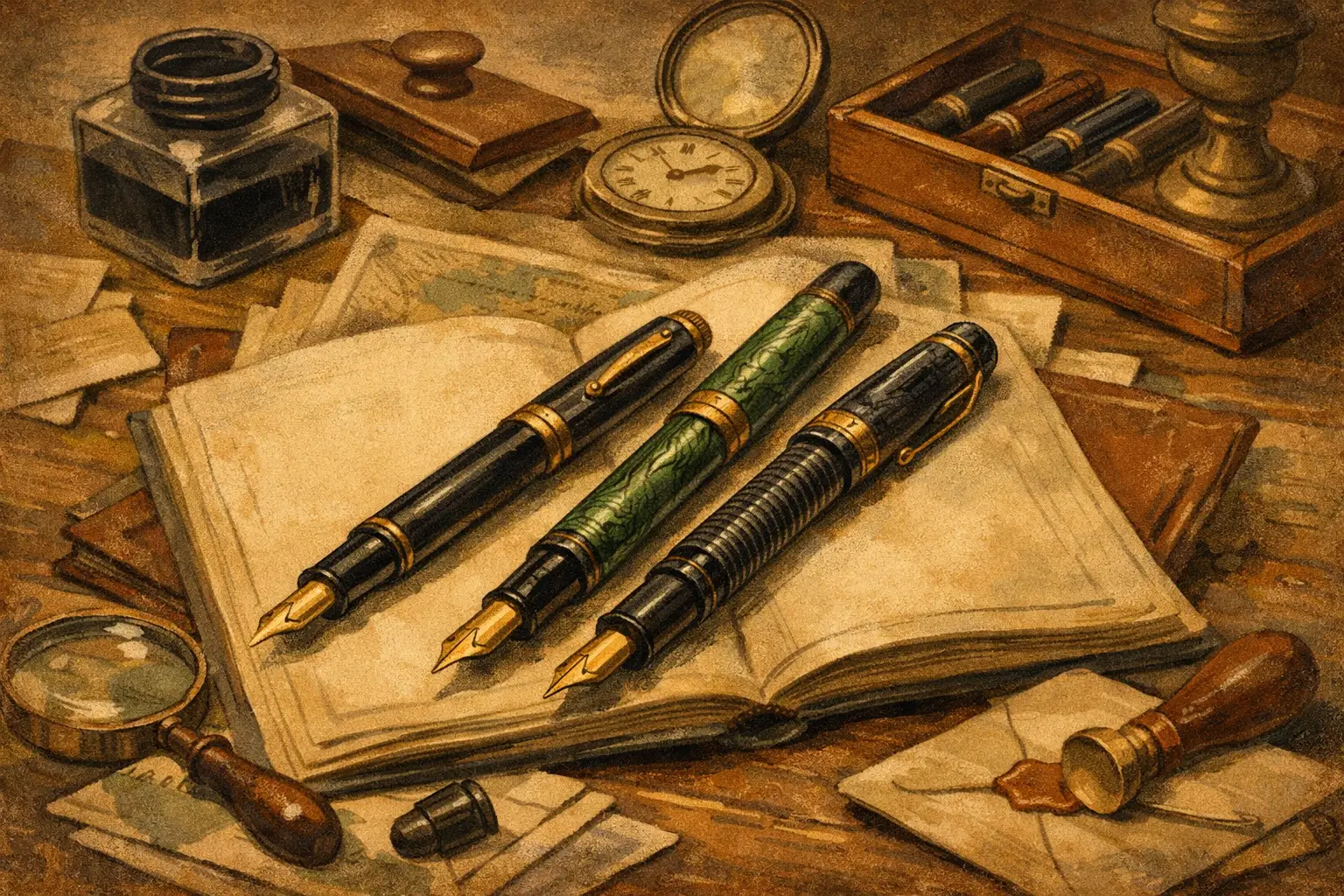
The first vintage pen you buy tends to set the tone for everything that follows. It might be a Parker with a lovely chased barrel, a Conway Stewart in a colour you have never quite forgotten, or a Waterman that writes far better than many modern pens. A good vintage pen collecting guide should help you enjoy that first purchase without making expensive mistakes, and just as importantly, it should help you recognise when a pen is worth collecting, using, or passing by.
Collecting vintage pens sits at an unusual and satisfying crossroads. These are historical objects, but they are also tools. A pen can have the right imprint, the right nib, and the right date range, yet still be a poor buy if the restoration is careless or the mechanism is tired. Equally, a modest model in excellent restored condition can offer more pleasure than a rarer pen that spends its life in a drawer because it is too fragile or temperamental to trust.
A vintage pen collecting guide starts with focus
New collectors often begin by buying whatever catches the eye. There is nothing wrong with that, but the collection usually becomes stronger once you decide what you actually want to pursue. Some collectors are brand-led and concentrate on Parker, Sheaffer, Waterman, Pelikan or Montblanc. Others collect by filling system, so lever-fillers, button-fillers, piston-fillers or safety pens become the thread that ties the cabinet together.
There is also a case for collecting by period or by country. British makers such as Conway Stewart, Burnham and Onoto appeal to those who enjoy domestic manufacturing history, while American and German pens often attract buyers interested in design development and engineering. If your interest leans more towards use than rarity, then nib character may matter more than model hierarchy. A flexible writer with a wonderful line variation can be more rewarding than a top-tier pen fitted with a rigid nib.
That early decision matters because it shapes how you judge value. If you are collecting for daily writing, restoration quality and nib performance should sit near the top of your list. If you are building a display-led collection, originality may carry more weight, even when that means accepting honest wear.
Which vintage pens are worth collecting?
The short answer is that many are, but not all for the same reasons. Some models are collected because they are historically significant. Others because they are scarce, mechanically interesting, beautifully made, or simply dependable writers. The market does not always reward those qualities equally.
Parker remains one of the easiest entry points because the brand offers depth across price levels. A Duofold can be a serious collector’s piece, while a well-restored Parker 51 gives practical reliability and enduring style. Sheaffer attracts collectors who appreciate clever filling systems and distinctive nib design. Waterman holds particular appeal for those who value earlier hard rubber pens and expressive nibs. Conway Stewart draws collectors who love British colourways and classic form. Pelikan and Montblanc often sit at the more premium end, though condition and originality still decide whether the price is justified.
The better question is not only which pens are worth collecting, but why you want to collect them. A pen worth owning for regular use is not always the same as a pen worth chasing for investment or rarity. Some highly collectible pens are expensive because they are scarce, not because they are better writers.
Condition, originality and restoration
This is where many collections improve or fall apart. In vintage pens, condition is never a simple matter of shiny versus worn. You need to look at the whole pen as an object and as a mechanism.
A crisp imprint is usually a good sign because it suggests the pen has not been heavily polished. Cracks, cap lip damage, barrel distortion, missing trim, deep tooth marks and replacement parts all affect desirability, though the degree matters. Light brassing on trim may be acceptable on a user-grade pen. A hairline crack in the cap is a different matter altogether.
Restoration deserves particular care. A vintage pen should not merely look presentable. It should be properly serviced, with the filling system repaired as required and the nib aligned and tested where appropriate. A lever-filler with a perished sac, a piston-filler with dried seals, or a button-filler with a failing pressure bar may look fine in photographs and disappoint as soon as ink goes near it.
Originality also has trade-offs. Collectors often prefer original clips, nibs and trim, but a sympathetically restored pen with sound working parts may offer far more real enjoyment than an untouched example that cannot safely be used. For many buyers, especially those who intend to write with their pens, expert restoration is not a compromise. It is the reason the pen is worth buying.
How to buy without overpaying
A practical vintage pen collecting guide has to address the market as it really is. Prices can vary sharply for the same model depending on colour, nib grade, trim variation, country of manufacture, condition and seller credibility. Provenance and presentation also play a part, though less than some buyers assume.
The safest way to avoid overpaying is to compare like with like. A restored pen from a specialist dealer should cost more than an untested attic find, because the risk is lower and the pen is ready to use. That extra cost is often money well spent. Buyers sometimes focus on headline price and overlook what they may later need to spend on repairs, replacement parts or nib work.
Ask sensible questions. Has the pen been restored or merely cleaned? Does the filling system function properly? Is the nib original to the pen? Are there cracks, chips, dents or personalised engravings? Has the pen been tested with ink or only dipped? Reassuring answers should be specific, not vague.
This is also where dealing with a specialist can make a marked difference. A retailer such as Heritage Collectables is built around restored stock and category depth, which gives buyers a clearer basis for comparing pens by brand, era and condition than they are likely to find in a general antiques setting.
Storage, use and care for a growing collection
Collectors sometimes separate pens into two camps too rigidly: those for display and those for use. In reality, many vintage pens can do both if handled properly. The key is to match the pen to the role.
If a pen is especially rare, brittle, or fitted with delicate materials, it may be better as a cabinet piece. If it is a sound, properly restored fountain pen with a reliable filling system, regular use is not abuse. Pens were made to write. In fact, sensible use often helps you understand a collection more deeply than display alone.
Storage should be dry, stable and away from extremes of heat or direct sunlight. Hard rubber can discolour, celluloid can be sensitive, and plated trim does not benefit from rough handling. Keep pens clean, avoid leaving ink to dry out inside them, and be cautious with highly saturated or specialist inks if the pen is older or more temperamental.
Cases, trays and racks all have their place, but overcrowding is a common mistake. A collection is easier to enjoy and preserve when each piece can be removed, examined and returned without rubbing against the next.
Common mistakes new collectors make
The most common error is buying on appearance alone. Photographs can flatter polish, hide repairs and tell you nothing about how the pen feels in the hand. The second is chasing rarity before learning the basics. An uncommon model is not automatically a good purchase.
Another mistake is ignoring nibs. The nib is not a detail. It is central to both value and enjoyment. A pen with a damaged, over-polished or ill-suited nib can be far less satisfying than a more ordinary model with a superb original point. New collectors also tend to underestimate the importance of seller knowledge. In this field, expertise is part of the product.
Finally, do not build a collection so quickly that you have no time to learn from what you buy. A handful of well-chosen pens teaches more than a drawer full of compromises.
Building a collection that lasts
The strongest collections usually have some internal logic, even if it only becomes clear over time. You may begin with a single favourite brand and later notice that your real interest is pre-war British pens, marbled celluloid, or flexible nibs. Let the collection sharpen your eye.
There is room here for both scholarship and pleasure. Some buyers keep careful records of model numbers, dates and restoration notes. Others remember a pen because of its balance, its nib, or the way the barrel catches the light. Both approaches are valid. What matters is that you buy with care, use judgement rather than impulse, and choose pens from sellers who understand what they are offering.
The best collections are not always the largest or the most expensive. They are the ones assembled with patience, curiosity and respect for the craft that made these instruments worth saving in the first place. If you keep that standard in view, the next pen you buy is far more likely to earn its place.
Looking for one? Browse our fully restored vintage fountain pens – all restored in our workshop and ready to write.