
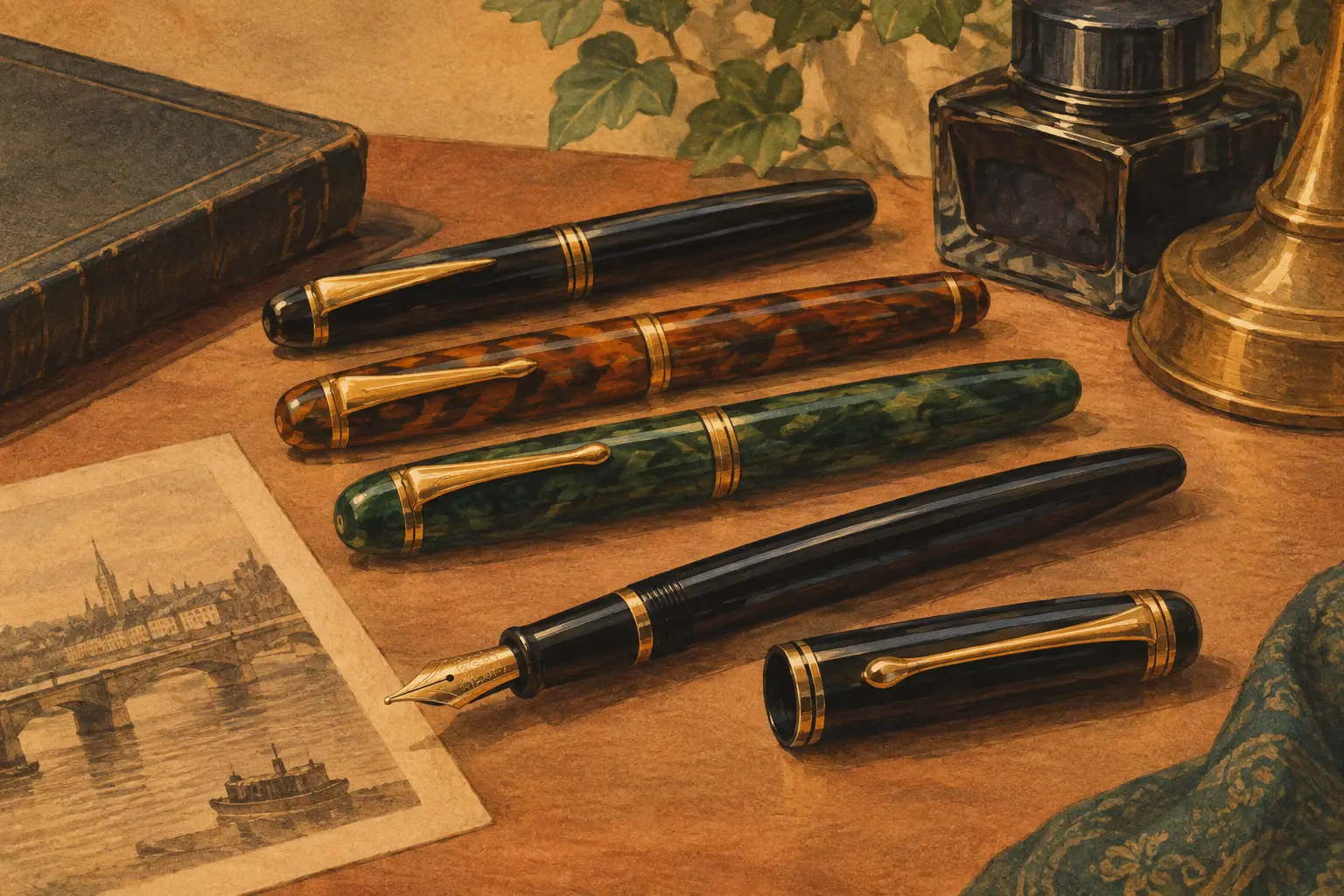
A Waterman found in a desk drawer can look deceptively simple: a black barrel, a gold clip, a nib marked Ideal. Yet waterman vintage pen identification is rarely settled by one feature alone. The most desirable and correctly described examples are recognised by a combination of material, imprint, filling system, trim, nib and proportions. Getting that combination right protects a collector from an expensive misdescription and helps a writer choose a pen that will genuinely earn its place in daily use.
Waterman has a long, complex history, spanning early American hard-rubber eyedroppers, elegant lever-fillers, colourful celluloid pens, post-war plastics and later cartridge models. Parts were sometimes used across ranges, export pens can differ from domestic catalogues, and a good restoration may involve necessary replacement consumables. For those reasons, identification should be methodical rather than based on a single online photograph or a number on the barrel.
Waterman Vintage Pen Identification Starts With Construction
Begin by looking at what the pen is made from. Material immediately narrows the likely period, although it does not provide a definitive date by itself.
Early Waterman pens were often made from hard rubber, also called ebonite. This material was usually black, though it could be mottled or patterned, and it has a warm feel unlike later moulded plastics. Oxidation commonly turns black hard rubber brown or olive, particularly on caps and barrel ends exposed to light. That discolouration is not necessarily damage, but it does affect collector value.
A chased hard-rubber barrel with crisp engraved lines, a screw cap and an eyedropper filling arrangement points towards the early twentieth century. Waterman safety pens from this broad era are another distinct group. Their nib retracts into the barrel when capped, and their mechanisms demand knowledgeable inspection before use. A safety pen may be wonderfully compact and historically significant, but it is not the best first restoration project.
By the 1920s and 1930s, lever-filled hard-rubber and celluloid pens became especially prominent. The famous Waterman 52 family is central to many collections. A black chased 52, for example, generally has a lever filler and a flexible gold nib, but the exact configuration, trim and imprint deserve close checking. Red ripple, mottled hard rubber and other finishes may belong to related models or variants, often with substantially different rarity.
Celluloid brought richer colour and more dramatic patterns. Waterman Hundred Year pens, associated with the late 1930s and early 1940s, are frequently recognised by their streamlined profile and distinctive celluloid finishes. These are attractive users when properly restored, but celluloid needs careful storage away from heat, direct sunlight and unstable materials.
Read the Barrel Imprint Carefully
The barrel imprint is one of the most useful clues, but wear, polishing and regional variation can make it misleading. Use magnification and angled light. Do not aggressively clean a faint imprint in the hope of making it clearer: rubbing can remove what little remains.
Early pens may carry wording such as “L. E. Waterman” and “Ideal”, sometimes with patent information or a globe device. Later models may use Waterman’s branding in different layouts, while post-war and European-made pens may have markings that reflect changes in manufacture and ownership. The wording should be considered alongside the pen’s design, not treated as an isolated verdict.
Country-of-origin marks can help, particularly on later pens. “Made in U.S.A.”, “Made in England” and French markings may indicate different production routes. They do not automatically make one pen better than another. A British-made Waterman can be every bit as appealing as an American counterpart, but it should be described and priced according to its own model history rather than assumed to be identical.
Imprints also reveal warning signs. Soft, uneven lettering, a suspiciously fresh barrel surface, or markings that do not suit the cap, lever or nib may suggest a composite pen. Mixed parts are not always dishonest. Over many decades, caps crack, nibs are changed and restorers save usable parts. The key is candid description. A pen assembled from period-correct components may be a sound writer, but it is not equivalent to a wholly original collector example.
Use the Filling System to Narrow the Date
A filling system often tells you more than an ornate cap band. Waterman produced several systems over the years, and each carries practical implications for restoration and use.
An eyedropper-filled pen has no internal lever or button. The barrel itself holds ink, usually with an appropriate seal at the section threads. These early pens have great charm but need cautious filling and a sound seal.
The lever filler became a Waterman mainstay. A small lever on the barrel compresses an internal sac, which draws ink in when the nib is immersed and the lever is released. Many classic Waterman models use this arrangement. The presence of a lever does not identify a pen as a 52, however, nor does a number on the barrel provide a precise production year. Waterman numbering can refer to size, trim or configuration, and catalogues evolved over time.
Later pens may use cartridge or proprietary cartridge-converter systems. The Waterman C/F, introduced during the 1950s, is a notable example of the move towards modern filling convenience. It has a very different feel from a hard-rubber lever filler and should not be forced to accept unsuitable modern cartridges. With vintage pens, compatibility is a mechanical question, not a matter of appearance.
Examine the Nib, Clip and Cap as a Set
The nib deserves close attention because it influences both value and writing character. Many earlier Waterman pens carry gold Ideal nibs, often with flexible qualities that modern writers actively seek. Flex should never be assumed from a photograph or from the word “Ideal” alone. Some nibs are firm, semi-flexible or altered by prior repair. A proper assessment considers tine alignment, tipping, cracks, corrosion, spring and how the nib performs on paper.
Nib markings can support identification, but replacement nibs are common. A correct Waterman nib is encouraging, not conclusive. Equally, a high-quality period replacement may make a pen a better writer without making it fully original.
Look next at the clip and cap band. Waterman clips changed shape over the decades, from plainer early designs to more stylised post-war forms. Cap bands may be narrow, broad, engraved or absent. Compare their fit and finish with the rest of the pen. A loose band, mismatched plating or clip screws that disturb the cap material can indicate repair work.
Measurements matter too. Record the capped length, barrel diameter and posted length rather than relying on memory. Waterman made similar-looking pens in several sizes, and photographs can obscure scale. A pen that appears oversized beside no reference object may prove to be a slender pocket model.
Condition and Restoration: What Should Be Original?
For a collector-grade Waterman, originality carries weight. Original finish, clear imprints, matching cap and barrel, correct trim and an appropriate nib all strengthen desirability. But a vintage fountain pen is also a working mechanism. A perished ink sac, hardened seals or worn cork components are not badges of authenticity worth preserving at the expense of function.
A sympathetic restoration normally replaces consumable parts while retaining the pen’s historic character. An expertly renewed sac in a lever filler is expected. A careful clean, correct adjustment and tested filling system make the pen usable again. Heavy polishing, recolouring, re-plating or concealed cracks are more serious matters, especially where a pen is sold as original.
Ask whether you are buying for a cabinet, regular correspondence or a gift. A scarce early eyedropper with a fragile cap may suit the dedicated collector. A professionally restored lever-filled Waterman may be the better choice for someone who wants the pleasure of writing with vintage flex each week. Neither aim is wrong, but they lead to different buying decisions.
A Practical Way to Verify a Waterman
When assessing a prospective purchase, bring the evidence together. Check the material and profile first, then read the imprint, identify the filling system and inspect the nib, trim and measurements. Finally, assess condition and ask what restoration has been carried out. Clear photographs of the cap, barrel, imprint, nib, feed, lever and any defects should be available from a specialist seller.
Be wary of overconfident dates attached to incomplete evidence. “Circa 1920s” can be more honest and useful than a precise year with no catalogue support. Likewise, words such as “rare” and “flexible” should be backed by visible features and a practical writing assessment, not used as sales shorthand.
At Heritage Collectables, restored instruments are valued not simply because they look impressive in a case, but because their history and their mechanics are treated with equal respect. A correctly identified Waterman can be a serious addition to a collection, a memorable gift or a superb everyday pen. Take the time to read its details closely, and the pen will tell you far more than its age.