
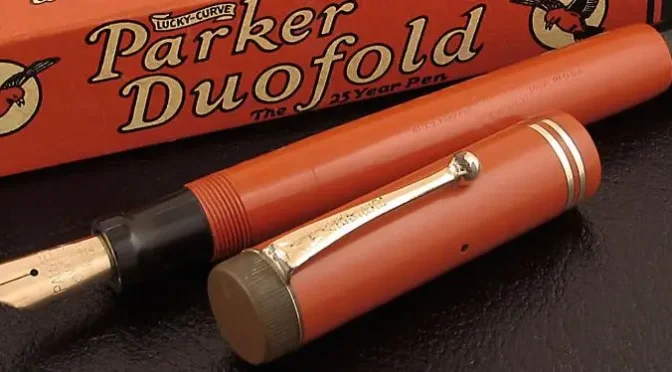
A Parker pen can look deceptively straightforward to date. A striped Vacumatic, a black Parker 51 or a colourful Duofold often carries visual clues that seem familiar at once. Yet knowing how to date Parker pens properly means separating a useful factory marking from an assumption. Parker produced pens in several countries, changed designs gradually and used components across overlapping periods. The best result is usually a confident date range, supported by several pieces of evidence, rather than a date guessed from one stamp alone.
For collectors, this matters. A pen’s age affects its historical interest, correct specification, desirability and value. For a writer, it also helps explain which filling system, nib and restoration requirements are appropriate. The process is rewarding precisely because Parker left so many clues behind.
How to date Parker pens: identify the model first
Before looking for a date code, establish what Parker model is in front of you. The code only becomes meaningful when read in the context of the pen’s design.
A Duofold is not one single period of Parker production. The original large flat-top Duofolds arrived in the 1920s, followed by streamlined versions in the 1930s and later English Duofolds with their own materials and proportions. Likewise, the Parker 51 was made over many years in several important forms. A date code ending in “8” may indicate 1938, 1948 or 1958 in isolation, but a Parker 51 cannot be from 1938 because the model was introduced in 1941.
Start with the broad model family, then narrow the period through its defining features. A Vacumatic, for example, belongs principally to the 1930s and 1940s and is recognised by its laminated celluloid body and diaphragm filling system. A Parker 61 with its original capillary filling arrangement belongs to the earlier part of that model’s life, while the later cartridge/converter version points to a later production period. A Parker 45, introduced in 1960, has a very different construction and era from a Vacumatic even when both carry a similar-looking number.
The following landmarks are especially useful when handling common collectible Parkers:
- Duofold flat-tops date from the 1920s, while streamlined Duofolds are generally 1930s onward.
- Vacumatics were produced from 1933 into the late 1940s.
- The Parker 51 began in 1941; Aerometric-filled examples followed from 1948.
- The Parker 61 was introduced in 1956, with the cartridge/converter version arriving in 1969.
- The Parker 45 began production in 1960, and the Parker 75 followed in 1964.
- The original Jotter ballpoint arrived in 1954, making it an important benchmark for dating Parker ballpoints.
These are starting points, not substitutes for close inspection. Parker frequently introduced a revised clip, cap finish or filling mechanism before every older example had disappeared from retailers’ stock.
Read Parker date codes, but do not rely on them alone
The most direct clue is normally the date code stamped into the barrel, often close to the imprint. On many American-made Parker fountain pens, particularly from the 1930s through the 1950s, this takes the form of a numeral accompanied by dots. The numeral represents the final digit of a year, and the dot arrangement was used to indicate the production quarter.
That sounds simple, but it demands care. A “6” is not automatically 1946. The model, filler and imprint must establish the likely decade first. Once that is known, the dots can refine the date further. On a correctly identified Vacumatic, a code ending in “6” will normally be read within the 1930s or 1940s. On a Parker 51, the same figure is much more likely to relate to 1946 or 1956.
Dots are often faint, incomplete or lost beneath wear and polishing. They may be obscured by discolouration in the imprint, especially on well-used celluloid. Use a loupe, indirect light and a clean barrel rather than rubbing hard at the marking. A missing dot is not proof that it was never there.
Parker’s coding practices also changed over time, and not every pen was marked in the same way. Later pens can show different formats, while some lower-priced lines, export models and replacement parts provide less help. A code should therefore be treated as evidence to test, not a verdict to repeat in a listing.
Match the code to the factory
Country of manufacture is a vital part of Parker dating. “Made in U.S.A.” is not interchangeable with “Made in England”, and an English Parker should not be dated solely by an American chart. Parker’s British operation at Newhaven produced a substantial range of pens, including models that resemble their American counterparts but differ in trim, filling system, materials and imprint style.
An English Parker 51, for instance, may have characteristics that make perfect sense for Newhaven production but look unusual beside a Janesville-made example. The same applies to Duofolds and later cartridge pens. Always record the full barrel imprint, including country of origin, patent wording and any letters or figures. Those small details can be more informative than the pen’s colour.
If the pen has no readable imprint, examine it more cautiously. Heavy polishing, barrel replacement and cap swaps are all possibilities on a pen that has been used for seventy years or more.
Let the construction confirm the period
Once the model and likely decade are established, inspect the details Parker changed during production. This is where a broad date range becomes a more persuasive identification.
The filling system is particularly revealing. Early Parker 51s use the Vacumatic-style diaphragm system, whereas later examples are fitted with the familiar Aerometric squeeze filler. This means an Aerometric Parker 51 cannot be an original 1941 production pen, regardless of what a cap or nib might suggest. Conversely, a Vacumatic-filled 51 should prompt a closer look if it appears to carry features associated with later manufacture.
Caps and clips offer equally valuable evidence. Parker adjusted clip profiles, cap bands, jewels and cap materials across model runs. On the Parker 51, the transition from the earlier blue diamond clip to later clip styles helps to place a pen within its production history. Vacumatic cap band widths and patterns, Duofold clip forms and Jotter cap designs can all help distinguish an early version from a later one.
Nib markings deserve attention, but should be read with restraint. A nib may carry a date, country name, gold content or model name, yet nibs can be replaced during a pen’s long working life. A nib date that conflicts with the barrel does not automatically mean that either part is counterfeit. It may simply indicate a legitimate period repair or a later replacement. The question is whether the whole pen presents a credible, coherent combination.
Watch for restored and assembled pens
A professionally restored Parker should be ready to write, but restoration does not turn a pen into something other than it is. A new diaphragm in a Vacumatic, a replacement sac in an earlier button-filler or a fresh cork where appropriate are service items. They preserve use without changing the pen’s production date.
Other replacements matter more to collectability. A substituted cap, barrel, section, nib or blind cap can create a pen assembled from correct Parker parts of different dates. Such a pen may still be an excellent writer and a sensible purchase, provided it is described honestly. It should simply be valued differently from an untouched, matching example.
Look for consistency in colour, wear and fit. A cap with markedly different wear from the barrel, a clip that does not sit correctly, or an imprint at odds with the model’s filling system warrants further investigation. None of these signs is conclusive alone, but together they can reveal a mixed pen.
For a significant purchase, keep the seller’s description alongside clear photographs of the imprint, filler, nib and cap. A specialist dealer should be willing to identify the model, country of manufacture and known restoration work, while being candid where a precise quarter or original component cannot be confirmed.
Dating a Parker is less about finding one magic number than reading a well-made object as a whole. Begin with the model, use the date code in its proper context, and let the filler, imprint and trim either support or challenge your first conclusion. That patient approach is the one most likely to lead you to a Parker that is not only correctly described, but a pleasure to own and use.