
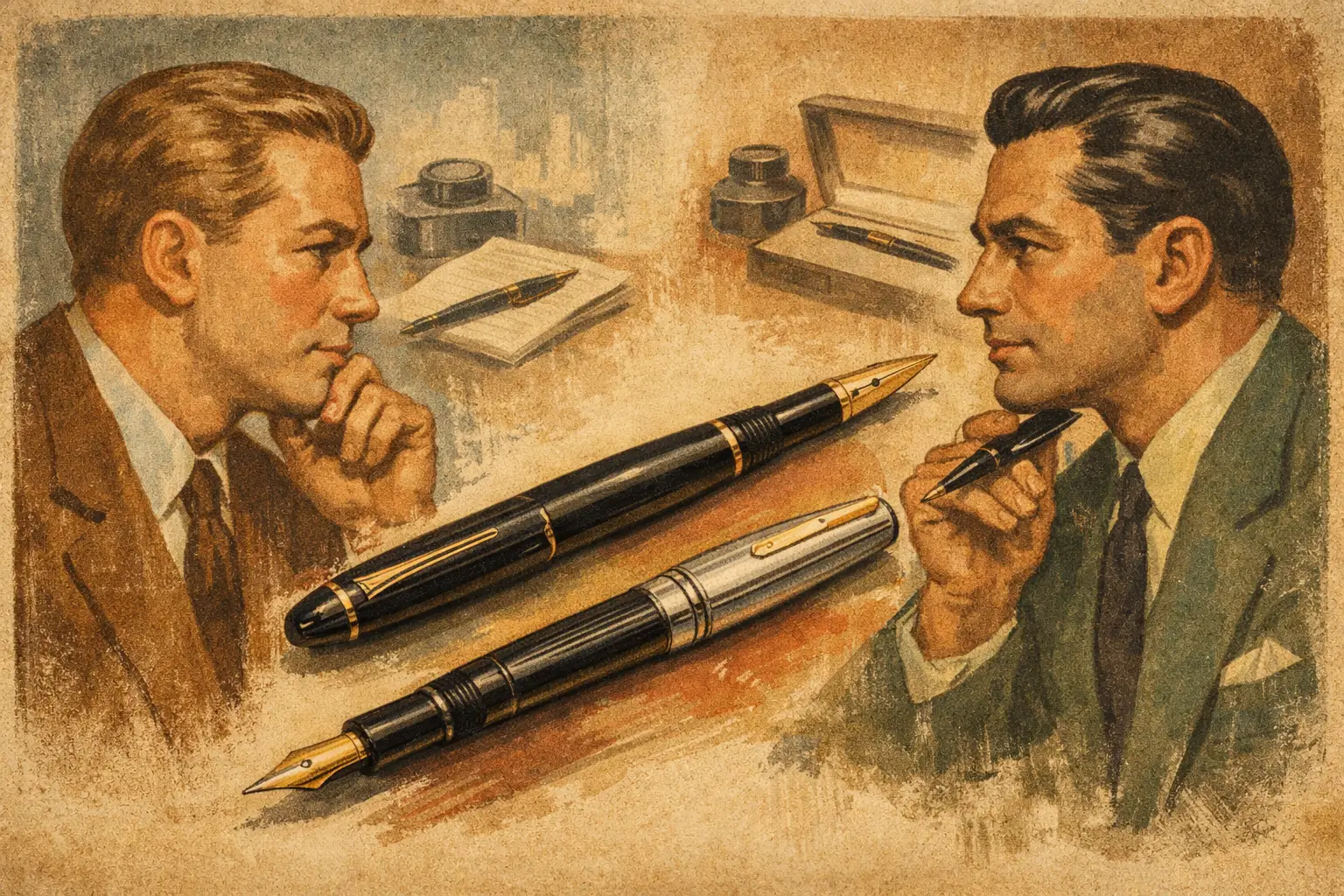
A Waterman 52 with a flexible gold nib and a Sheaffer Balance with its reassuring lever filler can both make superb daily writers. Yet they offer very different pleasures. The question of Waterman versus Sheaffer pens is not simply which name is more prestigious. It is a question of period, filling system, nib character, design taste and how you want a vintage pen to feel in the hand.
For the collector, both makers reward close attention. Waterman represents some of the most important developments in early fountain pen history, from reliable hard-rubber safety pens to elegant celluloid models. Sheaffer brought equally significant innovation, particularly in lever filling, oversized flat-top pens and the distinctive snorkel and touchdown mechanisms of the mid-century. A good choice begins by recognising what each brand does best.
Waterman versus Sheaffer pens: the character of each brand
Waterman is often the natural starting point for collectors interested in the golden age of the fountain pen. The company’s early success was built on practical self-filling pens, at a time when eyedropper pens could be messy and inconvenient. By the 1910s and 1920s, Waterman had established a strong reputation for dependable construction and excellent gold nibs.
The classic Waterman look is restrained and refined. Black chased hard rubber, slender barrel proportions, simple clips and finely engraved gold bands give many early models a distinctly Victorian or Edwardian presence. The Waterman 52, 54 and 56 lever-fillers remain highly regarded because they combine practical usability with nibs that can be expressive without being difficult to live with.
Sheaffer has a more assertive visual identity. Early Sheaffer lever-fillers often have broad, confident proportions, particularly the flat-top models of the 1920s. The later Balance range introduced a streamlined silhouette that still feels remarkably modern, while the Triumph nib, White Dot and military-style clips became instantly recognisable features. A Sheaffer can feel more engineered, more substantial and, in many cases, more distinctly American in its styling.
Neither character is inherently better. Waterman often appeals to those drawn to traditional craftsmanship and a sensitive writing experience. Sheaffer is especially attractive to collectors who enjoy bold design, mechanical innovation and pens with a solid, purposeful feel.
Nibs: flexibility, firmness and everyday writing
The nib is where many buying decisions are made. Vintage Waterman nibs have an exceptional reputation, particularly those from the hard-rubber and early celluloid eras. A Waterman with a fine, semi-flexible or flexible nib can produce beautiful line variation under light pressure. For correspondence, journal writing or anyone who enjoys a more expressive hand, this is a major part of the appeal.
That said, not every Waterman nib is flexible, and a flexible nib is not automatically the best nib. Many are firm fine writers, designed for everyday business use. Condition matters more than a broad claim about brand character. Alignment, tipping, feed performance and whether the nib has been over-flexed by a previous owner all deserve careful inspection.
Sheaffer nibs are commonly firmer, especially from the 1930s onwards. This makes them excellent for controlled, consistent writing. A firm Sheaffer Fine or Medium is often a sensible choice for regular notes, forms and modern handwriting, where the paper may not suit a generous wet line. The company’s conical Triumph nib is admired for its durability, smoothness and distinctive appearance. It is also usually a very practical choice for a pen that will be used rather than displayed.
Collectors should avoid treating this as an absolute rule. Sheaffer produced some responsive early nibs, while Waterman made plenty of firm examples. If nib feel is your priority, buy the individual pen rather than the label on the barrel.
Filling systems and restoration considerations
Both brands produced lever-fillers, and these are among the most straightforward vintage fountain pens to maintain when properly restored. A lever filler generally uses a rubber sac inside the barrel. Raising the lever compresses the sac; closing it allows ink to be drawn in. It is a proven system, but a perished sac, corroded pressure bar or poorly fitted replacement can turn a handsome pen into a frustrating purchase.
Waterman lever-fillers are usually uncomplicated, which is one reason they remain popular with first-time vintage buyers. Their hard-rubber pens need sensible care, as prolonged sunlight can fade black rubber towards brown and excessive polishing can soften the chasing. A well-restored example, however, can provide years of reliable service.
Sheaffer presents a wider mechanical range. Standard lever-fillers are generally simple and dependable. Later touchdown and snorkel models are more complex, involving seals, sacs and internal components that must work together correctly. The snorkel system is particularly ingenious: its thin filling tube extends from beneath the nib, allowing the pen to fill without immersing the nib in ink. It is a delightful piece of engineering, but not a mechanism to buy casually if restoration quality is uncertain.
For this reason, a restored Sheaffer snorkel or touchdown pen can be a superb user, while an unrestored one may require specialist attention. With Waterman and Sheaffer alike, a clear restoration standard matters. A pen should not merely hold ink for a photograph. It should fill, write, seal and operate as intended.
Design eras worth seeking out
A collector comparing the two brands will find particularly rewarding periods in each catalogue. Waterman’s chased hard-rubber pens offer early fountain pen history in an accessible, usable form. The 1920s and 1930s brought more colour through celluloid, including attractive mottled and marbled finishes. Later Waterman pens can also be excellent writers, though many collectors focus on the earlier flexible-nib period.
For Sheaffer, the 1920s flat-tops are commanding objects, often found in jade, black and other early plastics. The Balance, introduced in the late 1920s, is one of the landmark streamlined fountain pen designs and suits those who want vintage character without a sharp-edged profile. Mid-century Sheaffers, including the Triumph, Touchdown and Snorkel families, have a clean, technical elegance that works particularly well as a gift for someone who appreciates design history.
Colour can affect both desirability and condition. Jade celluloid, for example, is beloved but can discolour over time. Black hard rubber may show oxidation. Transparent ink windows can darken. These changes are part of the material history of a vintage pen, but they should be honestly reflected in condition and price.
Which offers better value for a collector?
Value depends heavily on model, condition, trim, nib and rarity. A common restored Waterman lever-filler may offer an outstanding entry into vintage flex at a sensible level, while a large-size Waterman, unusual overlay or rare colour can command much more. Waterman’s strongest appeal is often the combination of historic importance and genuinely pleasurable nibs.
Sheaffer can represent excellent value for buyers seeking a dependable vintage writer with a more unusual mechanism or a broader body. A restored Balance or Triumph-nib pen can feel like a great deal compared with more fashionable brands. Snorkels are often a sensible choice for collectors who enjoy mechanical interest and want a pen that starts conversations at a desk or writing table.
For gifting, the decision is often simpler. Choose Waterman for a recipient who values traditional elegance, fine writing and the romance of an earlier age. Choose Sheaffer for someone drawn to confident design, clever engineering and a substantial feel. In either case, a restored pen with a sound filling system is a far better present than an untouched example with uncertain internals.
What to examine before buying
When considering either maker, begin with the practical details. Confirm that the pen has been restored or serviced properly, rather than merely cleaned. Ask whether the filling system has been tested, whether the nib writes cleanly and whether there are cracks around the cap lip, lever box or section. These areas can be costly or difficult to address.
Look closely at the nib photograph and description. A fine nib is not the same as a flexible fine nib, and a smooth writer may still be firm. Check the cap and barrel for fading, shrinkage, brassing and personal engravings, then decide whether these are acceptable signs of age or drawbacks for your purpose. For a daily writer, a little cosmetic wear is often a worthwhile trade-off for a sound, well-priced instrument.
At Heritage Collectables, the enduring attraction of both names lies in this balance of history and utility. The right vintage pen should feel like a personal object, not a museum piece you are afraid to ink. Whether you choose Waterman’s quieter elegance or Sheaffer’s inventive confidence, select the example whose condition, nib and character invite you to write with it often.