
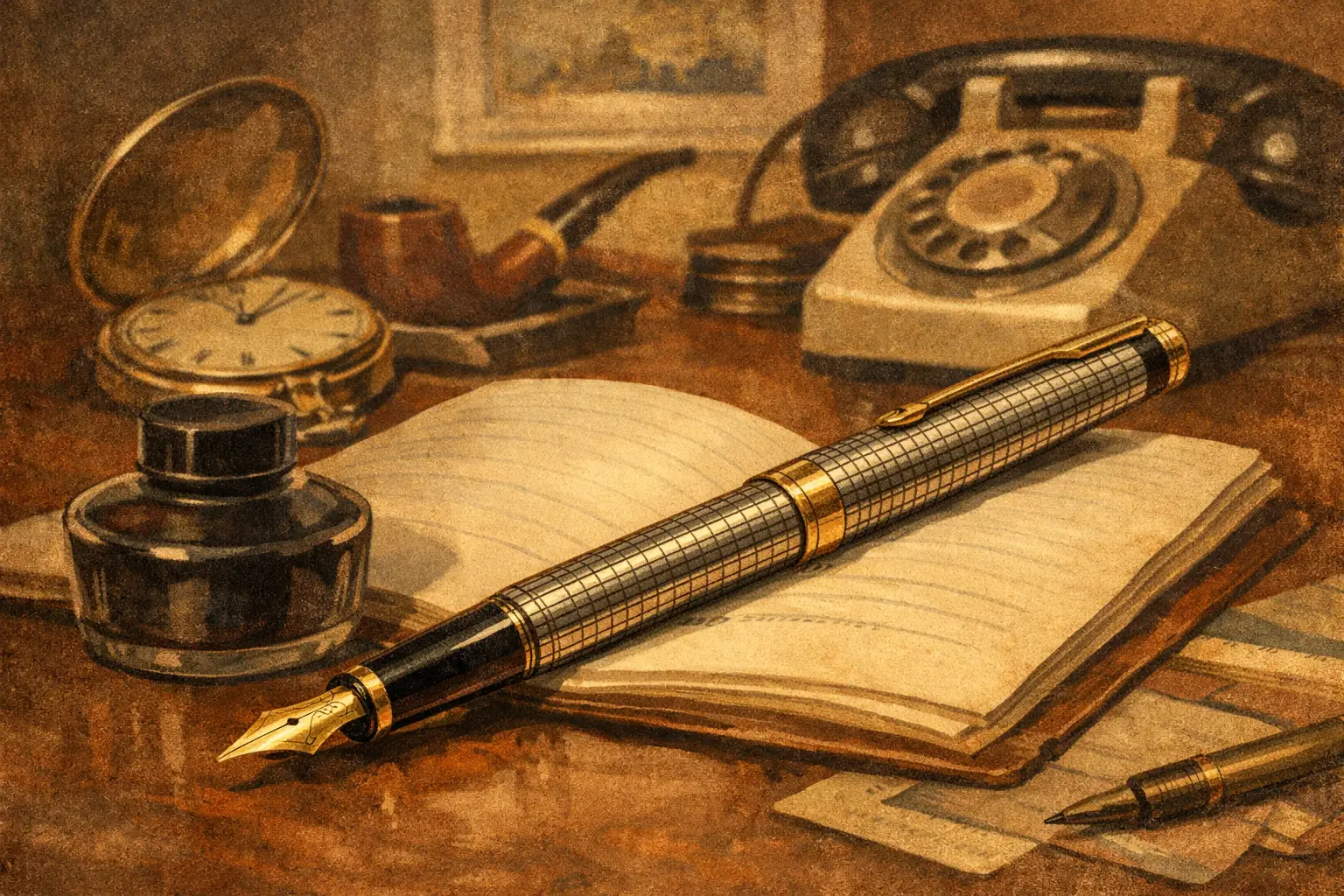
The Parker 75 is one of those pens that can look more formal in a cabinet than it feels in the hand. This Parker 75 review concerns the point that matters most to collectors and regular writers alike: beneath its finely worked finish is a genuinely practical fountain pen, designed to be used rather than merely admired.
Introduced in 1964 to mark Parker’s 75th anniversary, the model brought a level of refinement that set it apart from the company’s more everyday pens. The original sterling silver Ciselé version, with its precise grid pattern and black enamel-filled lines, remains the best-known expression of the range. It is restrained, unmistakably mid-century and, when properly restored, still an exceptionally satisfying writer.
Why the Parker 75 still earns its reputation
The Parker 75 was positioned as a premium instrument, but not as an impractical one. Its proportions are compact, its cap posts securely, and its relatively slim barrel gives it a controlled, precise character. It is particularly appealing to writers who find large modern pens tiring or ungainly.
The pen’s signature feature is its adjustable nib assembly. Small reference marks on the grip section allow the nib to be rotated into a position suited to the writer’s natural hand angle. Parker called this the “Zero” system. Some owners will set it once and forget it; others may never need to adjust it at all. Yet it remains a thoughtful piece of design, especially for left-handed writers or anyone whose grip does not sit comfortably with a fixed nib orientation.
That adjustability should not be mistaken for a cure for every writing issue. A poor nib, damaged feed or misaligned tines will not be improved by rotating the section. On a sound, serviced pen, however, the system offers a degree of personal fit that few vintage fountain pens provide.
The feel of the Ciselé finish
The Ciselé pattern is more than decoration. It gives the fingers a subtle purchase without making the pen feel rough, while the sterling silver has a warmth and density absent from plated alternatives. The cap and barrel are slim, but the pen does not feel insubstantial.
Over decades, silver develops tarnish, minute marks and, occasionally, deeper scratches from careless use. Many collectors prefer a gentle, even patina because it confirms the material and lends the pen character. Excessive polishing can soften the crispness of the engraved grid, so a bright finish is not automatically a better finish.
Parker also produced the 75 in a wide variety of finishes, including gold-filled, lacquered, enamelled and patterned versions. These can be highly collectible in their own right. Nevertheless, the sterling Ciselé remains the model most buyers have in mind, and it is the strongest starting point for anyone wanting to understand the appeal of the series.
Parker 75 review: how does it write?
A good Parker 75 nib is usually firm, smooth and accurate rather than soft or expressive. It is a pen for controlled handwriting, correspondence, annotations and daily notes. Writers accustomed to flexible vintage gold nibs may find it comparatively restrained, but that is part of its character.
Most examples are fitted with 14-carat gold nibs in widths ranging from extra fine through to broad, with oblique and specialist options appearing less often. The finer grades can be excellent for compact handwriting, though nib width on vintage pens must always be judged by the individual example rather than the stamping alone. Decades of use, adjustment and polishing can alter a nib’s performance considerably.
The writing experience depends heavily on condition. A properly aligned nib and clean feed should give a reliable, moderately wet line with little effort. A neglected pen may hard-start, write dry or suffer from ink flow interrupted by old deposits. This is not a failing inherent to the model. It is simply the reality of buying a fountain pen that may be fifty or sixty years old.
The cap is a positive feature. It slips on and off with a satisfying, secure fit, and the pen is light enough when posted to suit longer writing sessions. Unposted, it is quite short. Those with larger hands may prefer it posted, whereas writers who favour a compact pen may enjoy its balance exactly as it is.
Filling system and everyday ownership
The Parker 75 uses a cartridge/converter arrangement, which makes it far easier to live with than many earlier lever-fillers or button-fillers. A suitable converter allows the use of bottled ink, while cartridges offer convenience for travel or occasional use.
As with any vintage pen, confirm that the supplied converter is sound and compatible rather than assuming it is original or fully functional. A tired sac in an older converter can cause poor filling or leaks. Replacement converters and cartridges may be available, but compatibility should be checked carefully before purchase.
For day-to-day use, choose a well-behaved fountain pen ink and keep the pen clean. Highly saturated, heavily pigmented or permanent inks can be rewarding, but they demand more frequent maintenance and are seldom the best choice for a vintage pen with a fine feed. A conventional washable ink is a sensible place to begin.
What to inspect before buying
A Parker 75 can be an excellent purchase, but condition and originality influence both value and enjoyment. The model was made for many years in several factories, with small changes to caps, clips, sections and nib arrangements. A close inspection is worthwhile, particularly when buying an example described only as “vintage”.
Look for these points before committing:
- Check that the cap fits firmly and that the clip is straight, secure and free from obvious damage.
- Examine the sterling pattern for dents, worn areas and signs of aggressive polishing, especially at the cap lip and barrel edges.
- Confirm that the nib is straight, the tipping is present and the tines meet correctly. A photograph from above is useful, but it is not a substitute for a writing test.
- Ensure the adjustable grip section turns as intended without being loose, cracked or forced.
- Ask whether the pen has been cleaned, tested and restored, and whether a compatible working converter is included.
The last point matters. A handsome Parker 75 with an untested nib is a restoration project, not necessarily a ready-to-write pen. There is nothing wrong with taking on a project if the price reflects it, but buyers should know which they are purchasing.
Originality, restoration and value
A professionally restored Parker 75 does not need to be untouched to be desirable. Sensible servicing, careful cleaning and a replacement consumable component can make a vintage pen more useful without compromising its integrity. What should give pause are poorly matched parts, damaged plating disguised by photographs, or heavy polishing that removes the definition of a desirable finish.
Rarer finishes, unusual nibs, presentation sets and early production details may command stronger prices. Yet the standard sterling Ciselé often represents the most satisfying balance of collectability, availability and usability. It is recognisable, handsome and still comparatively accessible beside many high-end vintage fountain pens.
For a gift, the Parker 75 is especially persuasive when the recipient appreciates understated design. It does not shout for attention, but a silver Ciselé pen has an immediate sense of occasion. Its practical filling system also means the gift is likely to be used, not placed in a drawer after a single signature.
Who should buy a Parker 75?
This is a particularly good choice for the collector who wants a first serious vintage Parker, or for the writer seeking a slim, dependable gold-nibbed pen with genuine design history. It suits neat handwriting and deliberate note-taking better than dramatic calligraphy or broad, wet ink effects.
It may be less suitable for someone who prefers oversized pens, very soft nibs or a high-capacity piston filler. Similarly, collectors focused only on pristine, boxed examples will need patience and should expect to pay accordingly. The pleasure of the Parker 75 lies in the fact that it can be both a collectible object and a working tool.
At Heritage Collectables, restored vintage pens are assessed with that dual purpose in mind. A Parker 75 deserves to retain its period character, but it should also be capable of earning its place on a desk.
If you find an example with a sound nib, honest finish and proper servicing, do not be afraid to ink it. The finest proof of the Parker 75’s design is not how it looks in a display case, but how naturally it returns to the page.