
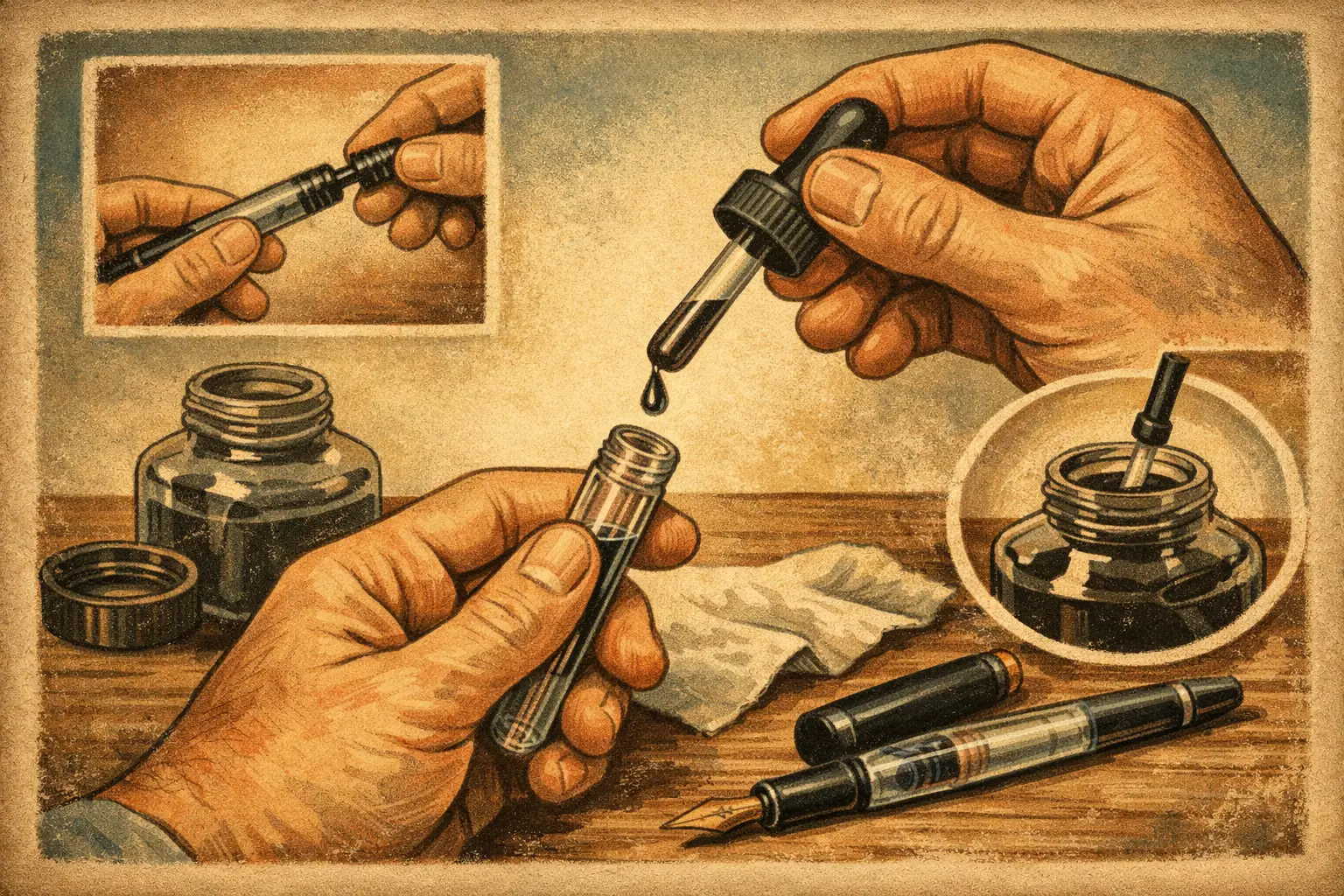
A true eyedropper fountain pen offers one of the most direct connections between writer, ink and paper. There is no cartridge, converter or filling lever between them – simply a barrel filled with ink and a carefully fitted section. Learning how to fill eyedropper pens properly is straightforward, but it deserves a little patience, particularly when the pen is vintage, made from hard rubber or fitted with a precious original nib.
The reward is considerable: generous ink capacity, an uncluttered mechanism and the pleasure of using a filling system from the earliest years of fountain pen history. The risks are equally clear. Ink in the wrong place can stain a cap, find a hairline crack or seep through an imperfect section joint. A clean filling routine is the difference between a satisfying writing instrument and an avoidable restoration problem.
First, establish whether the pen is an eyedropper
Not every fountain pen with an empty barrel should be filled directly with a pipette. Many vintage models were designed for a rubber sac, a button filler, a lever filler, a vacuum mechanism or a captive converter. Filling one of these directly can flood the barrel, damage the internal filling system or leave ink where it cannot be properly cleaned.
An original eyedropper usually has a hollow barrel with no internal mechanism and a section that unscrews from the barrel. Early Waterman safety pens, some Mabie Todd models and a range of early Continental instruments may use variations on this principle, but construction varies considerably by maker and era. A modern pen converted to eyedropper use is a separate matter. Such conversions are only suitable when the manufacturer has specifically designed the barrel, section threads and materials for direct filling.
With a vintage pen, do not rely on appearance alone. Check for a sac nipple inside the section, a pressure bar in the barrel, traces of an old sac, a threaded blind cap or a mechanism at the rear. Any of these is a sign to pause. A properly restored lever or button filler should be filled through its intended system, not treated as an eyedropper.
What you need before filling
Prepare a protected work surface before opening the pen. Fountain pen ink is wonderfully persistent on fingertips, cotton shirts and unfinished wood. A folded paper towel or absorbent cloth, a clean eyedropper or blunt syringe, a bottle of suitable fountain pen ink and a small container of water are normally enough.
Choose conventional fountain pen ink from a reputable maker. Highly saturated permanent inks, heavily pigmented inks, iron gall formulations and shimmer inks can be excellent in the right pen, but they demand more from the writer and the pen. For a vintage eyedropper, a well-behaved, washable ink is usually the sensible starting point. It is easier to flush, less likely to leave stubborn staining and kinder to older feeds and seals.
Inspect the section threads and barrel lip under good light. They should be clean, dry and free from obvious cracks. If the pen has hard rubber or ebonite components, remember that age, heat and previous use may have changed the material. Never force a resistant section. A pen that needs attention should be examined before it is put into service.
How to fill eyedropper pens step by step
The central rule is simple: keep ink below the threads, and keep the threads clean.
- Unscrew the section carefully. Hold the barrel in one hand and the section in the other, turning only as much as required. Avoid gripping a delicate nib or twisting a section that feels seized. Set the cap aside well away from the ink bottle.
- Draw ink into the eyedropper or syringe. A blunt syringe gives the best control, especially with a narrow barrel opening. Draw a little less than the barrel appears to hold. Overfilling leaves no room for thermal expansion and makes it much easier to contaminate the threads.
- Fill the barrel slowly. Keep the barrel upright and introduce the ink in a steady stream. Stop at roughly 80 to 90 per cent full, leaving a visible air space at the top. This space is not wasted capacity. It helps manage pressure changes and reduces the chance of ink being pushed into the cap when the pen warms in a pocket or hand.
- Clean the threads before reassembly. Wipe the barrel threads, the section threads and the edge of the opening with a clean paper towel. This small step prevents ink from being carried into the joint, where it can cause staining and make a leak look worse than it is.
- Reassemble without overtightening. Screw the section back into place until it is snug. Do not tighten it as though sealing a jar. Older plastics and hard rubber can crack under unnecessary pressure, while a well-made joint should not need brute force to remain secure.
- Wipe, test and let the feed settle. Clean the exterior, hold the pen nib-down over a towel for a moment and then write a few lines. The feed may need a little time to become fully saturated. If ink appears around the section joint, stop using the pen and investigate before placing the cap on.
Do you need silicone grease or sealant?
This depends entirely on the pen. Some modern pens intended for eyedropper conversion benefit from a tiny amount of pure silicone grease on their section threads. It improves the seal without permanently altering the pen. A very small amount is sufficient – excess grease can migrate into the ink and make cleaning more difficult.
For a historic instrument, caution is the better course. Never apply grease, shellac, thread tape, glue or sealant simply because an online filling guide recommends it. A leak in a vintage eyedropper may indicate damaged threads, distortion, a missing sealing surface or an earlier repair that needs specialist correction. Masking the symptom can complicate a proper restoration later.
Silicone grease should also be kept away from the feed, nib and ink channels. Its role, where appropriate, is confined to the threads. If you are uncertain whether a particular pen was designed for direct filling, it is safer not to experiment with a valuable barrel.
Managing leaks, burps and changing temperature
An eyedropper pen has a large reservoir of ink and air. As the pen warms in the hand, the air expands. As the ink level falls, there is more air inside the barrel and a greater chance of a sudden heavy flow, often called burping. This is not always a fault. It is a characteristic of the filling system that can be managed with sensible use.
Keep the pen nib-up when carrying it, especially during warm weather or air travel. Avoid leaving it in a hot car, near a radiator or in direct sunlight. Before writing with a partly empty pen, allow it to rest nib-up for a moment, then make a few gentle strokes on scrap paper. If the pen tends to run very wet when the barrel is low, refill it rather than trying to use the final few drops.
A leaking joint, however, is different from normal burping. Ink emerging consistently from the section threads, barrel end or a crack in the barrel calls for immediate cleaning and assessment. Empty the pen, rinse it with cool water and do not leave ink sitting in a compromised instrument. Vintage hard rubber and early celluloid deserve particular care, as staining and structural damage can be difficult to reverse.
Cleaning an eyedropper between fills
One advantage of the system is that cleaning is uncomplicated. Empty the remaining ink into an appropriate container, then flush the barrel and section with cool water until it runs clear. Do not soak hard rubber, casein or unknown vintage materials for long periods, and do not use hot water. It can distort components, damage old adhesives and affect fragile finishes.
Drying matters as much as flushing. Leave the section and barrel apart on an absorbent cloth, with airflow around both pieces. A little residual water will only dilute the next fill, but trapped moisture over a prolonged period is never ideal for an older pen. If you are changing from a dark or strongly coloured ink, take extra time to clean the feed thoroughly.
Treat the barrel as part of the pen’s history
A large ink reservoir is appealing, but it should not tempt you to leave a pen filled for months. Regular use is ideal. If the pen is going back into a display case, drawer or collection cabinet, empty and clean it first. This is especially worthwhile with collectible instruments, where original material, clarity of imprint and condition of finish remain part of their value.
The best routine is calm rather than clever: use a suitable ink, leave air space in the barrel, clean the threads and respond quickly to any sign of a leak. Filled with care, an eyedropper pen is not merely an early filling system. It is a remarkably immediate way to enjoy a restored writing instrument exactly as it was meant to be used.