
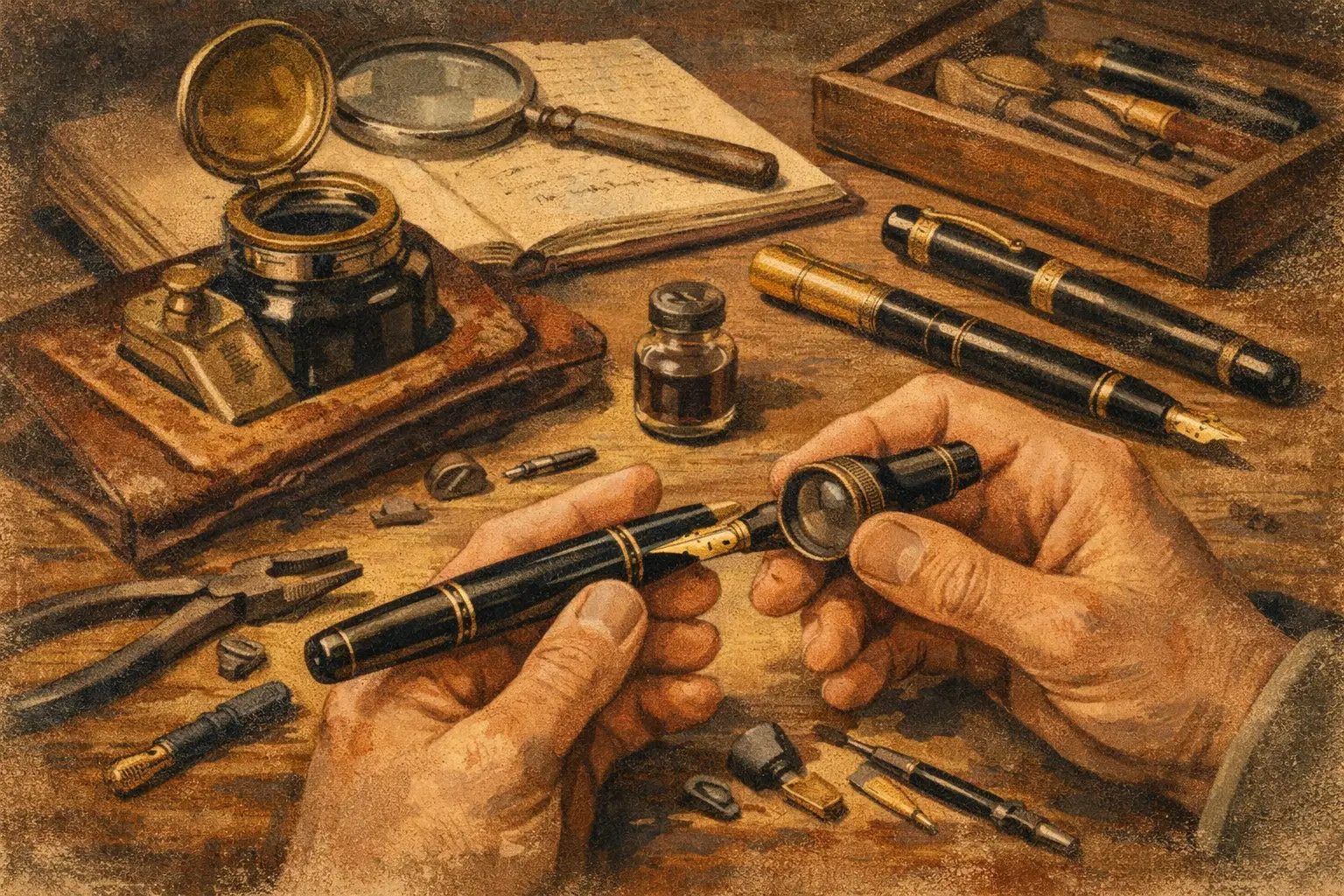
A Waterman Ideal can arrive looking deceptively simple: black hard rubber, a chased pattern softened by decades of handling, perhaps a worn lever and an imprint that needs close inspection. Yet a proper Waterman Ideal repair is rarely a simple matter of fitting a new sac and polishing the barrel. These are historic writing instruments, often more than a century old, and their value lies as much in original material, crisp detail and sound workmanship as in their ability to write again.
For the collector who wants an authentic example, and the writer who wants a dependable daily pen, the right restoration balances preservation with practical use. The best result is not a pen that looks newly manufactured. It is a pen that remains recognisably itself, functions as it should, and has not lost the features that make an Ideal worth owning.
What a Waterman Ideal Repair Should Preserve
The Ideal name covers a broad family of Waterman pens made over many years, from early eyedroppers to lever-fillers in chased hard rubber, decorative overlays and later celluloid models. Exact identification matters before repair begins. A repair suitable for a 1920s lever-filler may be entirely inappropriate for an earlier safety pen or an overlay with a fragile hard-rubber base.
The first responsibility is to preserve original components wherever they can safely remain. A hard-rubber barrel with honest oxidation tells part of the pen’s story. Heavy polishing may make it appear darker for a short time, but can round the chasing, weaken the imprint and leave an artificial finish. Equally, a cap with a fine hairline crack should not be disguised under a thick coating that alters its appearance and makes future assessment harder.
A carefully restored Ideal should retain its correct profile, trim and filling arrangement. Replacement parts can sometimes be justified, particularly where a sac, pressure bar or inner seal has failed beyond use. They should be chosen for fit, function and period sympathy rather than convenience alone.
Diagnosis Comes Before Dismantling
Before a Waterman Ideal is taken apart, its condition needs to be assessed as a whole. That means examining the cap and barrel for cracks, checking the cap threads, testing whether the lever moves freely, inspecting the nib for alignment and looking closely at the feed. The imprint, chasing, clip and any decorative bands also provide useful clues to model, age and originality.
This initial examination often reveals why a pen has been put away. A stiff lever may point to a fossilised ink sac, but it can also indicate corrosion around the pressure bar or a distorted lever box. Forcing it risks cracking the barrel wall. A dry nib may simply need cleaning, although poor flow can also result from a blocked feed channel, incorrect nib seating or damage hidden beneath old ink.
There is a difference between a pen that is dirty and a pen that is structurally unsound. Old ink residue can usually be dealt with patiently. A split cap lip, damaged threads or a badly corroded internal component calls for a more measured decision about the extent of repair. In some cases, retaining a scarce original part and accepting limited use is wiser than making an invasive alteration.
Common Problems Found in Waterman Ideals
The most familiar issue in a lever-filling Ideal is sac failure. Rubber sacs harden, shrink and eventually break down. The debris can adhere to the inside of the barrel and, if neglected, may affect the pressure bar and lever assembly. Replacing the sac is standard restoration work, but correct sizing is essential. A sac that is too large can place unnecessary strain on the barrel; one that is too small reduces ink capacity and may fill poorly.
Hard rubber presents its own challenges. It can oxidise from deep black to brown or olive, particularly where it has seen sunlight. It may also become brittle, with shrinkage around cap openings or threaded areas. Light cleaning is often appropriate, but aggressive restoration is not. Once chased detail and imprints have been worn away, they cannot be convincingly returned.
Caps demand particular care. A loose cap may arise from wear, shrinkage, thread damage or an earlier poorly judged repair. A crack at the lip is common on pens that have been repeatedly posted or overtightened. The temptation is to make every fault disappear, but a sympathetic stabilisation may be better than a conspicuous repair that changes the cap’s dimensions.
The nib is another area where appearances can mislead. Waterman’s gold nibs are admired for their responsive writing character, but tine misalignment, a bent tip or old corrosion around the breather hole can spoil performance. A nib should not be straightened casually. Gold is forgiving only to a point, and repeated bending can create a weakness that was not there before.
Materials and Methods Matter
A sound repair uses materials compatible with the pen and reversible where possible. The sac should be correctly fitted and secured without excess adhesive. Internal metalwork should be cleaned or replaced only when its condition demands it. A pressure bar that has lost its spring may need replacement, but the installation must not scrape or stress the barrel from within.
Cleaning needs restraint. Ink deposits around the feed and section may require time rather than force. Heat can be useful in experienced hands, yet it is one of the quickest ways to damage a vintage pen when misapplied. Hard rubber, celluloid and early ebonite feeds do not all respond in the same way, and a repairer must understand the material in front of them rather than apply one method to every pen.
Polishing is equally selective. Metal trim can benefit from careful cleaning, but removing every trace of age is not automatically an improvement. The softened lustre of an original clip or band can be more desirable than a bright surface with its plating thinned away. The same principle applies to barrel finish: preservation is usually more valuable than cosmetic overcorrection.
Restoring the Writing Experience
Once the filling system is dependable, attention turns to the writing end. The feed needs to deliver ink consistently without flooding, while the nib must be clean, aligned and properly seated. A correctly adjusted Waterman Ideal can offer a wonderfully expressive line, from a firm fine point suited to correspondence to a flexible nib capable of subtle variation.
Not every nib should be made wetter or smoother to modern preferences. A very fine original point may have been intended to write with precision, and a flexible nib should not be pressed hard in pursuit of dramatic line variation. The aim is to restore the nib’s intended character, not impose a generic feel on it.
For regular use, sensible ink choice also protects the repair. A conventional, fountain-pen-safe ink is generally the sensible option for a vintage sac-filler. Highly saturated, permanent or shimmer inks can be demanding to clean from old feeds and should be approached with caution. Regular flushing and avoiding prolonged storage with ink inside will do more for a restored pen than any cosmetic treatment.
Collector Value and Usability Are Not Opposites
A Waterman Ideal need not be locked in a display case to retain collector appeal. In fact, a well-restored, correctly functioning pen often has greater practical appeal than an untouched example with a perished sac and clogged feed. The distinction is between careful servicing and alteration that erases evidence of originality.
It depends on the particular pen. A common black chased hard-rubber lever-filler with a sound body may be an excellent candidate for full functional restoration and regular writing. A scarce overlay, unusual colour, rare nib or example with exceptional provenance may call for a lighter touch. Buyers should expect a specialist to explain those trade-offs clearly rather than treating every Ideal as identical.
At Heritage Collectables, the appeal of vintage Waterman pens lies in this combination of history and use. A properly assessed instrument gives the next owner confidence that it has been restored with respect for its period construction, not merely made presentable for a photograph.
When Specialist Repair Is the Better Choice
A new sac alone can seem straightforward, but the surrounding risks are not always visible. Seek experienced repair work where the lever is seized, the cap or barrel has cracks, the nib is bent or split, the section will not release, or the pen has evidence of prior adhesive-heavy repair. These are the moments when patience and the right tools protect both the pen and its value.
Ask what work is proposed and why. A good repairer will be able to distinguish necessary replacement from optional cosmetic improvement, identify uncertainty where it exists, and explain any limitations remaining after restoration. That openness is especially valuable with pens that have survived a century of use, storage and earlier interventions.
The reward for getting it right is more than a functioning filling system. It is the quiet pleasure of writing with a Waterman Ideal that still carries its original character in the hand, on the page and in every small detail that time has left behind.