
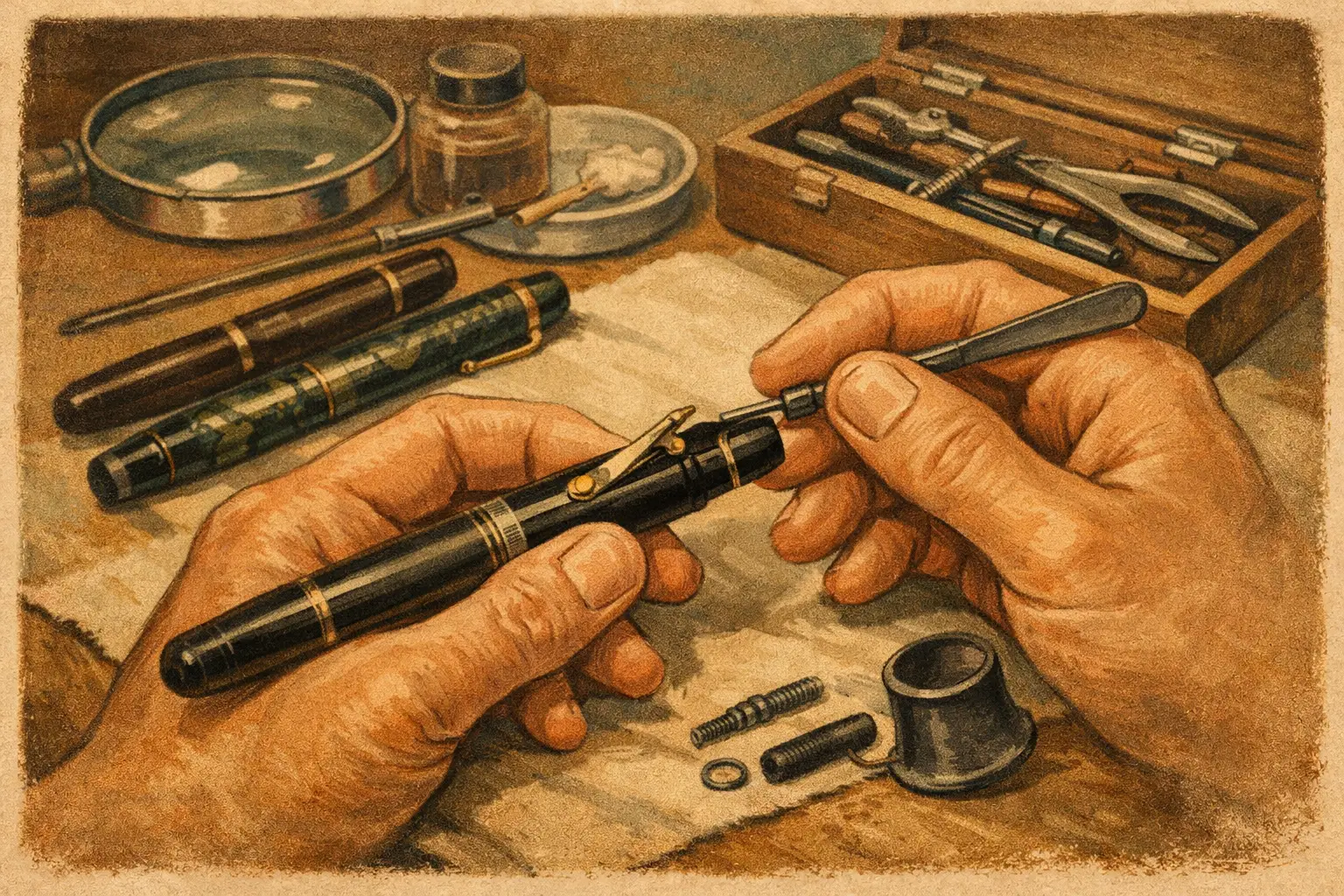
A lever that will not move can turn a handsome vintage fountain pen into a display piece very quickly. Yet repairing pen levers is rarely just a matter of freeing a stuck bar or fitting a brighter-looking replacement. On a Parker Duofold, Conway Stewart, Waterman or other lever-filling pen, the mechanism is tied directly to the ink sac, the barrel, the trim and, ultimately, the pen’s collector value.
A properly restored lever should lift with controlled resistance, depress the pressure bar cleanly and sit flush against the barrel when closed. It should not rattle, scrape the celluloid, spring open, or require force. Knowing the difference between a modest adjustment and a full restoration helps preserve both the writing experience and the integrity of the original instrument.
What a Fountain Pen Lever Actually Does
The familiar side lever is part of a simple but carefully balanced filling system. When lifted, it pivots on a small pin or rivet and presses an internal pressure bar against the rubber ink sac. Closing the lever allows the sac to reinflate and draw ink through the section.
That apparent simplicity disguises several vulnerable components. The lever may be sound while the pressure bar has corroded. The pressure bar may work perfectly while the sac has hardened into a brittle plug. On some pens, the lever box – the metal fitting set into the barrel – has become loose or distorted. Treating the visible lever alone can therefore leave the real fault untouched.
The age of the pen matters. Early hard-rubber pens, marbled celluloid models and certain casein pens each react differently to pressure, moisture and heat. A repair approach suitable for a common 1950s lever-filler may be wholly unsuitable for a scarce pre-war example with fragile colour and chased detail.
Diagnosing a Fault Before Repairing Pen Levers
The most common mistake is forcing a lever because it appears reluctant. A stuck lever often indicates that an old sac has ossified around the pressure bar. Pushing harder can bend the lever, tear out its retaining pin, crack the barrel around the lever box or damage the internal bar.
Start with observation rather than movement. Check whether the lever sits level in its slot and whether there is a visible gap around the lever box. Look for corrosion, missing plating, a bent tip, or an unusually loose action. If the lever lifts but feels limp, the pressure bar may be detached, broken or no longer meeting the sac. If it lifts normally but the pen will not fill, the sac itself is the more likely culprit.
A gentle shake can reveal a loose pressure bar, but avoid repeatedly operating the mechanism before the pen has been opened. Dried ink, old rubber and corrosion can conceal several faults at once. This is particularly true of pens that have spent decades in a drawer rather than being regularly used.
Lever problems and what they can mean
A lever that is loose at the hinge may have a worn pin, enlarged holes in the lever box, or a fractured mounting. A lever that springs back before it reaches the barrel may be fouling the pressure bar or have been incorrectly shaped during an earlier repair. One that sits proud of the barrel can indicate a bent lever, a displaced box, or a replacement part that does not properly match the model.
Discolouration is not automatically a reason to replace a lever. Gentle age-related wear can be entirely appropriate on a vintage pen, especially where the cap band and clip show similar patina. Bright new plating on one small component may look less convincing than a correctly functioning original lever with honest signs of age.
Why the Ink Sac Must Be Considered
On most lever-fillers, a lever repair and sac replacement belong together. The lever cannot be meaningfully tested against a sac that has perished, and fitting a new sac without checking the pressure bar risks another dismantling shortly afterwards.
After careful section removal, the old sac is cleared from the nipple, the pressure bar is inspected, and the inside of the barrel is examined for debris and corrosion. The correct sac size is selected to suit the pen’s internal dimensions. Too large a sac can make lever closure difficult and place stress on the barrel. Too small a sac reduces ink capacity and may fail to make reliable contact with the pressure bar.
The replacement sac also needs suitable clearance. It must not snag on the lever box, twist around the pressure bar, or bunch near the section. A pen may appear to fill after a hurried repair yet suffer poor ink flow, weak capacity or premature sac failure in use.
When an Original Lever Can Be Saved
Preserving an original lever is normally preferable when it remains structurally sound. A specialist can often correct a slight bend, secure a loose pivot, clean oxidation, or adjust the relationship between lever and pressure bar. These small interventions retain the pen’s original character and avoid the uncertainty of matching a replacement.
However, conservation has limits. A lever with severe metal fatigue, a snapped pivot area, deep corrosion or missing material may no longer be reliable. The aim is not to keep every original part at any cost. A vintage fountain pen should be safe to operate, and a weak lever can cause further damage to an otherwise excellent barrel.
Replacement is often sensible where a period-correct part is available and the alternative is an unstable repair. Even then, the fit must be assessed with care. Lever profiles, lengths, plating tones and pivot arrangements vary between manufacturers and models. A generic lever may physically fit the opening but sit at the wrong angle or damage the pen over time.
The danger of a poor replacement
A badly fitted replacement lever can enlarge the barrel opening, scrape surrounding celluloid or fail to align with the pressure bar. It may also mislead a future owner about the pen’s originality. On a collectible model, the quality of the repair is part of the provenance. A discreet, well-documented sympathetic replacement is far more desirable than a crude alteration that cannot easily be reversed.
For this reason, retain any removed original part where practical. Even a damaged lever can be useful as a reference for profile, finish and manufacturer-specific construction.
Tools Are Not the Same as Expertise
Vintage pen restoration uses deceptively modest equipment: fine pliers, pin punches, section pliers, sac tools, magnification and controlled heat where appropriate. The important distinction is not owning the tools but knowing when not to use them.
Heat, for example, can help release a section sealed with old shellac, but excessive heat can warp celluloid, damage plating, fade colour and distort a lever box. Likewise, a pin punch can remove a lever pivot neatly in experienced hands, but one misplaced strike can split the surrounding barrel or deform the box beyond straightforward correction.
Adhesives deserve equal caution. A loose lever box may tempt an owner towards a quick household glue repair. Most such fixes create future complications, seep into the mechanism and make later professional work more difficult. Restoration materials should be chosen for compatibility, restraint and the possibility of future servicing.
When to Leave the Repair to a Specialist
A straightforward sac replacement on a common, already worn pen can be a rewarding workshop task for an experienced hobbyist. Repairing the lever assembly itself is more demanding, particularly if the pen has a cracked barrel, a loose box, missing trim, unusual construction or significant collector value.
Seek specialist attention if the lever is seized, the box moves in the barrel, the pivot is missing, the pressure bar is corroded, or the pen is made from fragile material. The same applies to valuable examples from recognised makers, where an apparently minor intervention can affect desirability. Heritage Collectables approaches these repairs with the same priority given to every restored instrument: the pen should remain faithful to its period while being ready to write again.
Before commissioning work, ask what will be retained, what may need replacing, and whether a replacement will be period-correct or newly made. A good restoration is transparent about those choices. It respects the pen as an object of design history, not merely a container for ink.
Using a Restored Lever-Filler Well
Once restored, a lever-filling fountain pen benefits from regular but gentle use. Fill it with fountain pen ink rather than waterproof drawing ink or India ink, wipe the section after filling, and do not leave old ink to dry in the pen for years. Lift the lever only as far as its natural travel permits and close it without snapping it against the barrel.
If resistance changes noticeably, stop rather than forcing it. A prompt inspection may turn a minor adjustment into a simple service instead of a more involved repair. The pleasure of a vintage lever-filler lies partly in that small, deliberate action – a mechanism designed generations ago still doing its work with quiet precision.