
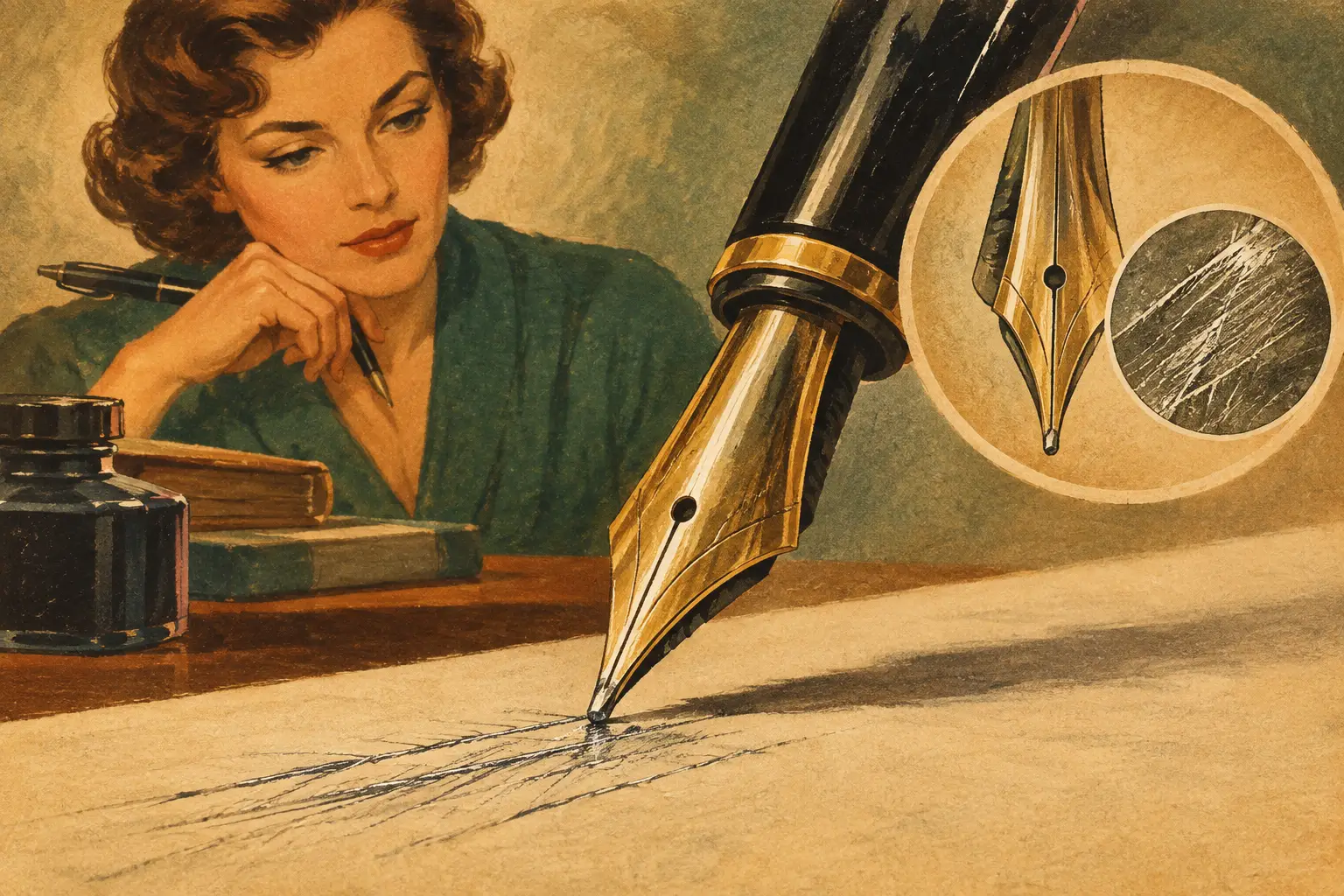
A fountain pen should tell you something about the paper beneath it. A little feedback can feel precise, controlled and characterful, particularly with a fine vintage nib. Scratching is different: it catches, drags, skips or feels as though one tine is digging into the page. If you have wondered why pen nibs scratch, the answer is rarely just that the nib is old. Most causes are identifiable, and many can be corrected without compromising the character of a valued pen.
Scratchy, toothy or feedback: knowing the difference
Before assuming there is a fault, distinguish between feedback and scratchiness. Feedback is the faint, audible resistance of nib on paper. It is common in extra-fine and fine nibs, whose small writing points naturally reveal more of the paper’s texture. Many writers actively prefer it, especially for deliberate handwriting, annotations and precise work.
Scratchiness feels less even. The pen may write smoothly in one direction but catch on downstrokes, cross-strokes or loops. It may become worse when the nib is turned slightly, or it may leave intermittent dry lines. A broad nib can also scratch, but the sensation is often most obvious with finer grades because there is less tipping material at the point of contact.
A vintage nib need not feel like a modern, highly polished medium. Its appeal may lie in a responsive semi-flex action, a crisp fine line or a degree of pencil-like feedback. Restoration should preserve that intended writing character, not reduce every nib to the same glassy feel.
Why pen nibs scratch: the most common causes
Misaligned tines
The two tines should meet at the same height, with the slit centred and open enough for ink to travel to the tip. If one tine sits even fractionally higher than the other, its edge can catch the paper fibres. This is the classic cause of a nib that feels pleasant in one direction and distinctly sharp in the other.
Tines can become misaligned through a knock, being pressed too firmly against paper, or an earlier attempt at adjustment. Flexible vintage nibs deserve particular care. Their ability to spread under pressure is part of their charm, but it also means they should not be forced or treated like a firm modern steel nib.
Rough, worn or damaged tipping
The writing point of a good fountain pen nib is usually finished with a hard tipping material. Over many years, this material can wear into an uneven shape. A tiny flat spot is not automatically a problem, but a sharp edge, a burr or a chipped area can make the nib catch.
Damage is not always easy to see without magnification. A nib may look perfectly sound from above while the underside of the tipping has a small rough patch. This is why aggressive home polishing can be a false economy: it can remove useful tipping, alter the line width and spoil a nib that needed only careful alignment.
Ink flow that is too dry
A scratchy sensation is sometimes a lubrication problem rather than a point problem. Fountain pen ink helps the nib glide across the page. When flow is restricted, the pen feels dry and resistant, and may skip on the first stroke after a pause.
Dried ink in the feed, an old sac or converter issue, a poorly seated cartridge, or simply an ink that runs dry in that particular pen can all contribute. Vintage pens that have been stored unused for years often benefit from a proper clean before any conclusion is reached about the nib. Ink residue can sit unseen in the feed channels and interfere with a pen that is otherwise mechanically sound.
Paper and ink combinations
Not every pen and paper combination is kind to a fine nib. Highly absorbent office paper can feather, catch at fibres and make a perfectly aligned nib feel harsher than it does on smoother writing paper. Coarse, recycled or heavily textured stock can exaggerate normal feedback.
Ink matters as well. Some inks are notably wetter and more lubricated than others, while permanent, pigmented or shimmer inks may demand more diligent cleaning. There is no universal best pairing. A crisp extra-fine Parker, Waterman or Conway Stewart nib may feel excellent with one well-behaved ink and noticeably drier with another.
Writing angle and pressure
Fountain pen nibs are designed to write with the tipping material resting on the page, not with the bare edge of the nib pushed into it. Holding the pen unusually upright, rotating it too far, or applying ballpoint-like pressure can produce catching and hard starts.
This is particularly relevant when returning to fountain pens after years of using ballpoints. Let the pen’s own weight do more of the work. A light hold and a slightly lower writing angle often reveal whether the apparent scratchiness is actually a technique issue. That said, a properly adjusted nib should tolerate ordinary variations in hand position without feeling hostile.
A sensible way to diagnose a scratchy nib
Start with the least invasive checks. Flush the pen with clean water where appropriate for its filling system, then fill it with a reliable fountain pen ink. Write several lines on smooth, fountain-pen-friendly paper, including verticals, horizontals and figure eights. Notice whether the catch occurs in one particular direction or all the time.
Next, inspect the nib in good light. Look directly at the tip rather than only at the upper surface. The tines should appear level, symmetrical and free from obvious debris. Do not pull them apart to improve flow, and do not press the nib hard into paper to make it write wetter. Both actions can create a larger problem, especially on an irreplaceable vintage nib.
If the pen remains dry, a thorough clean may be enough. If it catches consistently in one direction, tine alignment is a likely suspect. If it is rough in every direction even with good flow and suitable paper, the tipping may need professional attention.
When home care is appropriate, and when it is not
Routine care is entirely worthwhile. Regular flushing, sensible ink choice and using clean paper help preserve a nib’s performance. Removing visible dried ink from the nib with water and a soft cloth is generally straightforward, provided the pen’s materials and filling system are respected.
Adjustment is another matter. Experienced users may make very minor corrections on inexpensive modern pens, but vintage fountain pens are not ideal practice pieces. Gold nibs, plated trim, delicate feeds and ebonite components can all be damaged by unsuitable tools, excess force or heat. A pen with historical value should be assessed as an instrument, not merely as a writing point to be smoothed.
Avoid nail files, household abrasives and enthusiastic use of polishing films. These may make a nib feel smoother for a moment while removing too much tipping or rounding an originally crisp writing point. The result can be a broader, less distinctive line and lower collector appeal.
The value of sympathetic nib work
Proper nib work is precise rather than dramatic. A specialist examines alignment, flow, tine gap, tipping shape and the way the pen writes under realistic pressure. The aim is not to make every nib broad and buttery. It is to make the pen reliable, comfortable and true to its grade and period.
That distinction matters with restored instruments. A fine 1930s nib should still offer a fine line; a flexible nib should still respond without being overworked; a firm accountant-style nib may retain purposeful feedback while no longer snagging fibres. The best restoration respects both usability and originality.
A scratchy nib is therefore not necessarily a disappointment, nor an excuse to abandon a promising vintage pen. Often it is a small signal that the pen needs cleaning, a better ink and paper pairing, or informed adjustment. For collectors and everyday writers alike, that careful attention is part of the pleasure of owning a well-made writing instrument. If a favourite pen continues to catch after the basic checks, entrusting it to a specialist such as Heritage Collectables can protect the nib, the pen’s history and the enjoyment it was made to provide.