
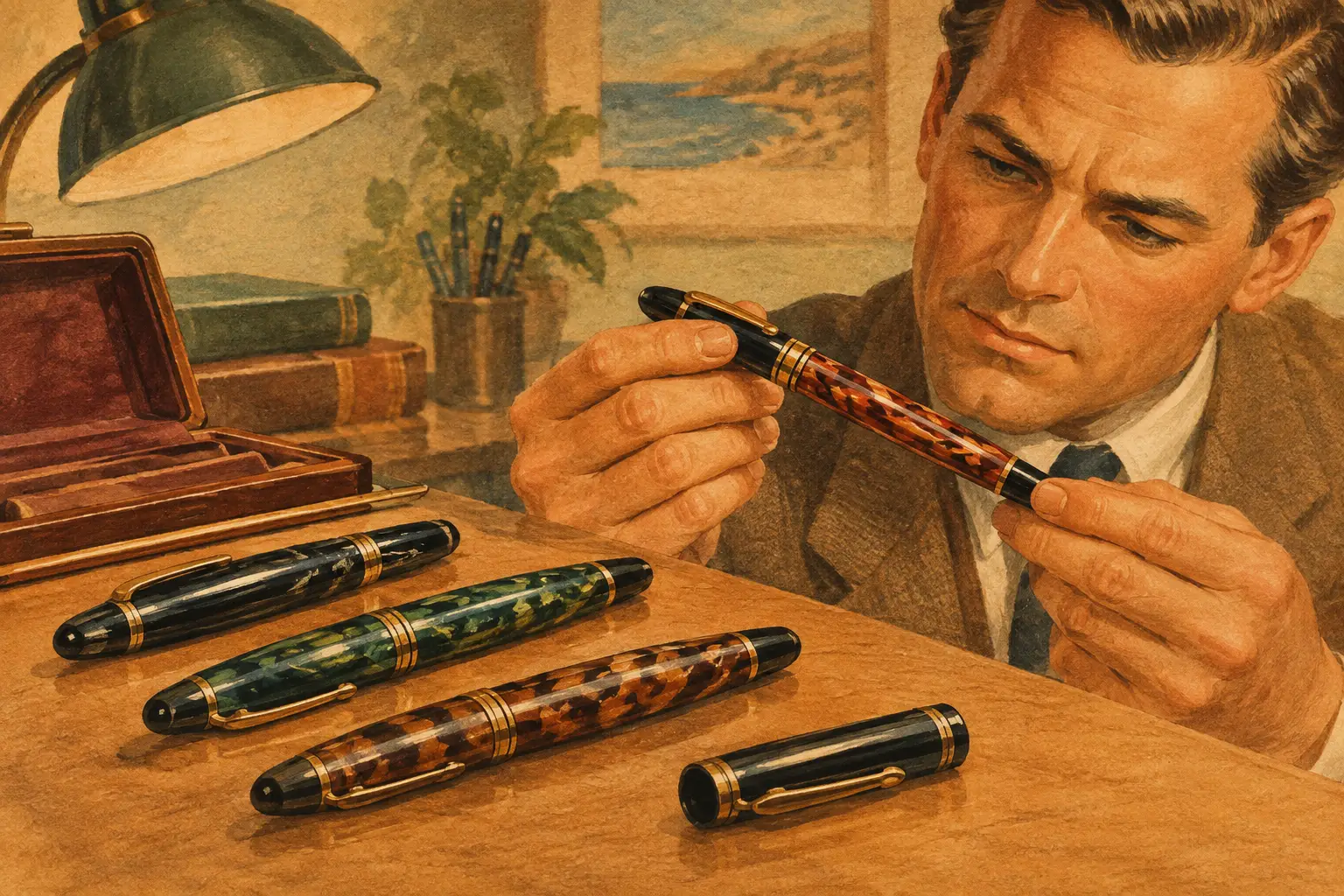
A celluloid fountain pen can look perfectly sound in a tray, yet refuse to accept its cap, show a proud trim ring, or develop a hairline split around the section. So, can celluloid shrink? Yes. It can, although the change is often uneven, slow, and easily confused with ordinary wear, distortion or damage from an earlier repair.
For collectors, this matters because celluloid is among the most beautiful materials used in vintage pens. Its depth of pattern and colour gave makers such as Conway Stewart, Waterman, Parker and Sheaffer finishes that are still difficult to match. It also asks more of its owner than hard rubber, acrylic or modern injection-moulded plastics. Recognising shrinkage early can make the difference between a pen that remains a pleasurable writer and one that becomes unsafe to use.
Can Celluloid Shrink in a Vintage Fountain Pen?
Celluloid is an early plastic, commonly made from cellulose nitrate and camphor. Camphor acts as a plasticiser, helping the material remain workable and less brittle. Over many decades, it may slowly migrate or evaporate. The celluloid can then become drier, less flexible and, in some cases, slightly smaller.
Shrinkage is not always uniform. A barrel may tighten around a metal cap band while the cap remains stable, or a cap lip may contract enough to make removal difficult. Different thicknesses, colours, manufacturing batches and storage histories all affect the outcome. A pen kept for years in heat, direct sunlight or a very dry environment may show more change than an equivalent example stored carefully.
It is also worth separating genuine shrinkage from other faults. A loose or lifted band may result from failed adhesive. A bowed barrel can be heat distortion. A cap that will not seat may have a damaged inner cap or altered threads. Only close inspection can establish which issue is present, and several problems can exist together on one instrument.
The signs collectors should look for
The most familiar sign is trim that no longer sits comfortably. A cap band may appear too wide for the cap, stand slightly proud, or leave a visible ridge where the celluloid has drawn away. On some pens, the metal may effectively restrain the material, creating stress that later becomes a crack.
Look along the barrel and cap under good, indirect light. Fine circumferential cracks near bands, at the cap lip, around the section joint or by a lever slot deserve attention. So do ripples, slight pinching, or an unusual change in the way parts meet. A section that once fitted correctly may become tightly wedged as its surrounding barrel changes.
The feel and smell can offer clues too. Healthy celluloid may have a faint, old-plastic or camphor-like scent, especially in a closed case. Deteriorating cellulose nitrate can produce a much sharper chemical odour. A sticky surface, whitening, crazing, discolouration or a powdery bloom are more serious warning signs than shrinkage alone. These may indicate active degradation rather than a stable historical change.
Do not assume that an attractive finish is automatically stable. Striated, pearlescent and vividly patterned celluloids vary greatly in condition, even within the same model. A careful assessment is more useful than a broad judgement based on colour or brand.
Why Celluloid Changes Over Time
Age is part of the story, but storage conditions often decide how quickly problems emerge. Celluloid is vulnerable to heat and ultraviolet light. A sunny windowsill, hot car or radiator shelf can accelerate distortion and chemical ageing. Damp conditions are not kind either, particularly where moisture is trapped in an airtight, poorly ventilated case.
Celluloid also changes as it releases or reacts with compounds over time. In advanced cases, degradation can be self-perpetuating: the material produces gases that encourage further deterioration. This is why a pen with a strong acrid smell should not be shut away with healthy pens. The concern is not merely cosmetic. As the material loses flexibility, threads, cap lips and thin decorative areas become more liable to fracture.
Metal fittings complicate matters. Bands, clips and overlays do not shrink in the same way as celluloid. Where the material draws in against a rigid component, stresses concentrate at the edge. A collector may first notice the fault as a lifted band, but forcing that band back into place can split the cap. The correct treatment depends on whether the trim is loose, the celluloid has contracted, or corrosion and an old repair are involved.
What Not to Do With a Shrinking Celluloid Pen
The temptation with a tight cap or stuck section is to add force. That is precisely how otherwise repairable pens lose their cap lips, threads or barrel ends. Never use pliers, boiling water, a heat gun or household solvents on a suspected celluloid problem. Gentle warmth has a place in experienced repair work, but celluloid is not a material for casual heat treatment.
Avoid polishing aggressively in the hope of restoring a bright finish. Abrasive compounds may remove a thin surface layer, soften crisp chasing or conceal early crazing until it worsens. Equally, oils, silicone products and strong cleaners do not reverse shrinkage. They may leave residue that attracts dust or complicates later restoration.
A problematic pen should not be kept tightly capped simply because that is how it was found. If removal takes appreciable force, stop. Repeated stress at the cap lip can turn a small fitting issue into a clean break. The same caution applies to lever fillers and button fillers: do not operate the mechanism until the barrel, pressure bar and sac condition have been checked.
Storage That Gives Celluloid Its Best Chance
Stable, moderate conditions are the aim. Keep celluloid pens away from direct sunlight, radiators, lofts, sheds and places subject to strong temperature swings. A drawer or cabinet in a normally occupied room is usually preferable to an extreme environment. Avoid sealing a collection in an airtight plastic container, particularly if any pen has an unusual odour or visible deterioration.
Store pens separately enough that you can inspect them, and avoid allowing clips and metal furniture to press into neighbouring barrels. Soft individual sleeves or divided pen trays are sensible, provided they are clean and non-reactive. For long-term collection storage, periodic observation is more valuable than setting a pen aside and forgetting it for years.
If a pen smells sharply acidic, feels sticky, shows powdering, or appears to be deteriorating rapidly, isolate it from the rest of the collection. Photograph its condition and seek specialist advice. The purpose of isolation is caution, not alarm: many vintage celluloid pens remain stable for decades, but active degradation needs proper assessment.
Can a Shrunken Celluloid Pen Be Restored?
Restoration can often make a pen safe and presentable, but it cannot reliably return lost material or reverse chemical ageing. A specialist may be able to stabilise a crack, refit or carefully manage trim, replace a perished ink sac, correct a previous poor repair, and assess whether the pen can be used. The best result is sometimes a pen restored for gentle writing; at other times, it is a historically important piece preserved as a display example.
That distinction is worth making before purchase. A rare celluloid pen with a slightly proud band may still be a desirable collector’s piece if it is stable, accurately described and priced accordingly. A common pen with deep cap-lip cracks and active deterioration may be better valued for parts or avoided altogether. Rarity does not remove the physical risks of the material.
When considering a restored vintage pen, ask how it has been assessed, whether the filling system has been serviced, and whether there are known material limitations. At Heritage Collectables, restoration is approached with the understanding that originality, stability and usability must be balanced rather than treated as competing afterthoughts.
A Practical Inspection Before You Buy or Use
Examine the alignment of cap, barrel and section. Check whether trim lies flush, but do not press it down. Look for cracks under the clip, around cap bands and beside lever slots. If photographs show a cap sitting unusually high or a line around the cap lip, ask for a clear explanation before committing.
For a pen already in your collection, inspect it several times a year and make a note of any change in fit, smell or surface appearance. Use only gentle handling. If it is inked, flush it appropriately before storing it for an extended period, but do not dismantle a tight section merely to satisfy curiosity.
Celluloid rewards patience. Its finest patterns have survived because earlier owners treated them as more than ordinary plastic. Give a changing pen room, stable conditions and informed attention, and it may continue to be appreciated – and, where condition permits, written with – for many more years.