
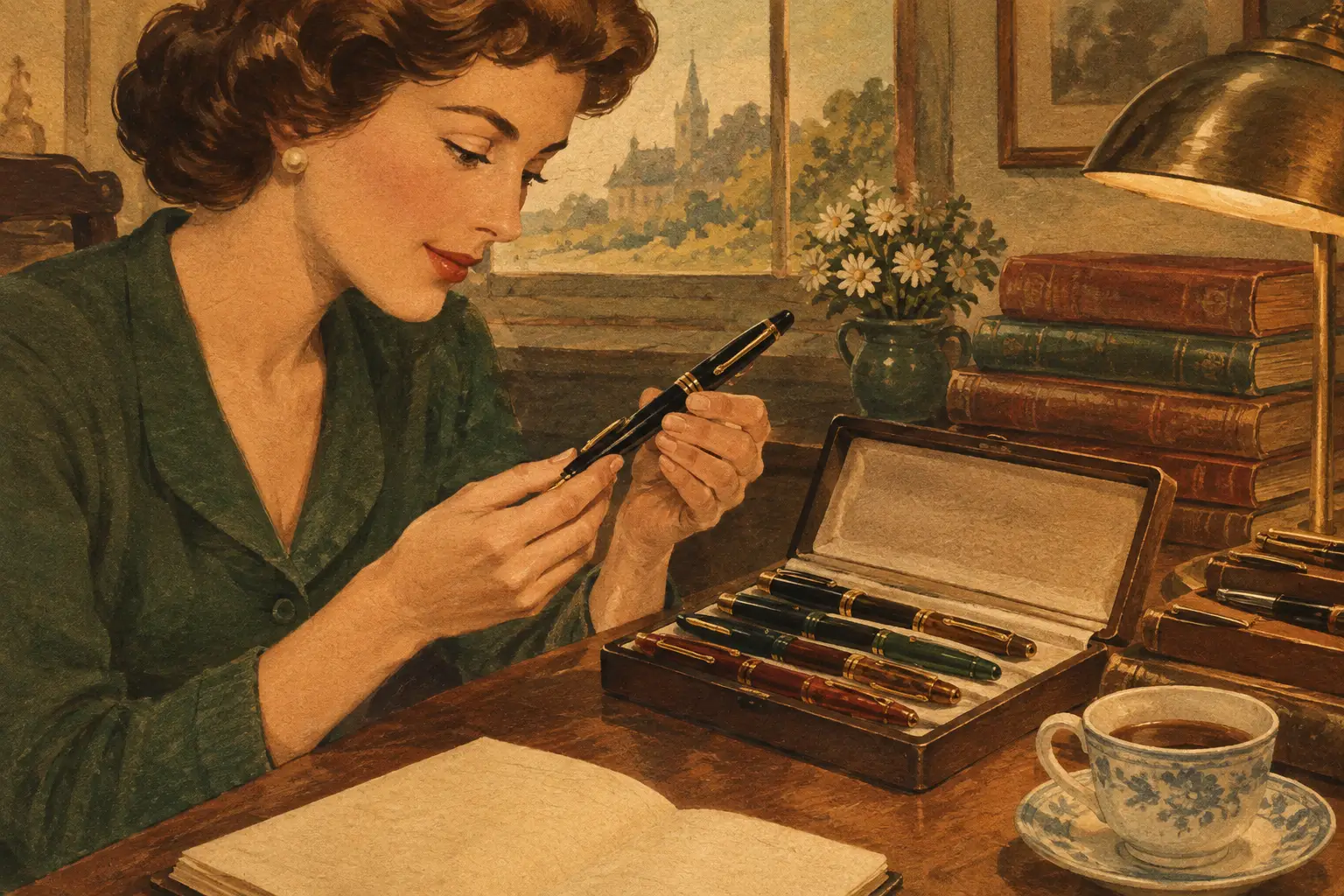
A vintage pen should not spend its entire life in a drawer. The pleasure of pen collecting lies in picking up an object made decades ago, feeling the balance of its barrel, and finding that it still puts a proper line of ink on paper. A well-chosen Parker, Waterman, Conway Stewart or Sheaffer can be a small piece of design history, but it can also be the pen you reach for when a message deserves more than a hurried signature.
For many collectors, that combination is the point. Vintage writing instruments reward close attention: materials, filling systems, nib character, condition and provenance all matter. Yet a collection does not need to begin with rare museum pieces or follow somebody else’s idea of what is valuable. It needs direction, sound condition and the confidence that each instrument has been properly assessed.
Why pen collecting becomes personal
Pens were once everyday tools, made in extraordinary variety. Manufacturers competed through colour, filling mechanisms, nib design, clips and advertising. A 1930s celluloid fountain pen, a post-war aerometric filler and a British-made lever-filler tell different stories about changing tastes and technology.
That variety gives a collection its character. One person may focus on Parker Duofolds in rich marbled finishes; another may look for elegant Waterman lever-fillers, early Conway Stewart colours or German piston-fillers from Pelikan and Montblanc. Others build a working selection around nibs: a fine nib for annotations, a medium for correspondence, and a flexible nib for expressive writing.
The most satisfying collections often have a simple rule. It might be one maker, one decade, one material or pens connected to a particular place. A collecting focus helps when a tempting purchase appears, because it asks a useful question: does this add something meaningful, or is it simply another pen?
Start a pen collection with a useful first piece
A first vintage fountain pen should be enjoyable rather than intimidating. Choose a recognised maker with a practical filling system, a sound cap and barrel, and a nib that suits how you write. For regular use, a restored lever-filler, button-filler, piston-filler or aerometric model can be an excellent choice, provided its internal components have been correctly serviced.
Do not assume that age alone creates value. An uncommon pen with cracks, corrosion or a damaged nib may be a demanding restoration project, while a more familiar model in excellent restored condition can give years of reliable use. Rarity, condition, original features and desirability work together. The maker’s name matters, but it is not the whole story.
Size deserves attention as well. Many earlier pens are smaller than modern instruments, and a pen that looks superb in photographs may feel slight in a large hand. Posted cap length, barrel diameter and weight are all worth considering. A good dealer should make these details clear, particularly when the pen is being bought for daily writing or as a gift.
Restoration is part of the value
A vintage pen is a mechanical object, not merely an ornament. Its sac, seals, diaphragm, piston, pressure bar or breather tube may have been designed for a working life that ended many decades ago. A pen can look immaculate while being unable to hold ink safely.
Professional restoration addresses the parts that allow a pen to function as intended. Depending on the model, this may involve replacing a perished ink sac, servicing a piston, fitting a correct diaphragm, cleaning the feed, adjusting the nib and checking that cap and barrel threads are secure. Care is needed throughout. Over-polishing can erase chased patterns and soften crisp engraving; unsuitable replacement parts can compromise both operation and collector appeal.
There is a trade-off to understand. A fully restored pen is usually the sensible option for someone who intends to write with it, and it offers reassurance for a newer collector. An untouched example may appeal to a specialist who values originality or enjoys repair work, but it should be bought with a realistic view of its condition and likely cost. Heritage Collectables concentrates on restored vintage instruments because usability is an essential part of their appeal.
Questions worth asking before you buy
Condition descriptions should be specific rather than vague. Before adding a pen to your collection, establish whether it has been tested and how it was restored. Ask about nib material and tip size, any plating wear, visible cracks, personalised engraving, barrel discolouration and whether the mechanism fills and expels ink cleanly.
Four areas are especially worth checking:
- The nib should be correctly aligned, with no obvious cracking, severe corrosion or damaged tipping.
- The cap should fit securely, and threads, clip and lever or button should operate without strain.
- The filling system should have been tested with water or ink after restoration.
- The description should distinguish honest age-related wear from faults that affect use or value.
Photographs are important, but they cannot always show a hairline cap-lip crack, a distorted nib or the feel of a hesitant lever. Clear descriptions and a sensible returns policy are valuable safeguards, particularly when buying online from another country.
Build around nibs, not only brands
A fountain pen’s nib is where collecting becomes writing. Two nominally identical pens can feel entirely different. One may have a firm fine line suited to a diary; another may offer a soft medium stroke with gentle line variation. Vintage nibs are often admired for their responsiveness, although flexibility should never be assumed from age or gold content alone.
A broad collection gains depth when it includes different writing experiences. Fine nibs suit smaller handwriting and everyday notes. Medium nibs tend to be adaptable. Broad and italic nibs show off shading inks and make a statement on good paper, while flexible nibs ask for a lighter, more deliberate hand. If you are used to pressing hard with a ballpoint, begin with a firm nib and let the pen do the work.
Ink choice also matters. A conventional fountain pen ink is usually the best place to start with a restored vintage pen. Highly saturated, shimmering or permanent inks can be attractive, but they may demand more frequent cleaning and are not always suitable for older mechanisms. Regular flushing and sensible storage will protect both the feed and the filling system.
Condition, originality and the collector’s eye
Collectors often face a choice between pristine appearance and honest originality. A pen with light brassing to its trim, gentle wear to a cap band or faint signs of use may still be very desirable if its structure is sound and its finish remains attractive. Such marks can be part of an object’s history.
More serious concerns include cracks around the cap lip, shrinkage in celluloid, loose trim, distorted sections and deep discolouration. Black hard rubber can oxidise to brown or olive tones, while some celluloids are prone to staining or warping. These issues do not automatically make a pen undesirable, but they should be reflected in its price and stated clearly.
Originality needs context. A new sac inside a lever-filler is a necessary service part, not a loss of character. Replaced decorative trim, altered nibs or aggressive refinishing are different matters. The right question is whether work has preserved the pen’s function and integrity, or disguised a problem.
Give the collection a place and a routine
A good collection needs calm, dry storage away from direct sunlight and sharp changes in temperature. Celluloid and hard rubber deserve particular care. Keep pens separated in a pen case, tray or rack so that clips and barrels do not rub against one another. Avoid leaving an inked pen near a radiator, in a car or in a pocket for long periods.
For pens used regularly, clean them when changing ink and before storing them for an extended time. Empty the pen, flush gently with cool water until it runs clear, then allow it to dry. Do not force a stiff mechanism. A vintage pen that suddenly resists filling is asking for inspection, not extra pressure.
It is also worthwhile to keep a simple record of purchases: maker, model, approximate date, nib, restoration details, price and any notable marks. This turns a group of possessions into a properly understood collection. It also makes insurance, future selling and the search for missing variations far easier.
Let the collection develop at its own pace
The best finds are not always the most expensive or the most famous. A modest British pencil in an unusual finish, a Victorian dip nib with fine engraving, or a well-restored fountain pen in a colour you have not seen before can become a lasting favourite. Leave room for those discoveries.
Buy from descriptions you trust, learn the familiar details of the makers you enjoy, and use the pens whenever the occasion allows. With each line of ink, pen collecting becomes less about owning old objects and more about keeping fine writing instruments alive.