
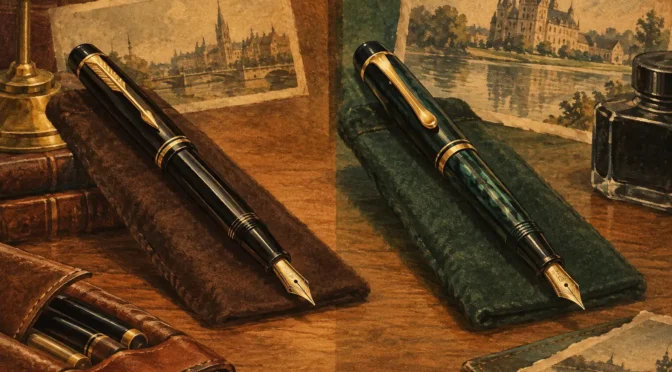
A Parker 51 can feel like a precisely engineered tool from the moment its hooded nib meets paper. A Pelikan 400, by contrast, often announces itself through its striped barrel, generous ink window and a nib that seems made to put character into every line. Parker versus Pelikan is not simply a contest between two famous names. It is a choice between two distinct approaches to fountain pen design, ownership and writing pleasure.
For a collector, the appeal lies as much in the differences as the reputations. Both manufacturers produced pens of outstanding quality, both have models that reward careful restoration, and both remain entirely practical to use. Yet the best choice depends on whether you value quiet reliability, expressive nibs, celluloid charm, industrial design, or a particular place in writing history.
Parker versus Pelikan: two design philosophies
Parker built much of its success on practical innovation and broad appeal. The American company was exceptionally good at identifying the small frustrations of everyday writing and designing them out. The button-filling Duofold made a strong visual statement in the 1920s, while the Vacumatic introduced an ingenious diaphragm filling system and a transparent striped barrel that revealed the ink supply. Then came the Parker 51, a pen so thoroughly considered that it became one of the defining fountain pens of the twentieth century.
Many vintage Parkers feel purposeful. Their styling can be handsome, even glamorous, but it rarely gets in the way of use. The Parker 51’s hooded nib, collector and cap arrangement were designed to reduce drying and make the pen dependable for busy writers. The later Parker 61, 75 and classic Duofold ranges each carry their own character, yet the consistent theme is intelligent, user-led engineering.
Pelikan takes a rather different path. Its German-made piston fillers are renowned for their capacious reservoirs and straightforward operation. The classic Souverän-style shape, particularly in the 100, 400 and 800 families, has a reassuringly traditional balance: rounded ends, striped barrel material, a visible ink window and an elegant beak clip. A Pelikan seldom needs to shout to be recognised by an enthusiast.
Where Parker often refined the writing instrument for the widest possible audience, Pelikan cultivated a more personal relationship between pen, ink and hand. The piston mechanism makes filling a small ritual. The nib units, especially on later models, can be removed for cleaning or exchange. The writing experience is often wetter and more expressive, with line variation and softness available in a way that many Parker nibs deliberately avoid.
Writing character: precision or expression?
This is where the Parker versus Pelikan decision becomes especially personal. A well-restored Parker 51 is one of the finest choices for someone who wants a vintage fountain pen to work without ceremony. Its nib is usually firm, controlled and smooth, with a modest line that suits notes, correspondence and prolonged writing. It is an excellent pen for those who enjoy vintage design but do not want to adjust their writing habits around it.
The Vacumatic can offer more visual flair and a livelier feel, though its filling system requires knowledgeable servicing. Its semi-transparent laminated celluloid remains one of the most attractive materials used in mass-produced fountain pens. A good example is a joy to own, but it deserves a restorer who understands diaphragms, breather tubes and the correct assembly of the mechanism.
Pelikan nibs, particularly vintage gold examples, are admired for their responsive feel. A 1950s Pelikan 400 with an oblique or broad nib can make ordinary handwriting feel considered and individual. This does not mean every Pelikan is flexible – many are firm or semi-flexible rather than true flex nibs – but they often provide more spring and shading potential than the typical Parker.
That expressiveness brings a trade-off. A wetter Pelikan nib may ask more of the paper and ink. On poor-quality office paper, a fine Parker 51 can be more forgiving. For journals, letters and quality stationery, a Pelikan’s generous flow and responsive nib can be wonderfully satisfying. Neither is universally better; the question is whether you want the pen to disappear into the task or become part of the experience.
Filling systems and the realities of restoration
A vintage pen should be judged not only by its appearance but by the condition of the parts hidden inside. This is particularly relevant when comparing Parker and Pelikan, because their best-known models use very different filling systems.
Parker offers considerable variety. Button fillers, Vacumatics, aerometric fillers, cartridge/converter pens and capillary designs all appear across its long history. The aerometric Parker 51 is especially respected because, when properly restored, it is durable and easy to fill. Its pli-glass sac is generally long-lived, although age, ink residue and poor previous repairs must always be considered.
Vacumatics are more specialised. Their diaphragms are consumable parts, and a correct restoration involves much more than fitting a replacement. The transparency of the barrel, condition of the celluloid, breather tube and pump action all matter. They are rewarding pens, but a bargain that does not fill correctly is not necessarily a bargain.
Pelikan’s piston system is wonderfully practical when sound. It draws a substantial quantity of ink directly from the bottle, avoids the need for sacs and gives the owner a clear view of the ink level. However, a seized piston, hardened seals or a cracked barrel can make restoration technical work. Older celluloid models should be examined carefully for shrinkage, discolouration and cracking around the section or cap threads.
For either maker, restoration quality is part of the pen’s value. A polished exterior cannot compensate for a poorly fitted sac, a leaking feed, damaged threads or a nib that has been improperly smoothed. Buying from a specialist who tests the fill, flow and operation offers reassurance, particularly for a first vintage purchase. At Heritage Collectables, restored pens are selected for the pleasure of using them as well as for their place in a collection.
Collectability, value and the models worth seeking
Parker provides a particularly broad collecting field. Early hard rubber pens, colourful Duofolds, Vacumatics in different laminations, the many variants of the Parker 51, and later pens such as the 75 give collectors years of interest. Rarity, condition, trim, filling system and nib all affect value. A common model in a scarce colour or with an unusual nib can be more compelling than a nominally higher-grade pen.
The Parker 51 remains an excellent entry point because there are many examples, it has a substantial history and it is genuinely useful. Collectors who enjoy colour and material often move towards Vacumatics or Duofolds. Those who prefer a more modern, balanced instrument may find the Parker 75 especially appealing, with its distinctive grip reference marks and range of finishes.
Pelikan collecting tends to be more concentrated around model families, but no less absorbing. The 100 and 100N represent early milestones, while the 400 and 400NN are favourites among users and collectors for their size, striped celluloid and excellent nibs. Larger models such as the 500, 600 and 800 appeal to those who prefer greater weight or presence. Tortoiseshell finishes, rare cap bands, unusual nib grades and clean ink windows can materially increase desirability.
Condition is crucial with both brands, but it presents differently. Parker collectors often look closely at cap condition, plating, barrel transparency and correct matching parts. Pelikan buyers should pay equal attention to barrel clarity, cap lip integrity, piston operation and the absence of celluloid deterioration. Originality matters. A pen that has been sympathetically restored to working order is desirable; one assembled from mismatched parts or altered beyond recognition is a different proposition.
Which should you choose?
Choose Parker if you want a vintage pen with a strong record of dependable daily use, clever engineering and a broad range of historic designs. The Parker 51 is difficult to beat for a first serious vintage fountain pen, particularly for regular note-taking, work and travel. A Vacumatic or Duofold makes greater visual impact while retaining genuine writing pedigree.
Choose Pelikan if the appeal of a piston filler, visible ink supply and expressive gold nib outweighs the desire for a more neutral writing tool. A sound Pelikan 400 or 400NN offers one of the most satisfying vintage writing experiences available: light in the hand, generous with ink and full of visual warmth.
The most rewarding choice is often the pen that makes you want to write another page. Handle examples where possible, ask about the restoration undertaken, and give proper attention to nib width and condition. A carefully chosen Parker or Pelikan is not merely a collectable object in a case – it is a small, working piece of design history waiting for the next letter, journal entry or signature.