
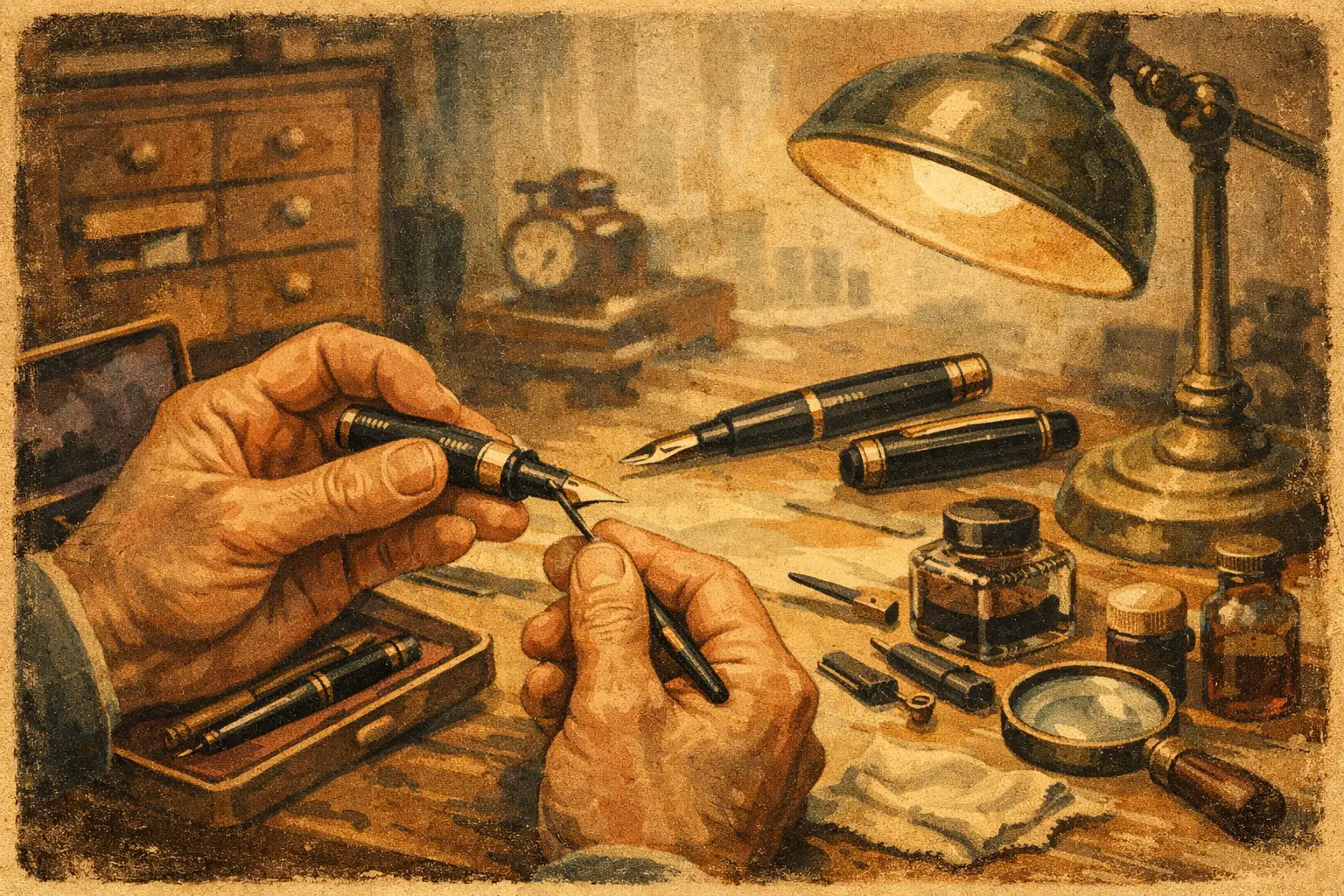
A vintage fountain pen can look beyond hope and still have decades of writing left in it. A perished ink sac, a seized piston or a cracked cap may make a pen unusable, but these are not always reasons to discard it. The best fountain pen repairs UK collectors seek are not simply about making ink flow again. They are about preserving the pen’s original character, function and value without replacing more history than necessary.
For a well-made Parker, Waterman, Conway Stewart, Sheaffer, Pelikan or Montblanc, careful restoration can turn an overlooked drawer find into a dependable daily writer. The deciding factor is not merely age. It is the condition of the material, the availability of correct parts and the standard of the work carried out.
What a Proper Fountain Pen Repair Involves
A fountain pen is a small mechanical object, often made from materials that behave very differently over time. Hard rubber can oxidise and discolour. Celluloid can shrink, craze or become unstable. Early plastics may crack at stress points, while cork, rubber and seals naturally harden after years without use.
Good repair work starts with diagnosis rather than immediate dismantling. A specialist considers the filling system, nib, feed, cap threads, section, barrel and trim as a whole. A pen that will not draw ink could have a failed sac, but it could also have a blocked feed, a damaged pressure bar or an air leak around the section. Treating the visible symptom alone is how unnecessary damage happens.
The aim should be sympathetic restoration. Where a component has reached the end of its useful life, such as a rubber sac or a worn seal, replacing it is sensible and expected. Where a part is original, sound and visually important, retaining it is usually preferable. This balance matters particularly to collectors, who want a pen to remain honest to its period as well as pleasant to use.
Common Fountain Pen Repairs in the UK
Some repairs are routine for a trained restorer, while others require a more cautious conversation about cost, value and risk. Most vintage pens can benefit from a thorough clean and service, but not every fault should be tackled in the same way.
Failed sacs, diaphragms and seals
Lever-fillers, button-fillers and many aerometric pens rely on flexible internal parts to hold and draw ink. Rubber sacs perish, diaphragms split and seals lose their compression. These are among the most common faults in vintage fountain pens and, provided the pen has not suffered deeper damage, are often straightforward to rectify.
The correct sac size and material matter. An incorrectly fitted sac can restrict ink capacity, obstruct the mechanism or split prematurely. On more complex filling systems, such as certain Vacumatic, snorkel and piston pens, specialist knowledge is especially valuable because the wrong approach can damage irreplaceable components.
Nib alignment and writing problems
A nib that scratches, skips or feels unpleasant is not necessarily ruined. Tines may be misaligned, the slit may be clogged with old ink, or the feed may no longer be delivering ink evenly. Careful adjustment can transform the writing experience, particularly with gold nibs that have been stored unused for many years.
There are limits. A severely creased nib, snapped tipping material or a crack at the base may need more extensive work, a donor part or a decision to keep the pen as a display piece. Nib repairs are skilled work, not a matter of pressing the tines into shape with household tools. A small mistake can turn a repairable nib into a replacement job.
Cracks, loose sections and cap problems
Cracks deserve prompt attention because ink and repeated handling can make them worse. A hairline crack in a cap lip may be stabilised, while a crack through a barrel can be more difficult, especially on thin-walled celluloid or valuable patterned material. The repair may make the pen usable, but it may still affect collector value. That is not a reason to avoid repair – it is a reason to set expectations honestly.
Loose sections, worn cap threads and weak clips also need a measured approach. Adhesives are sometimes appropriate, but only when they suit the material and allow for the pen’s future servicing. A permanent-looking fix that prevents the pen from ever being opened again is rarely a good outcome.
Piston and vacuum mechanisms
Piston-fillers and vacuum-fillers are admired for their engineering, but their internal mechanisms are more involved than a simple sac pen. Old lubricant, dried seals, worn cork or a damaged piston head can leave a pen stiff, leaking or incapable of filling.
These mechanisms often justify professional work, particularly on valuable Pelikan, Montblanc and early Waterman models. Parts availability varies. Some can be remade or carefully adapted; others are scarce enough that the repair route depends on whether preserving originality or restoring regular use is the greater priority.
When Is a Vintage Pen Worth Repairing?
Sentiment is a perfectly valid reason to repair a pen. A grandfather’s Parker 51 or a Conway Stewart given for a milestone birthday may be worth restoring even if its market value is modest. The pleasure of putting a family pen back into service is difficult to measure in pounds.
For collectors, condition and rarity matter more. A desirable model with an original nib, good colour and sound structure can usually justify a careful service. Conversely, a common pen with severe barrel damage, missing trim and an unsuitable replacement nib may cost more to repair than it is worth commercially.
That does not mean low-value pens have no place. They can make excellent writers and are often ideal for learning about vintage filling systems. The sensible question is not simply, “What is it worth?” Ask whether the repair will provide a reliable pen, preserve something meaningful or prevent further deterioration.
Before You Send a Pen for Repair
Do not force a stuck piston, lever or cap. Old ink can act like glue, and celluloid or brittle plastic can crack under pressure. Equally, avoid soaking the entire pen for days. Water may damage internal parts, lift old imprints or affect materials that require more controlled treatment.
Before arranging fountain pen repairs in the UK, record the pen’s make, model and visible faults. Take clear photographs of the nib, cap, barrel and filling mechanism. If a pen has been inked recently, empty it where possible and wipe the exterior gently with a soft cloth. It is helpful to mention whether it leaks, has a previous repair, smells strongly of old ink, or has any cracks you have noticed.
Packaging deserves care too. Cap the pen if it caps normally, but do not jam it into place. Wrap the pen separately, protect it from movement and use a rigid outer box. A vintage pen can survive a century of use only to be damaged by loose packing during one journey through the post.
Choosing a Specialist Rather Than a Quick Fix
Not all repair work is equal. A specialist should be able to explain what is wrong, what work is proposed and where uncertainty remains. With vintage instruments, certainty is not always possible until a pen has been inspected internally, especially where old repairs or hidden cracks are involved. Clear communication is a sign of care, not hesitation.
Ask whether original parts will be retained where practical, whether replacement components are period-appropriate, and whether the pen will be tested after repair. For a pen intended as a regular writer, testing for filling, flow and leakage is essential. For a collector-grade piece, cosmetic restraint can be just as important. Heavy polishing may make a pen shine, but it can soften chased patterns, remove plating or erase the gentle evidence of age that collectors value.
At Heritage Collectables, restored vintage pens are selected with this distinction in mind: a pen should be presented honestly, serviced carefully and ready to be enjoyed rather than merely admired from a distance.
Care After Restoration
Once repaired, use a sensible fountain pen ink and avoid leaving ink in the pen for long periods of inactivity. Flush it with cool water when changing colours or before storing it. Keep it away from strong sunlight, radiators and damp conditions, particularly if it is made from celluloid or hard rubber.
A restored vintage pen does not need to be treated as fragile museum furniture. It does, however, reward considerate use. Fill it gently, avoid forcing its mechanism and let it become part of your writing again. The finest repair is one that makes the pen feel natural in the hand while allowing its long history to remain visible.
One thought on “Fountain Pen Repairs UK: Is Yours Worth Saving?”