
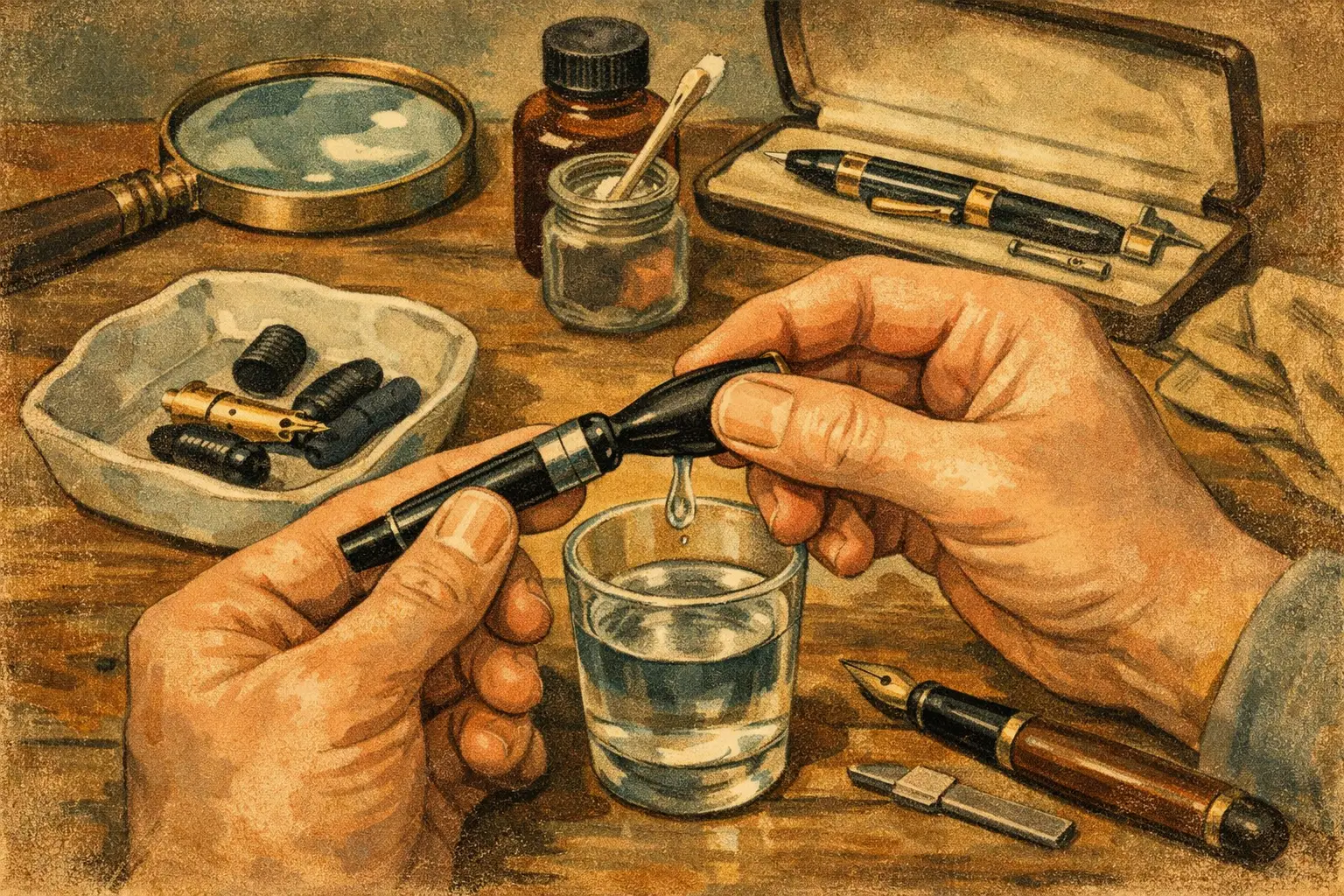
A newly acquired vintage fountain pen can look immaculate and still conceal a failed rubber sac. The section may shine, the nib may be original, and the lever may move freely, yet a hardened or perforated sac can release ink into the barrel at the first fill. Knowing how to test a pen sac before introducing ink is one of the simplest ways to protect both the pen and your hands.
A sac is the flexible rubber reservoir used in many lever-fillers, button-fillers and some other vintage fountain pens. Its job is uncomplicated: it compresses when the filling mechanism is operated, then expands to draw ink through the feed. After decades of use, storage and changing temperatures, however, rubber eventually loses its elasticity. Testing should be calm and methodical. A little pressure is useful; force is not.
What a pen sac test can tell you
A sound sac should be soft, flexible and capable of holding liquid without weeping. A failed one may be brittle, sticky, shrunken, split, or reduced to flakes inside the barrel. Occasionally, a sac appears acceptable until it is compressed, which is why a visual inspection alone cannot provide complete reassurance.
Testing also reveals problems beyond the sac. If the lever feels unusually stiff, the pressure bar may be corroded or displaced. If water emerges around the section rather than the nib, the section seal may need attention. These are different faults, but discovering them before using ink makes cleaning and repair far more straightforward.
How to test a pen sac safely
Before starting, use clean, cool water, a soft cloth and a small glass. Avoid hot water, detergents and household cleaning fluids. They can damage delicate materials, dull finishes or create problems that have nothing to do with the sac itself. Do not test an unknown vintage pen with ink first – old ink residue can hide a leak, and fresh ink makes the evidence much harder to clean away.
First, establish the filling system
This method applies to pens that genuinely use a rubber sac. A lever-filling Waterman, Conway Stewart or Parker Duofold is a likely candidate. A button-filler may also have a sac, although its mechanism is operated from the end of the barrel rather than by a side lever.
It does not apply in the same way to a cartridge/converter pen, a piston-filler, a vacuum-filler or an eyedropper. Those pens have different reservoirs and different testing points. Never operate a lever simply because a pen looks old: some levers are decorative features, and a misplaced attempt can damage a rare component.
Inspect the pen before operating it
With the cap removed, examine the nib, feed, section and barrel under good light. Look closely at the joint where the section meets the barrel. Dried ink around this area can indicate an old leak, though it may also be residue from a previous filling. Check that the barrel has no obvious cracks, particularly near the lever box, threads and cap lip.
Operate the lever or button only very gently at first. A healthy mechanism should offer controlled resistance. Stop immediately if it feels seized, gritty or requires significant force. A rigid sac can prevent the pressure bar from moving properly, and forcing the mechanism may bend the pressure bar or split an already fragile barrel.
If the pen has a translucent ink-view window, inspect it for crumbling rubber or dark staining. With opaque barrels, you may hear a faint rattle from loose sac fragments. That is usually a clear sign that the sac has reached the end of its service life and should be replaced before any wet test is attempted.
Check for flexibility without dismantling
A sac should not normally be removed merely to test it. On many vintage pens, the section is friction-fit and may be firmly seated after years in place. Pulling it without the right technique risks cracking the section, distorting the feed or damaging chased hard rubber.
Instead, use the filling mechanism as your first indication. With the nib pointed upwards and away from you, lift the lever slowly or depress the button once. A supple sac often produces a soft, cushioned resistance as it compresses. A hard sac may offer little movement, an abrupt crunching sensation, or no meaningful resistance at all.
This is only an indication, not a verdict. A pressure bar can still move against a deteriorated sac, while a good sac may feel firmer in a compact pen with limited internal space. The water test provides more useful evidence.
Perform a clean-water filling test
Place the nib and feed into a glass of cool, clean water. Operate the lever or button slowly, then return it to its resting position. Keep the nib submerged for several seconds while the sac expands. This gives the pen time to draw water through the feed.
Remove the pen from the glass with the nib pointing upwards and wipe the exterior carefully. Do not shake it. Watch the section-to-barrel joint, the lever box and the end of the barrel for moisture. Then hold the pen nib-down over the glass and allow a few drops of water to leave the nib. If it has drawn water and releases it normally, the sac is at least functioning at that moment.
Next, wrap the barrel lightly in a dry tissue and leave the pen nib-up for five to ten minutes. Any damp patch around the lever, barrel seam or section deserves investigation. A pinhole leak may not show instantly, especially if the sac has only been partially filled, so repeat the test once if the first result is unclear.
Do not squeeze the barrel to force a result. Most sac pens are not designed to be squeezed, and pressure can crack celluloid or compromise a loose section. Let the mechanism do the work it was designed to do.
Give a doubtful pen time
Some sacs fail only after they have been wetted and allowed to expand. If the pen appears sound after the first water fill, dry its exterior and rest it upright in a glass or pen stand for half an hour. Inspect it again for seepage and check whether the water level has dropped unusually quickly.
A pen that passes this short test is a better candidate for ink, but it is still sensible to use a washable fountain pen ink for the first few fills. Avoid highly saturated, permanent or shimmer inks in an unfamiliar vintage sac pen. They complicate cleaning and can stain a barrel if a fault reveals itself later.
Reading the results of your test
A clean draw of water, normal release through the nib and a completely dry barrel are encouraging signs. If the pen holds water for a short period without leakage, the sac is probably serviceable. Nevertheless, rubber sacs are consumable parts. A pen that works today may still need replacement soon if the sac is old and its history is unknown.
Water emerging from the lever slot commonly points to a split sac or a leak near the pressure bar. Moisture at the section joint can mean that the sac has detached from its nipple, although a loose section is also possible. If the pen does not draw water at all, the sac may be hardened, the pressure bar may not be reaching it, or dried ink may be obstructing the feed.
A strong rubber smell, tacky residue or black fragments inside the barrel are all reasons to stop testing. They indicate deterioration rather than a condition that further filling will improve.
When a pen sac should be replaced
Replacement is the right answer when a sac leaks, has hardened, has broken into pieces, or cannot fill consistently. It is also sensible when restoring a pen with an unknown service history, particularly if it is intended for regular writing rather than display.
The correct sac size and material matter. A sac that is too large can rub against the barrel or pressure bar; one that is too small reduces the ink capacity and may not operate reliably. Certain pens also require particular materials, such as silicone or PVC sacs, rather than conventional latex. The choice depends on the model, the barrel material and the filling system.
For a common user-grade pen, an experienced enthusiast may be comfortable replacing a sac with appropriate tools and knowledge. For a valuable, rare or delicate instrument, professional restoration is usually the safer course. A proper repair should respect the original components and leave the pen ready to write, not merely ready to display. This is the standard collectors should expect from a specialist-restored vintage pen, including those prepared by Heritage Collectables.
A final check before using ink
Once a pen has passed its water test, empty it fully and flush it several times with fresh water until the water runs clear. Leave it uncapped, nib-down in a suitable holder or resting on an absorbent cloth, until it is thoroughly dry. Water left in the feed will dilute the first fill, which is harmless but can make the ink appear pale.
The reward for this small amount of care is confidence. A vintage fountain pen was made to put ink on paper, but it deserves to be filled only after its hidden working parts have earned that trust.