
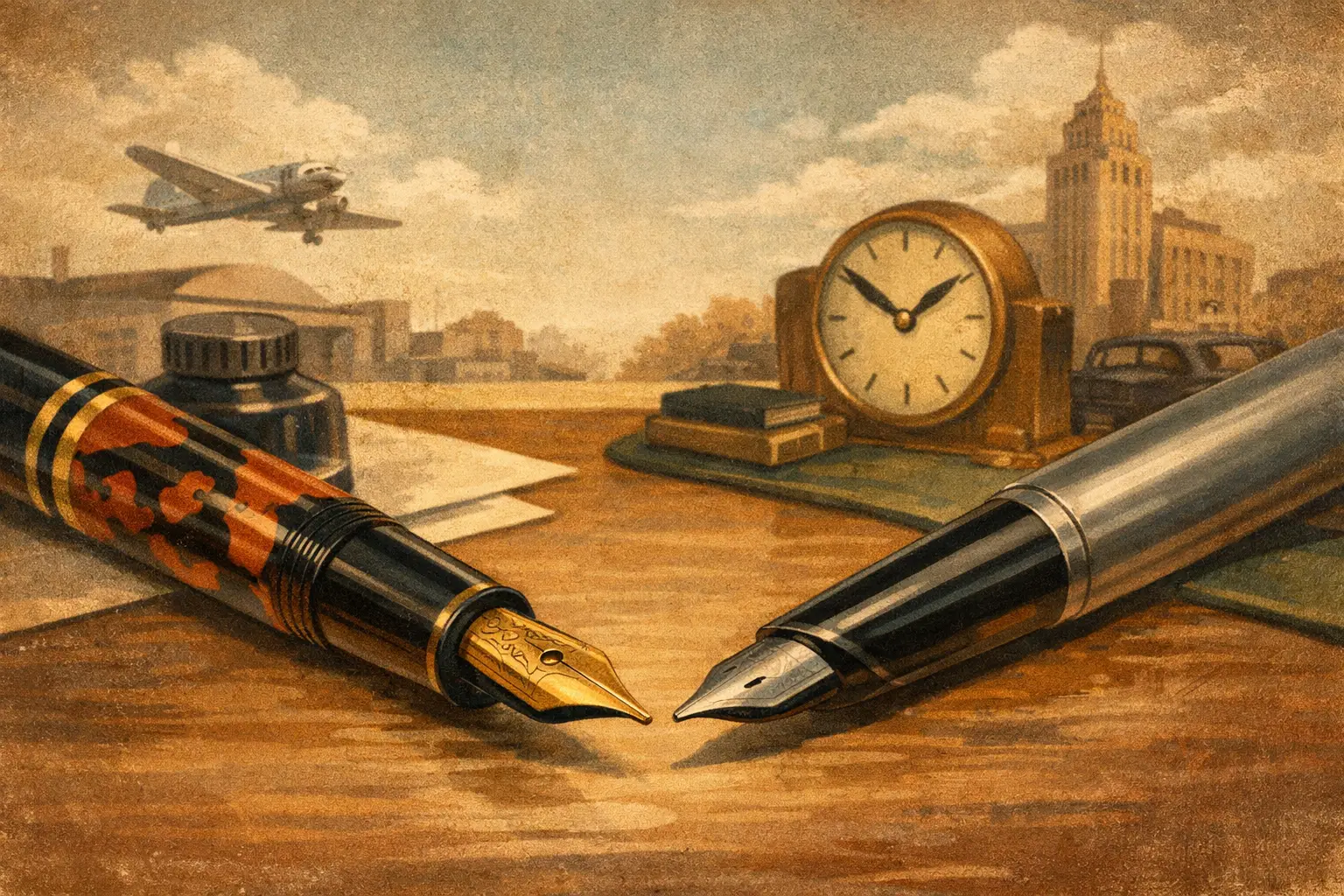
A bright red Parker Duofold on a desk attracts attention before its nib ever reaches paper. A Parker 51, by contrast, tends to earn affection after the first page: quiet, controlled and unusually capable with everyday ink. The question of Parker Duofold versus 51 is therefore not simply which model is better. It is a choice between two very different ideas of what a great fountain pen should be.
The Duofold is Parker’s great extrovert, a family of pens with a long history, broad shoulders and strong collector appeal. The 51 is the modernist workhorse, designed to make fountain-pen writing cleaner, more dependable and less intimidating. Both can be exceptional users when properly restored. Both deserve careful buying. Their appeal simply lies in different places.
Parker Duofold versus 51: the essential difference
The first complication is that a Duofold is not one pen. Parker used the name from the 1920s onwards, covering the famous hard-rubber Big Red button fillers, the streamlined Vacumatic-filling Duofolds of the 1930s, and numerous later British and American models. A comparison with the Parker 51 needs a little precision, because a 1920s Duofold Senior has a very different character from a post-war Duofold AF or NS.
Nevertheless, the broad distinction remains useful. Most vintage Duofolds offer a conventional, open nib and a more visibly traditional fountain-pen experience. Their nibs are on show; their materials and colours are often central to their attraction; and their larger models have a commanding presence in the hand.
The Parker 51, introduced in 1941, took the opposite route. Its nib is largely enclosed beneath a tapered hood, leaving only a small writing point visible. The result is a pen that looks restrained, writes with remarkable control and keeps the wet, vulnerable part of the nib protected. It was a thoroughly modern design for its period and remains one of the most practical vintage fountain pens to use regularly.
Design, presence and collecting appeal
A Duofold is generally the better choice for the buyer who wants their pen to feel unmistakably vintage. The early red hard-rubber models have an enduring authority, particularly when their chasing, imprint and colour have survived well. Later marbled celluloid and striped Duofolds bring a different sort of appeal: more streamlined than the original Big Red, but still rich in material and distinctly of their era.
Condition matters greatly. Hard rubber can oxidise and darken, discolouration can soften the vividness of early red pens, and celluloid can shrink or craze. These are not necessarily reasons to dismiss a pen, but they should be reflected in its value and described honestly. Crisp imprints, sound cap threads, original clips and good colour are all details collectors watch closely.
The Parker 51 has a more discreet elegance. Its cigar-shaped barrel, hooded nib and metal cap make it look almost contemporary, even eight decades after launch. Colours such as black, burgundy, cedar blue, cocoa and Nassau green reward closer inspection, while the range of cap styles gives collectors plenty to pursue. The early “double jewel” examples, distinctive cap finishes and matching pencils all have their following.
For a gift, the 51 is often the safer visual choice if the recipient prefers understated objects. A well-chosen Duofold is more personal and more theatrical. It announces itself, especially in red, jade or a lively marbled finish.
Size is more important than the catalogue name
Neither model should be bought by name alone. Early Duofolds range from compact Ladies and Junior versions to the substantial Senior and Maxima formats. Likewise, Parker 51s come in differing lengths and cap arrangements, with the later aerometric models often feeling particularly balanced in daily use.
If possible, compare dimensions rather than relying on photographs. A large Duofold can be superb for a writer who prefers a full barrel and a posted cap, but a smaller version may feel cramped. The 51 usually suits a wide range of hands, though some writers accustomed to oversize pens may find it modest.
Nibs and the writing experience
This is where many buyers make their decision. The exposed nib of a Duofold gives more visual drama and, depending on the specific pen, may offer a more expressive feel. Early Parker nibs can be firm yet responsive, with a touch of spring that makes ordinary handwriting look a little livelier. Broad, medium and fine examples exist, but vintage grading is never perfectly standard. A nib marked “medium” may write finer than a modern medium, particularly if it was made for the British market.
A Duofold rewards a writer who enjoys seeing the nib at work and who appreciates feedback from the paper. It can be an involving, characterful experience, especially with a well-tuned gold nib. That does not mean every Duofold is flexible or soft. Many are deliberately firm, and condition, previous use and restoration quality have far more bearing on performance than the model name alone.
The Parker 51 nib is usually smoother, more controlled and less showy. Its hood encourages a consistent writing angle and the collector nib is notably resistant to drying. This makes it particularly useful for notes, correspondence and longer sessions where one wants the pen to behave without ceremony. Fine and extra-fine 51 nibs can be excellent for small handwriting, while a good medium provides an easy, generous line without becoming untidy.
The trade-off is personality. Some writers find the 51 beautifully precise; others find its partly hidden nib slightly detached compared with an open-nib Duofold. Neither reaction is wrong. The better pen is the one that makes you want to write another page.
Filling systems and practical ownership
Early Duofolds generally use a button-filling mechanism with a rubber sac. It is simple, effective and satisfying, but the sac is a consumable part. A properly restored example should fill reliably and hold a useful amount of ink, yet it will eventually need replacement after years of use. This is normal vintage pen maintenance, not a defect.
Some later Duofolds use other systems, including the Vacumatic diaphragm mechanism. These can hold considerable ink and are fascinating pieces of engineering, but they require knowledgeable restoration. A pen that appears to fill is not automatically a pen that should be trusted with ink. The diaphragm, breather tube, seals and clarity of the barrel all deserve inspection.
Parker 51 filling systems divide broadly into Vacumatic and aerometric types. Vacumatic 51s are highly regarded, often with excellent ink capacity, but their restoration is specialised. Aerometric 51s have a metal squeeze bar beneath a pli-glass sac and are widely valued for their durability and straightforward practicality. Many have worked for decades with only sensible care, though any vintage filling system should be examined rather than assumed sound.
The later cartridge/converter Parker 51 is a different proposition and is usually less sought after by collectors than the earlier versions. It may still be a pleasant pen, but it does not offer quite the same engineering character as the Vacumatic or aerometric models.
For either pen, use a fountain-pen-friendly ink and avoid leaving it unused with ink inside for months. The Parker 51’s hood can conceal dried residue, while old sacs and diaphragms in Duofolds should not be exposed to harsh or heavily saturated inks without care. A restored pen deserves sensible habits.
Restoration is part of the comparison
A clean exterior tells only half the story. With a Duofold, the critical work may include replacing the sac or diaphragm, correcting nib alignment, checking cap threads and ensuring the lever or button mechanism operates as it should. With a Parker 51, restoration may involve cleaning the collector, setting the nib correctly beneath the hood, attending to the breather tube and making certain the filling system is sound.
The 51 can be deceptively easy to underestimate because it often looks tidy even when it needs attention. A misaligned nib, damaged hood or compromised collector can spoil the writing experience. Equally, a bright Duofold with heavy oxidation, a brittle section or a poorly fitted sac may be better regarded as a display piece than a daily writer.
This is why restored examples from a specialist are so valuable. At Heritage Collectables, the aim is not merely to present an attractive vintage pen, but to offer an instrument whose condition and practical potential have been properly considered. For a collector intending to write, that reassurance is worth more than an untested bargain.
Which should you choose?
Choose a Duofold if you are drawn to classic Parker history, visible gold nibs and materials with real visual warmth. It is the stronger choice for someone building a period-focused collection, for a writer who enjoys traditional fountain-pen character, or for a gift buyer seeking something immediately recognisable as a special vintage object.
Choose a Parker 51 if regular use is the priority. It is hard to better for controlled everyday writing, tidy ink behaviour and a design that remains practical rather than precious. An aerometric 51, properly restored with a sound hood and well-adjusted nib, is often one of the most confidence-inspiring entry points into vintage fountain pens.
There is also a sensible collector’s answer: own one of each. A Duofold offers the occasion, colour and history; a Parker 51 offers the dependable pen you reach for when there is a letter to write. Start with the one that suits your hand and your habits, then let the next pen follow the curiosity the first one creates.