
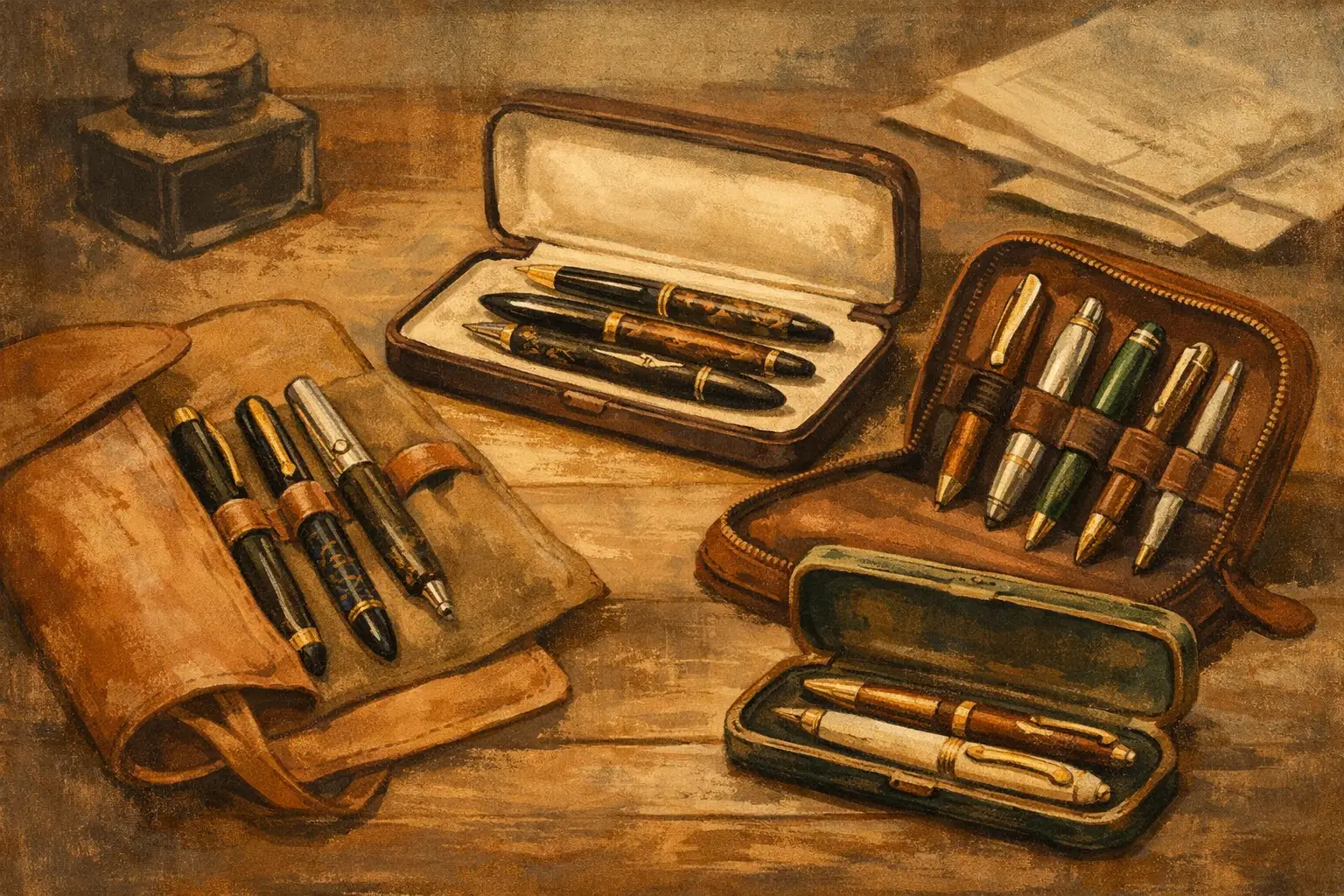
A fine vintage fountain pen should not spend its life loose in a desk drawer beside paper clips, coins and a forgotten key. The best pen cases do more than make a collection look orderly: they prevent scratches, protect delicate clips and levers, and make it far easier to choose the right instrument for the day.
For a collector, the right case also has a quieter role. It keeps restored pens stable between uses, separates materials that could mark one another, and offers a sensible way to transport a prized Parker Duofold, Waterman, Conway Stewart or Pelikan without treating it like an ordinary biro. The ideal choice depends on whether you need storage at home, protection in a briefcase, or a presentation-worthy case for a special acquisition.
What makes a pen case genuinely protective?
The first question is not how many pens a case holds. It is whether each instrument is held securely without being compressed. Vintage pens vary considerably in length and girth. A slim 1930s Waterman may sit comfortably in a narrow elastic loop, while an oversized modern fountain pen or a large vintage lever filler can be pinched, marked or difficult to remove from the same arrangement.
Look for individual slots, loops or padded channels that stop pens touching. A case with a soft internal lining, such as suede, velvet or a smooth synthetic fabric, is usually preferable to bare wood, hard plastic or coarse felt. The lining should be clean and colourfast. A vivid dyed material may look attractive, but it is not worth risking colour transfer onto a pale celluloid barrel or a chased hard-rubber pen.
Protection also means avoiding unnecessary movement. A pen that slides around inside a loose pouch can suffer more harm than one carried carefully in a well-fitted single-pen sleeve. For travel, a firm outer shell and a secure closure matter more than a large capacity.
Avoid pressure on clips and fragile finishes
Clips are among the most vulnerable features on vintage writing instruments. They can catch on elastic, bend against a hard lid, or rub against another pen during transport. Choose loops that accommodate the barrel rather than forcing the clip into a tight gap. If a case closes with a rigid top, check that there is sufficient depth above the pen cap.
This is especially relevant for pens with raised decorative bands, chased patterns, lacquered surfaces or delicate overlays. A case should support the instrument, not press its details flat against the lining.
The best pen cases for different purposes
There is no single best option for every collection. A collector with twenty restored pens ready for regular rotation needs something different from a gift buyer selecting a handsome case for one treasured fountain pen.
Single-pen sleeves for everyday carrying
A single-pen sleeve is often the most sensible choice for daily use. It takes up little room in a jacket pocket, bag or pen tray, and it ensures that a fountain pen does not share space with keys or other hard objects. Leather sleeves are popular for their durability and traditional appearance, while fabric sleeves can provide a lighter, softer alternative.
The trade-off is access. A snug sleeve is excellent for protection but may be less convenient when you want to remove and replace the pen repeatedly during the day. Make sure the sleeve is long enough for the pen when capped and does not catch on the cap lip or clip.
Two- and three-pen cases for a working set
For many enthusiasts, a compact case for two or three pens is the sweet spot. It allows a practical selection: perhaps a fine nib for notes, a broader nib for correspondence, and a pencil or ballpoint for forms and annotations. It is also ideal for travelling with a small, dependable rotation rather than taking a whole collection.
A zip case offers good all-round containment, but inspect its construction carefully. The zip should sit away from the pens and be protected by a fabric guard. A press-stud or flap closure can be gentler and more elegant, although it may offer less protection if the case is dropped or packed tightly.
Larger rolls and zip cases for regular collectors
Pen rolls and multi-pen zip cases suit collectors who like to keep a sizeable group visible and ready to use. A roll is particularly useful when space is limited. It can be laid flat to display the contents, then rolled up for storage, often holding ten or more pens without requiring a large cabinet.
That convenience comes with a caution. If the roll is overfilled or wound too tightly, pens may press against one another. This is not the best choice for exceptionally fragile instruments, oversized pens or valuable examples with sensitive finishes. A structured multi-pen case, with separated padded compartments, provides greater protection for transport and for more substantial pens.
Display cases for a collection at home
A display case makes sense when the pleasure of ownership includes seeing the collection. Glass-topped boxes, wooden cases and drawer organisers can turn a group of pens into an attractive focal point, especially when arranged by maker, period, colour or filling system.
For long-term home storage, however, appearance should not override condition. Keep display cases away from direct sunlight, radiators and damp rooms. Sunlight can fade materials and discolour some plastics, while excessive heat may affect sacs, seals and older adhesives. A cabinet in a stable, dry room is generally far kinder than a sunny windowsill or an attic with fluctuating temperatures.
Choosing materials: leather, fabric, wood or hard shell
Leather cases have lasting appeal for collectors. A well-made leather exterior develops character and gives a vintage pen an appropriately traditional setting. It is best paired with a soft lining and careful stitching, with no exposed rough edges near the pens. Leather can be excellent for carrying cases, but it should be kept dry and allowed to air occasionally.
Fabric cases are lighter and often offer generous padding. They are practical for travel and can be a good value choice for a working collection. Their weakness is that they offer less crush resistance, particularly in a packed bag. A fabric roll is best carried in a protected compartment rather than loose beside chargers and notebooks.
Wooden cases are most at home on a desk or in a cabinet. They offer attractive display and a sense of permanence, but they are not automatically safer than a soft case. Bare timber, ill-fitting trays and hard dividers can mark pens. Choose a properly lined interior with compartments that fit the instruments you actually own.
Hard-shell cases provide the strongest defence against knocks. They are sensible for air travel, events, pen club meetings or transporting pens for appraisal or repair. The drawback is bulk, and a rigid case that is poorly fitted can still permit movement. Internal padding and individual retention are more important than the shell alone.
Fit matters more than stated capacity
Case descriptions often state a number of pens, but capacity figures can be misleading. Ten slim vintage pencils will occupy a very different amount of room from ten broad fountain pens. Before buying, measure the longest and widest pen you intend to store, including its clip. Then compare those dimensions with the individual slot size, not just the case’s exterior measurements.
A little room around the barrel is desirable. Enough room for the pen to shift and collide with its neighbour is not. If you own a mixture of slender and oversized instruments, consider separate cases rather than trying to make one layout work for everything. It may feel less efficient, but it is safer and makes the collection easier to manage.
Storage habits that protect restored pens
Even the finest case cannot compensate for poor storage habits. Fountain pens should normally be emptied and cleaned before prolonged storage, particularly if they contain traditional dye-based ink that may dry in the feed. Keep them capped, store them away from extremes of temperature, and inspect them occasionally rather than leaving them untouched for years.
For pens filled for regular use, a case is still valuable, but consider the orientation during travel. A fountain pen carried nib-up is less likely to deposit ink into its cap; a pen that is freshly filled or known to run wet deserves particular care. Do not rely on any pen case to prevent leaks caused by changes in air pressure or a faulty seal.
If a treasured pen is going into storage after restoration, it is worth giving it its own clean, padded space. Heritage Collectables sees many fine instruments whose condition has been preserved not by elaborate display, but by owners who understood that careful storage is part of good stewardship.
A pen case is a modest purchase beside a collectible fountain pen, yet it can protect years of careful collecting and skilled restoration. Choose the format that matches how you write, carry and display your instruments, then give each pen enough room to remain exactly as it should be: ready for the next page.