
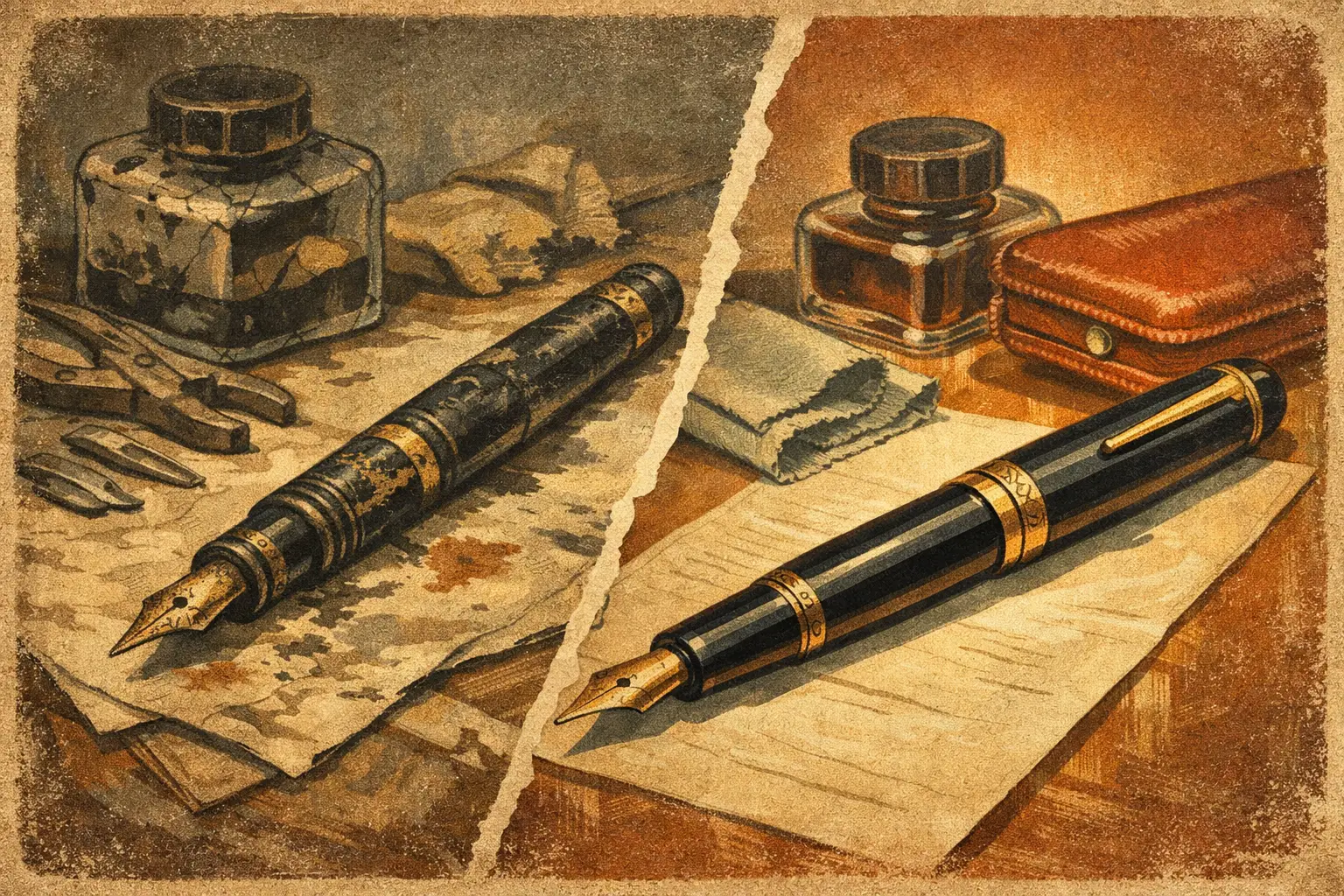
A vintage fountain pen can look presentable in a cabinet yet be entirely incapable of holding ink. Equally, a pen with a dull cap, tarnished trim and a stained barrel may conceal a superb nib and a mechanism worth saving. That is why before and after pen restoration is more than a visual comparison. It is evidence of careful diagnosis, sympathetic repair and the return of a writing instrument to useful life.
For collectors, writers and gift buyers, the most satisfying restoration does not make an old pen look factory-new. It respects the age, design and character that made the pen desirable in the first place, while dealing properly with the faults that prevent it being enjoyed.
What Before and After Pen Restoration Should Show
The “before” condition tells an honest story. A pen may have accumulated decades of ink residue, surface grime, oxidation and light scratching. Its original ink sac may have hardened into fragments, a piston seal may have failed, or a lever may no longer move freely. These are common faults, not necessarily reasons to dismiss an otherwise excellent Parker, Waterman, Conway Stewart, Sheaffer or Pelikan.
The “after” condition should show that the pen has been made sound and usable without removing its identity. The barrel should retain its correct colour and crisp chasing where applicable. Imprints should remain legible. Trim should be cleaned and carefully polished rather than aggressively plated over. Most importantly, the pen should fill, retain ink and write as its maker intended.
A dramatic cosmetic transformation can be appealing, but it is only part of the job. A glossy photograph tells little about whether a filling system has been serviced, a feed has been cleared, or a nib has been aligned and tested. The real value of professional work lies in the details that cannot always be seen at first glance.
The First Stage Is Assessment, Not Polishing
Every restoration begins with an inspection. Vintage pens were made in different materials and with very different mechanisms, so one treatment does not suit every example. Early hard rubber, celluloid, casein and modern plastics all react differently to moisture, heat, polishing compounds and exposure to light.
A restorer will examine the body for cracks, shrinkage, warping, missing parts and previous repairs. Cap threads must be checked, as worn or damaged threads can turn an otherwise handsome pen into an impractical one. On a lever filler, attention turns to the lever box, pressure bar and ink sac. On a piston filler, the piston assembly, seals and cork or synthetic components need proper assessment. Vacuum-fillers, button-fillers and cartridge-converter pens each bring their own set of considerations.
The nib deserves equally close attention. A nib may appear straight until it is viewed under magnification. Misaligned tines, an uneven tipping surface, dried ink in the feed or a damaged breather hole can affect flow and feel on paper. In many cases, the best result comes from gentle adjustment and thorough cleaning, rather than reshaping the nib beyond recognition.
Cleaning Without Erasing History
Cleaning is where judgement matters most. Decades of dirt can obscure a pen’s original finish, while over-cleaning can permanently reduce collector appeal. A faded barrel cannot always be restored to its original richness, and trying to force that result may do more harm than good.
For example, oxidation on black hard rubber can leave a brownish or olive cast. Some improvement may be possible through controlled cleaning and careful finishing, but it is not always wise to remove material simply to achieve a darker appearance. The same principle applies to brassing on gold-filled trim. Brassing is wear to the surface, not dirt, and it should be described honestly rather than disguised.
Celluloid requires particular restraint. It can have extraordinary colour and depth, whether in pearlescent green, marble red or striped grey, but it can also be sensitive to solvents, heat and excessive buffing. A thoughtful restoration brings out its remaining lustre while preserving the crisp edges, transparency and pattern that establish the pen’s originality.
Restoring the Filling System for Everyday Writing
A pen is not fully restored merely because it looks better. If it is sold as a usable fountain pen, its filling system must be capable of doing its job reliably.
Many vintage lever-fillers need a new ink sac. The old sac may have perished, become rigid or stuck to the inside of the barrel. Replacing it involves more than fitting a new rubber component. The restorer must select an appropriate size, inspect the pressure bar, ensure the section has been correctly sealed and allow the assembly to cure properly before testing.
Piston pens may need new seals, lubrication or repair to the turning mechanism. A failed seal can mean a pen draws no ink at all, while a stiff piston can place unnecessary stress on an aged barrel. The aim is smooth operation, not excessive force.
After reassembly, the pen should be tested with water and then ink where appropriate. It should draw fluid properly, avoid leaks around the section and fill mechanism, and write with consistent flow. This practical testing is one of the clearest distinctions between a decorative antique and a restored writing instrument ready for regular use.
Nib Work Is About Feel as Well as Function
The nib is where the pen meets the page, and it often determines whether a vintage piece becomes a favourite writer or remains in its case. A well-restored nib should start without hesitation, maintain a sensible ink flow and feel appropriate to its design.
That does not mean every nib should be made glassy smooth. Some collectors prefer the gentle feedback of a fine English nib; others seek the soft, expressive line of a flexible gold Waterman or Swan. Broad nibs can be wonderfully generous with ink, but they may not suit cheap paper or small handwriting. A properly adjusted nib preserves its character while removing faults such as snagging, skipping or uncomfortable sharpness.
There are limits. A cracked nib, missing tipping or severe corrosion may require specialist repair or replacement, and replacement can affect originality. Where a repair is visible or a component is non-original, clear description matters. Collector confidence depends on knowing exactly what has been done.
When Patina Should Stay
Not every sign of age is a defect. A little dullness on sterling silver, light marks from decades of use, or a discreet owner’s inscription can add to a pen’s story. Removing every trace of age can make a piece look sterile, or worse, can compromise material that cannot be replaced.
The right degree of restoration depends on the pen and its intended owner. A rare early model with scarce original parts may call for conservation-led work, where stabilising and preserving take priority. A common but handsome daily writer may justify a more comprehensive service, particularly if the intention is to use it regularly or present it as a gift.
This is also why photographs should be accompanied by a proper condition description. Buyers should be able to distinguish between light wear consistent with age, a repaired crack, brassing, replacement parts and a fully serviced filling system. Transparency is not an extra – it is part of responsible dealing in vintage instruments.
How to Judge a Restored Vintage Pen
When comparing before-and-after results, look beyond the shine. Ask whether the cap fits securely, whether the imprint remains clear, whether the filling system has been serviced and whether the nib has been tested. Consider whether the finish looks sympathetic to the pen’s age rather than unnaturally over-polished.
It is also worth considering what you want from the instrument. A collector seeking an original example may accept honest cosmetic wear in exchange for untouched detail. A writer may value a fresh sac, reliable flow and a carefully tuned nib above minor marks on the barrel. A gift buyer will often want both: a pen with visible heritage that performs confidently from its first fill.
At Heritage Collectables, restored vintage pens are valued not simply for how they appear after workshop attention, but for the pleasure of putting them back into service. The finest result is a pen that still looks like it has lived a life, yet feels ready to write the next chapter.