
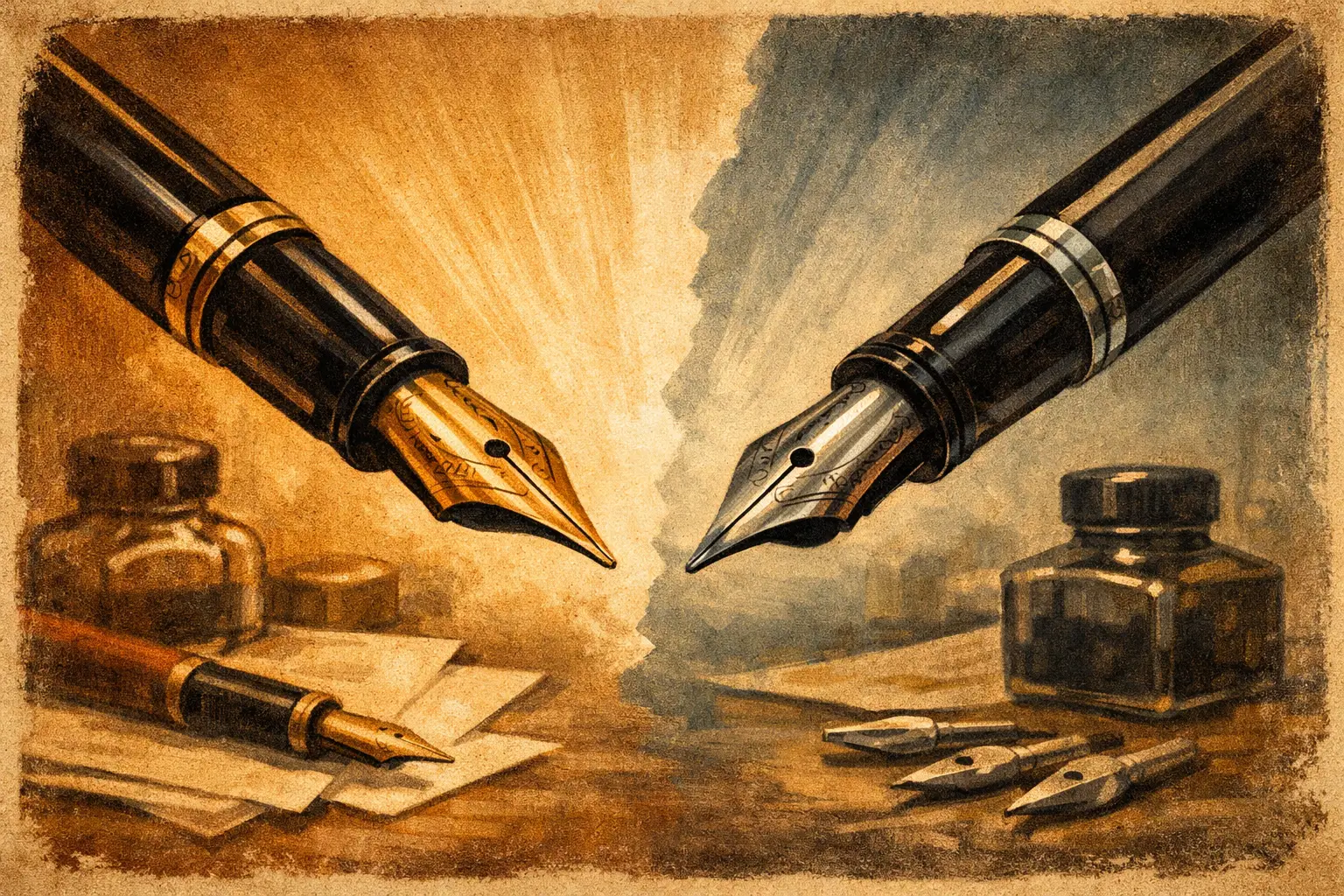
A fountain pen nib is not simply the point that puts ink on paper. It is the working heart of the instrument, and the gold nib versus steel nib question is really a question about the writing feel you want, the pen you are considering, and the condition in which it has survived. A well-restored vintage pen with either material can be a superb daily writer. Equally, an expensive gold nib in poor condition will not reward its owner.
For collectors, the appeal also reaches beyond performance. Nib material can reveal a great deal about a pen’s original market position, its maker’s design choices and the era in which it was made. Understanding the difference helps when selecting a practical writer, assessing a potential restoration, or choosing a gift with genuine heritage.
Gold nib versus steel nib: the real difference
Gold is naturally resistant to corrosion, which made it particularly desirable in the early fountain pen era. Traditional gold nibs are usually marked 14ct, 18ct or occasionally another gold content. The gold itself is alloyed with other metals to give it the strength required for writing, then tipped with a very hard wear-resistant material.
Steel nibs are commonly stainless steel, though vintage examples may be made from plated steel or more basic alloys. A quality steel nib is durable, capable of excellent ink flow and often pleasantly firm. It should not be dismissed as an inferior substitute simply because it is not gold.
The material affects the potential character of a nib, but it does not decide everything. Shape, thickness, temper, tipping, feed design and decades of use can matter more than the metal alone. Two 14ct gold nibs from different makers may feel completely different, while a carefully made steel nib can outperform a neglected gold one.
Writing feel: softness is not the same as flex
The most common assumption is that gold nibs are soft and steel nibs are hard. There is some truth in this, but it is an oversimplification that can lead to disappointing purchases.
Gold can be made into a nib with a more yielding feel because of the metal’s properties. Many vintage gold nibs offer a gentle, cushioned response that makes ordinary handwriting feel more expressive. This does not mean they are flexible nibs. A soft nib may give slightly under normal pressure, whereas a true flex nib opens its tines significantly to create noticeable line variation.
Flex depends on the nib’s geometry and temper: long tines, narrow shoulders, cut-outs and careful shaping all play a part. Some vintage Waterman and Conway Stewart gold nibs are celebrated for their responsive writing qualities, but there are also firm gold nibs designed for everyday business writing. Parker’s later gold nibs, for example, are often controlled and firm rather than dramatically flexible.
Steel generally has a firmer, more immediate feel. For many writers, this is a virtue. A firm nib provides consistency for note-taking, signatures and quick writing, and it is often more forgiving for someone still learning to use a fountain pen with a light touch. Certain vintage steel nibs, particularly from respected European makers, can be smooth, characterful and surprisingly springy.
A buyer seeking calligraphic line variation should look for a nib described specifically as flexible or semi-flex, not merely gold. A buyer who wants a dependable everyday pen may be better served by a smooth medium steel nib than by a soft gold nib that requires a gentler hand.
Gold, steel and vintage durability
Gold’s corrosion resistance is especially valuable in a vintage instrument. Old inks could be harsh, and pens were sometimes left inked for years. A gold nib often emerges from decades of storage in remarkably sound condition, even when the pen around it needs significant work.
However, gold is not invulnerable. It can be bent, creased, cracked at the breather hole or worn through misuse. Its softness means that a previous owner may have forced the tines apart or attempted an unsuitable repair. Gold nib restoration requires a practised hand because small adjustments can transform the writing quality or cause permanent damage.
Steel is more prone to corrosion where plating has failed or where old ink and moisture have been left unattended. Yet stainless steel nibs are highly practical and can remain in excellent condition for many decades. Their relative stiffness also makes them resistant to the accidental over-flexing that damages many fine gold nibs.
Condition is therefore more useful than material as a first measure of durability. Examine whether the tines are aligned, whether the tipping is present and even, and whether the nib writes smoothly with reliable flow. On a vintage pen, the feed, filling system and cap seal deserve just as much attention. A nib cannot perform properly if the pen cannot supply ink consistently.
Value is more than the price of the metal
A gold nib usually adds value, particularly when it is original to a desirable model and remains in fine condition. Collectors may seek the correct nib imprint, gold content and period styling as carefully as they seek the right cap band or clip. On certain Waterman, Sheaffer, Pelikan and Montblanc models, the nib is central to both identity and value.
That said, a gold nib does not automatically make a pen a better purchase. The premium can reflect gold content, prestige and collector demand, rather than a meaningful advantage for the individual writer. A restored steel-nibbed Parker 51, for instance, can offer one of the most comfortable and dependable writing experiences available, often at a more approachable price than a comparable gold-nibbed pen.
Steel nibs also make sense for pens intended for regular carrying, work or travel. If the pen is likely to be used heavily rather than kept as a display piece, a well-restored steel nib can offer reassurance without sacrificing enjoyment. The best choice is the one that encourages you to write.
How restoration changes the decision
With vintage fountain pens, restoration quality can matter more than the gold-versus-steel distinction. A proper restoration addresses the filling mechanism, seals, sac or diaphragm where appropriate, feed cleanliness and nib alignment. It should preserve original parts wherever possible rather than disguise faults with cosmetic shortcuts.
Nib work is particularly significant. A skilled restorer can correct slight tine misalignment, remove old ink residue, improve flow and assess whether a nib is suitable for normal use. This is not the same as grinding away character or turning every nib into a generic smooth medium. A fine original nib, a broad italic or a softly responsive semi-flex nib should retain the qualities that make it worth owning.
When buying online, clear descriptions are useful, but so are sensible questions. Ask about nib grade, writing condition, any known repairs and whether the pen has been tested after restoration. If you have a preference for a wet writer, a fine line, a left-handed writing angle or a little softness, say so. A specialist can often steer you towards the right instrument more accurately than a material label can.
Choosing the nib for the way you write
A gold nib may suit you if you enjoy a more tactile, yielding response, appreciate traditional craftsmanship, or are drawn to a particular higher-grade vintage model. It is also the natural choice where the pen’s historical specification matters to your collection.
A steel nib may suit you if you prefer a firmer line, want a dependable regular-use pen, or would rather put more of your budget into condition and restoration than precious metal. It can also be the wiser choice for a first vintage fountain pen, where comfort and reliability should take priority over assumptions about status.
There is no need to regard steel as a compromise or gold as a guarantee. Both have earned their place in fountain pen history, from modest school pens to handsome mid-century classics. At Heritage Collectables, the most satisfying restored pens are not defined by a single hallmark: they are the ones whose nib, feed and filling system work together as their maker intended.
If possible, choose with your hand rather than your expectations. A nib that feels natural after a page of writing will remain a pleasure long after the attraction of its material has become familiar.