
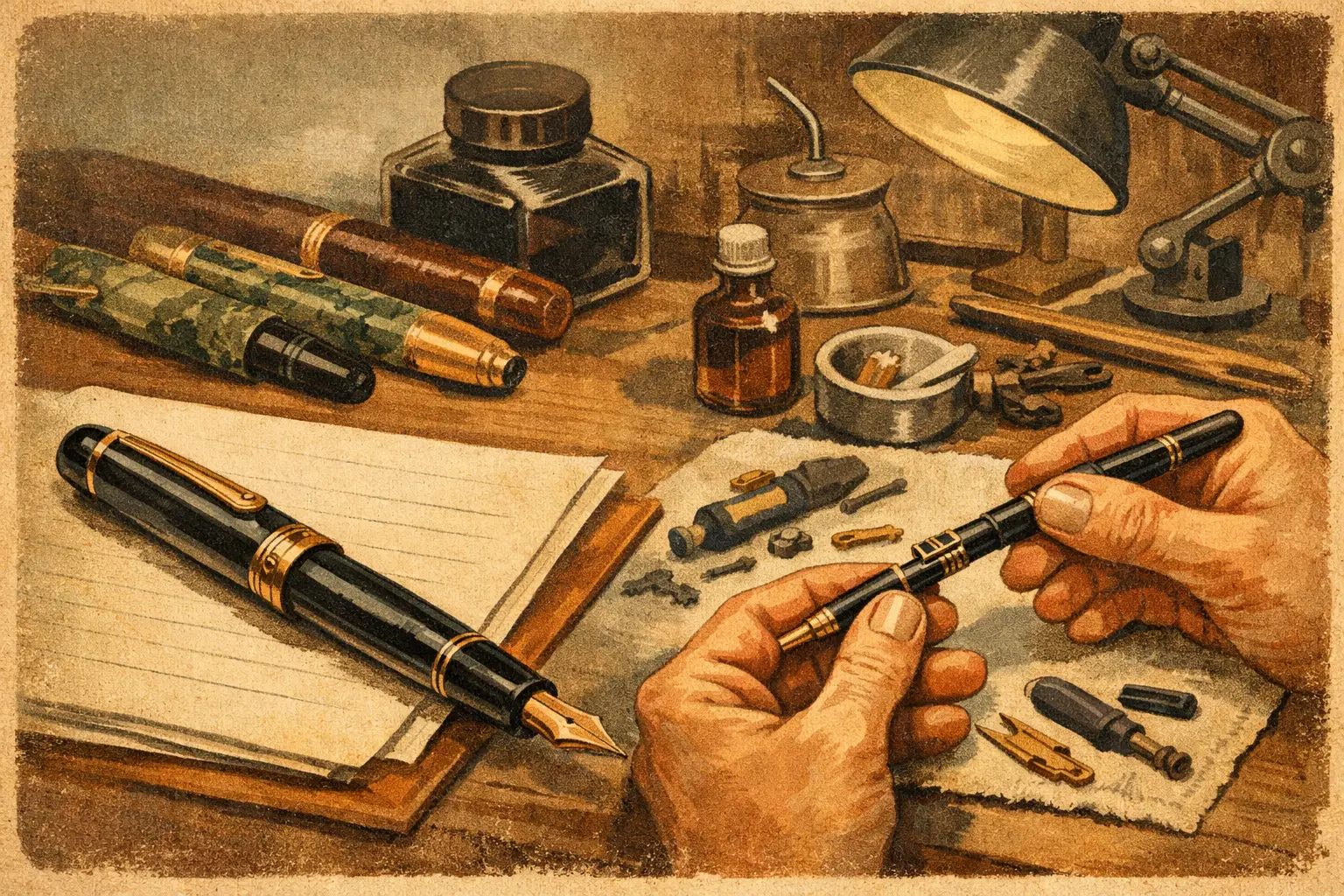
A vintage fountain pen may look immaculate in a cabinet yet be incapable of holding ink safely. So, do vintage pens need servicing? In many cases, yes – particularly if the pen has an original rubber sac, a piston that has stood unused for decades, or a filling system of unknown condition. Age affects the parts hidden inside the barrel far more predictably than it affects the finish outside.
That does not mean every old pen requires a full rebuild. A well-kept cartridge-converter pen from the later twentieth century may only need a careful flush and inspection. Earlier lever-fillers, button-fillers and vacuum-fillers are different propositions. Their internal materials were designed to be used, maintained and, eventually, replaced.
Why do vintage pens need servicing?
A fountain pen is both a writing instrument and a small mechanical system. The nib and cap may survive beautifully for a century, while the ink reservoir, seals and moving components quietly deteriorate. Restoring reliable function means assessing the whole pen, not simply polishing the exterior or making it write for a few lines.
The most common issue is the ink sac. Traditional sacs are usually made from rubber, which hardens, cracks or turns sticky with age. A degraded sac can prevent the pen from filling, restrict ink flow, or leak into the barrel. Leaving fragments inside may also corrode metal parts or obstruct the section.
Other filling systems have their own weak points. Cork piston seals can shrink and dry out. Synthetic seals may become distorted. A pressure bar in a lever-filler can rust or lose its spring. Diaphragms in certain vacuum-filling pens can perish. These are ordinary service concerns, but the correct repair depends on the model, its construction and the materials originally used.
Dried ink is another frequent problem. Ink residue can block the feed channels, cement a section in place, or leave a pen writing dry and unevenly. Old iron gall inks deserve particular caution because they can be more corrosive than modern fountain pen inks. A pen that has not been used for years should never be assumed ready simply because ink comes through when it is dipped.
The signs a vintage pen needs attention
A pen does not need to be leaking to require service. Look for clear clues before filling it for the first time. A lever that feels loose, a stiff piston, a filling button that will not move, or a sac that makes a faint crunching sound are all warnings to stop rather than force the mechanism.
Inspect the barrel and cap under good light. Cracks around the section, cap lip or lever area can worsen under pressure. On celluloid pens, look for unusual shrinkage, warping or strong chemical odours. Discolouration alone may be cosmetic, but distortion near a metal trim ring or an ink window can indicate a more serious material issue.
Writing behaviour matters too. A nib that scratches may simply be dirty or slightly misaligned, but it may also have bent tines, a split at the breather hole or an old repair. Ink flow that starts strongly then fades often points to a clogged feed, poor seal or filling problem. These faults are best diagnosed before the pen is put into regular use.
Be especially careful with pens described only as “untested” or “working”. A brief test can establish that ink reaches the nib; it does not prove that the pen will fill fully, retain ink overnight or withstand daily writing. For a collectible instrument, the distinction is significant.
What a proper service should include
The right level of work is determined by the pen rather than a fixed checklist. A sound, later cartridge pen may need a thorough clean, feed flush, nib inspection and fresh converter. A 1930s lever-filler commonly requires the old sac to be removed, the interior cleaned, the pressure bar checked and a correctly sized replacement sac fitted.
A careful service should preserve original parts wherever practical. The aim is not to make every vintage pen look factory-new. Honest wear, aged plating and small signs of use form part of an instrument’s history and collector appeal. Aggressive polishing can soften crisp chasing, remove plating or make a treasured pen less desirable.
Nib work also calls for restraint. Proper alignment and smoothing can transform the writing experience, but excessive smoothing may erase the character of a fine, flexible or deliberately crisp nib. Original nib geometry is particularly valuable on brands and models sought after by collectors. A service should make the pen safe and pleasant to use without turning it into something it was never meant to be.
For complex designs, specialist knowledge is essential. Vacumatic-style diaphragms, snorkel mechanisms, safety pens, early eyedroppers and certain piston fillers demand correct tools and an understanding of model-specific construction. A repair that appears inexpensive can become costly if a barrel, feed or scarce original component is damaged by avoidable force.
Cleaning at home versus professional restoration
There is a sensible middle ground between doing nothing and dismantling a pen on the kitchen table. If a modern-era pen has a cartridge or converter, no visible damage and a known service history, flushing it gently with cool water until it runs clear is often reasonable. Allow it to dry fully before refilling, and use a well-behaved fountain pen ink rather than waterproof, pigmented or shimmer-heavy formulations.
Home cleaning is not the same as servicing. Do not soak casein, hard rubber or celluloid for prolonged periods. Avoid hot water, alcohol, ultrasonic cleaners and household chemicals. Do not pull a section merely because it seems removable, and never force a stuck piston or lever. Vintage plastics can be brittle, and old adhesives or friction fits do not always respond as expected.
Professional restoration is the wiser choice when a pen has an unknown history, a non-working filling system, visible cracks, persistent ink blockage or a valuable original nib. It is also worthwhile when the instrument is intended as a gift. A restored fountain pen should offer the recipient the pleasure of writing, not an anxious first lesson in leaking sacs and seized mechanisms.
At Heritage Collectables, the value of a restored pen lies in that confidence: the piece retains its period character while being prepared for proper use. For collectors, this also provides a clearer basis for judging condition, originality and future care.
Does servicing reduce a vintage pen’s value?
Usually, sympathetic servicing protects value because it prevents damage and returns a pen to its intended function. Replacing a perished sac or worn seal is generally considered routine maintenance, much like fitting a new tyre to a classic car. The key is that work should be appropriate, reversible where possible and honestly represented.
Value can be harmed by over-restoration. Replating trim, heavily buffing a barrel, replacing an unusual nib with a generic alternative or altering a scarce filling system may reduce collector interest. There are exceptions: a rare pen with severe damage may warrant more extensive conservation. But such decisions should be informed by the model’s rarity, condition and purpose.
For a pen bought to write with, dependable operation has real value. For a museum-grade rarity, minimal intervention may be preferable. The best course depends on whether you are preserving an artefact, building a collection, or looking for a distinctive daily writer.
How often should a serviced pen be maintained?
A properly restored pen does not need annual dismantling. Regular use is often beneficial, provided it is cleaned when changing ink and not left full for months. Flush the pen before storing it, keep it away from heat and direct sunlight, and avoid leaving it in a pocket or bag where the cap can loosen.
Rubber sacs and seals remain consumable parts, even when expertly fitted. Their lifespan depends on use, storage conditions and ink choice. If filling becomes weak, ink appears inside the barrel, or a once-reliable pen begins to leak, arrange an inspection rather than continuing to use it.
A vintage pen earns its place not by surviving untouched, but by being cared for with judgement. Choose a sound, properly serviced example, fill it with suitable ink, and let the craftsmanship do what it was designed to do: put a memorable line on the page.