
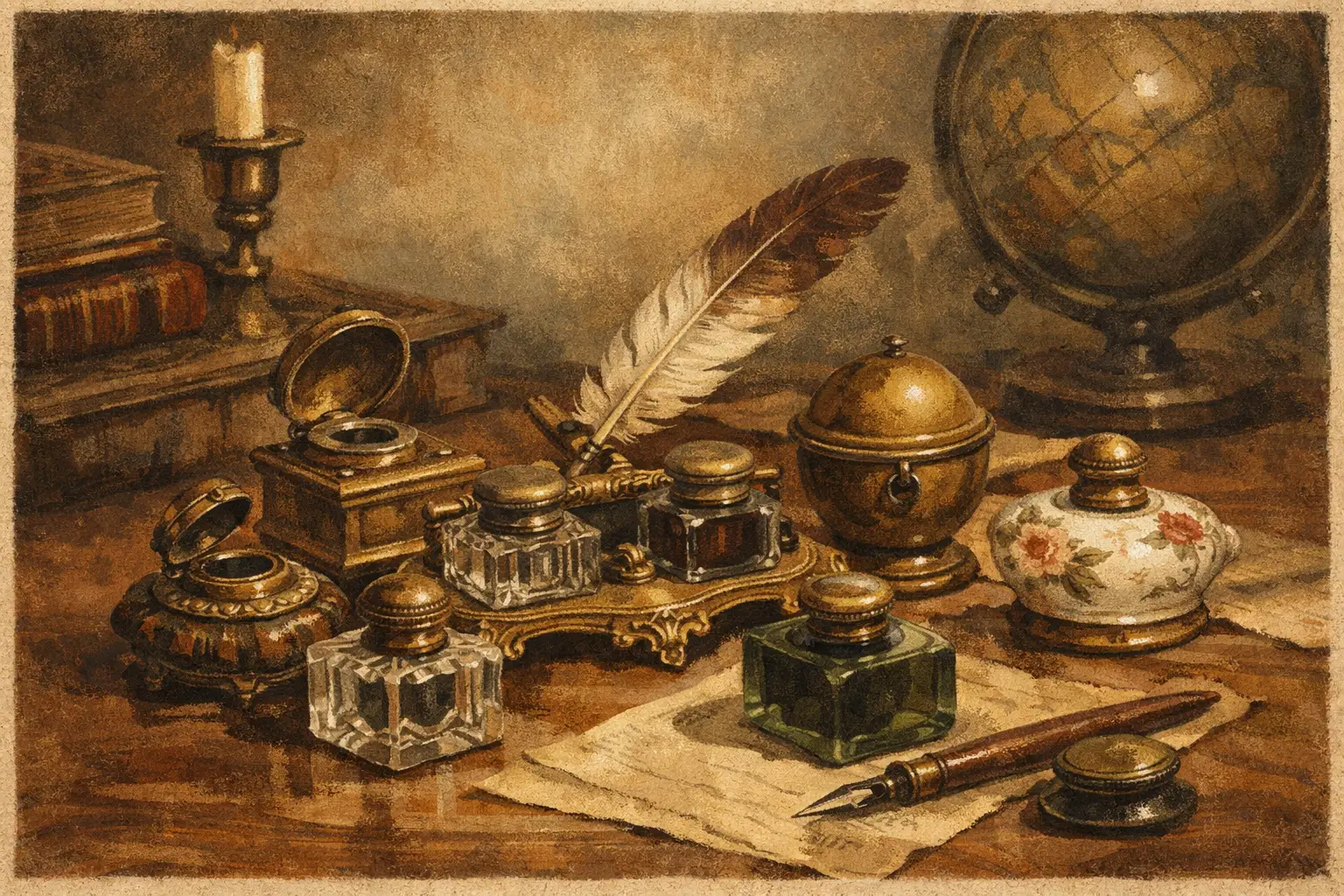
A well-chosen inkwell does more than hold ink. It changes the character of a writing desk, gives a dip pen a proper home and makes the ritual of filling a fountain pen feel considered rather than improvised. The best antique desk inkwells combine honest period detail with practical condition: sound glass, a lid that closes cleanly and a form that still earns its place beside the paper.
For collectors of vintage writing instruments, an inkwell is not merely a decorative extra. It is part of the wider desk set: the object that once sat beside a blotter, pen tray, seal and correspondence rack. The right example can complement a Victorian dip pen or bring an early twentieth-century fountain pen display into focus. The wrong one can be difficult to clean, poorly repaired or simply too fragile to use.
What makes the best antique desk inkwells?
Age alone does not make an inkwell desirable. The strongest examples have quality of manufacture, a recognisable design language and enough original condition to tell their story. A crisp cut-glass well in a well-made silver or brass stand will often be more satisfying than a rarer-looking piece with a chipped neck, replacement lid and tired plating.
Practicality matters too. If you intend to use an inkwell, look for a stable base, an intact internal reservoir and a lid that limits evaporation. A wide open well may look handsome but is better suited to occasional display, while a fitted inner glass liner or ceramic pot is much easier to live with. Antique ink was often corrosive, so staining around a rim is unsurprising; deep pitting, cracks and active corrosion are less welcome.
Provenance and maker marks can add interest, but they should not overshadow condition. A clearly marked quality maker is a bonus. An unmarked inkwell with excellent materials, elegant proportions and no damage can still be the better purchase.
Seven antique desk inkwells worth seeking
1. Victorian cut-glass and silver-plated inkwells
The classic Victorian desk inkwell usually pairs a faceted or hobnail-cut glass reservoir with a silver-plated or electroplated mount. It has enough sparkle to sit comfortably on a formal writing desk without becoming theatrical. Many were made as single wells, though double-well versions are particularly attractive when complete.
Look closely at the hinge, the fit of the lid and the plating on raised edges. Light wear is normal and often rather appealing. Base metal showing through across the whole mount, a loose hinge or a chipped glass shoulder affects both value and usability. These make excellent partners for Victorian dip pens and mother-of-pearl penholders.
2. Brass travelling and campaign-style inkwells
Compact brass inkwells made for travelling, military use or portable writing slopes have a purposeful charm. Their screw caps, sprung covers and compact proportions reflect a time when correspondence travelled with its writer. Some examples include an inner glass pot, while others rely on a tightly engineered metal closure.
These are among the most functional antique choices, provided the seals and threads remain sound. Check that caps do not cross-thread, that sprung lids latch properly and that any internal liner is present. They are small enough for a desk display but should not be assumed watertight after more than a century of use.
3. Ceramic and porcelain novelty inkwells
Ceramic inkwells range from restrained Edwardian pieces to wonderfully eccentric animal, shoe, book and character forms. The best have sharp modelling, clean glaze and a complete original pot or stopper. They bring colour and personality to a writing area, particularly where dark wood and black hard-rubber pens need a lighter companion.
Condition is decisive. Hairline cracks can hide beneath glaze, and old repairs may be difficult to spot without careful inspection. Turn the piece over, inspect the rim and look inside the reservoir. A charming novelty form is not automatically valuable, but a complete, well-modelled example from a known pottery can be a rewarding find.
4. Arts and Crafts copper and pewter inkwells
For a more architectural desk, Arts and Crafts inkwells in copper, pewter and hammered metal are hard to beat. Their appeal lies in texture, restrained ornament and hand-worked surfaces rather than shine. They sit particularly well with early Conway Stewart, Mabie Todd and other twentieth-century pens with warm, understated finishes.
Original patina is usually preferable to a harsh polish. Gentle cleaning may be appropriate where grime is obscuring detail, but an aggressively bright surface can remove the quiet character collectors value. Seek a firm base, honest hammer marks and a liner that has not cracked or become detached.
5. Edwardian oak desk stands with glass wells
An oak desk stand gives an inkwell context. These pieces often include one or two cut-glass wells, pen grooves and sometimes a space for a blotter or correspondence. They were made for daily work, and the best examples still have a reassuring solidity that lighter decorative inkwells lack.
The common faults are also easy to identify: missing glass inserts, warped timber, loose gallery rails and ink burns around the wells. Ink staining is part of the history, but severe swelling or splits in the wood need consideration. A complete stand with matching wells is far more desirable than one assembled from unrelated parts.
6. French bronze and ormolu inkwells
French nineteenth-century inkwells can be elaborate, with gilt bronze mounts, scrolling feet, classical motifs and porcelain or glass reservoirs. At their best, they are miniature pieces of decorative art. They suit collectors who want their writing desk to make a statement, perhaps alongside a finely chased dip pen or a substantial fountain pen in an early case.
They also demand more scrutiny. Check for loose mounts, regilding, bent feet and incomplete wells. Ornate decoration can conceal repairs, so assess the object from every angle. A simpler, complete bronze example is often a wiser acquisition than a heavily embellished inkwell with doubtful restoration.
7. Early twentieth-century branded desk sets
Inkwells associated with established writing brands or supplied as part of a desk set can have special appeal. A period fountain pen displayed with a matching stand, blotter or inkwell creates a coherent collecting story. Even where an inkwell is not directly branded, its design may reflect the era of a favourite Parker, Waterman, Sheaffer or Pelikan.
Buy these for the quality of the object first and the name second. Brand association can tempt sellers to overstate rarity. Examine stamps, construction and whether the components genuinely belong together. A well-matched set should show consistent materials, age and wear rather than a collection of convenient additions.
Choosing an inkwell for use rather than display
If the inkwell will see ink, choose conservatively. Glass and glazed ceramic reservoirs are the easiest to clean and least likely to react with modern fountain pen ink. Metal-lined wells can be attractive, but they may be unsuitable for long-term storage of ink, particularly where plating has worn or corrosion is present.
Do not leave ink in any antique inkwell for weeks at a time. Fill only what you expect to use, keep the lid closed and rinse the reservoir after use. For fountain pens, an inkwell is best treated as a decanting vessel rather than permanent ink storage. This protects both the antique object and the pen you have taken care to restore.
A deeper well is useful for filling lever-fillers or eyedroppers, but the opening must give enough clearance for the section without risking scratches against a sharp rim. Dip pen users may prefer a shallow insert that lets the nib reach ink without being submerged too far. It depends on the writing instrument and how regularly the inkwell will be used.
Condition checks before you buy
Photographs should show the lid open and closed, the interior of the reservoir, the underside and close views of any marks. Ask whether the glass is original, whether the lid closes securely and whether there are repairs, hairlines or losses. With plated pieces, ask where the plate has worn. With wooden stands, ask whether the wells match.
A restored antique can be an excellent purchase when the work is transparent and sympathetic. A replacement liner, for example, may make a desk inkwell usable again. What matters is that repairs are disclosed, materials are appropriate and the price reflects the condition. The same collector judgement that applies to vintage fountain pens applies here: originality has value, but careful restoration can preserve an object for genuine enjoyment.
At Heritage Collectables, the appeal of an inkwell lies in that balance between period character and practical use. Choose the example that suits the pens you reach for, not simply the one with the most ornament. A clean glass well, a dependable lid and a design you will enjoy seeing every day can turn even a short handwritten note into a small, satisfying ceremony.