
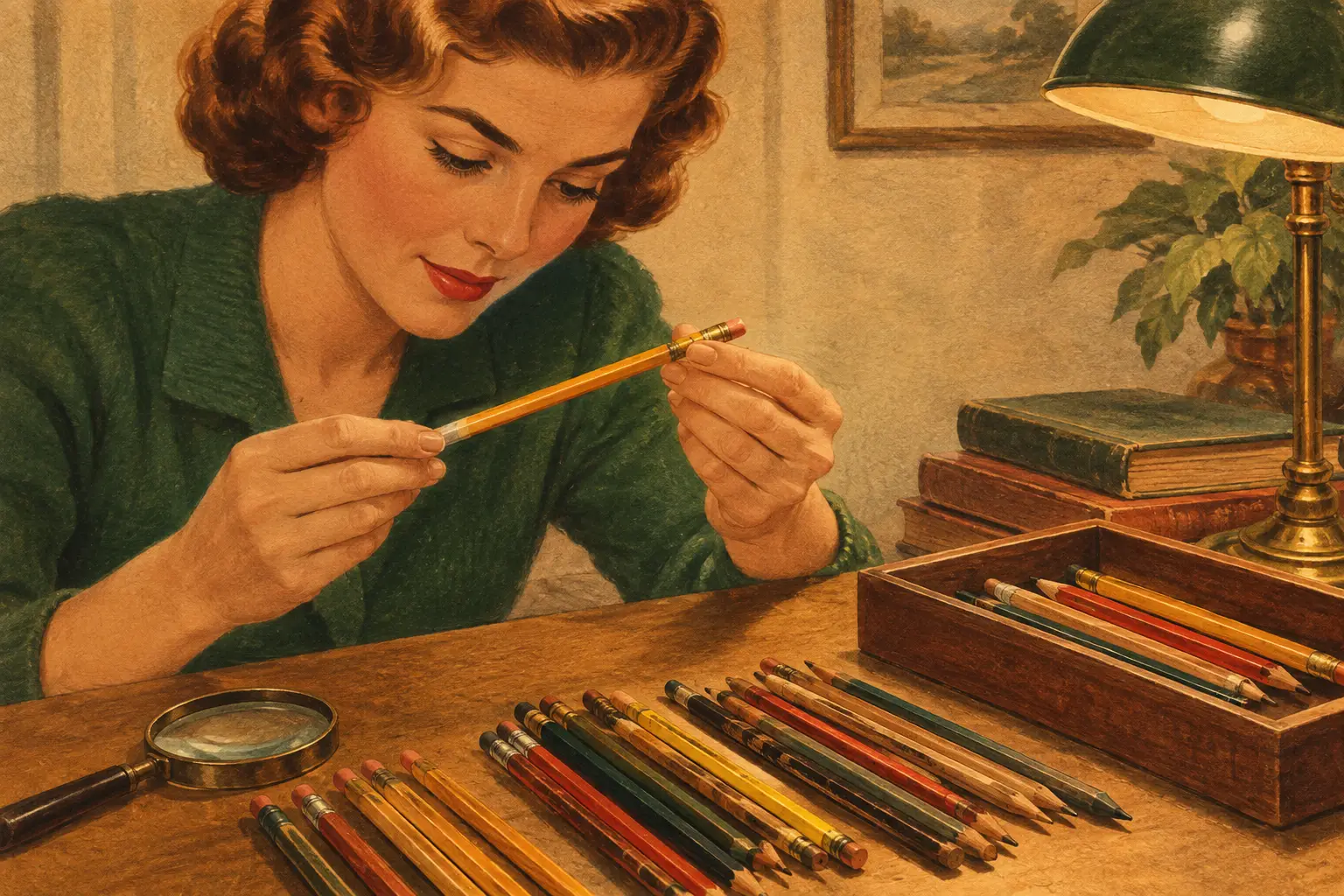
A vintage pencil can look deceptively simple: a slim barrel, a clip, perhaps a few worn letters at the cap. Yet learning how to date vintage pencils is rarely a matter of finding one definitive stamp. The most reliable answer comes from reading several clues together – the maker’s imprint, mechanism, materials, metalwork and period design – then allowing for the repairs and replacements a well-used pencil may have received.
For collectors, accurate dating does more than satisfy curiosity. It helps distinguish a scarce early pattern from a later production version, establishes whether its components belong together, and gives proper context to its value. For those who intend to write with their pencil, it also informs sensible restoration: preserving the evidence of age matters just as much as restoring dependable function.
Start by identifying the pencil type
Before looking for a year, establish exactly what you have. A wooden cased pencil, a Victorian propelling pencil, a twist-action mechanical pencil and a clutch pencil each leave different dating trails.
Early propelling pencils were often made in silver, gold-filled metal or plated metal, sometimes with decorative engine-turning, chased detail or seals at the terminal. By the early twentieth century, manufacturers increasingly offered streamlined metal and plastic mechanical pencils with repeatable components and branded mechanisms. Post-war pencils brought new finishes, coloured plastics, more economical construction and, eventually, the familiar thin-lead formats.
The terminology used in an advert or catalogue can be revealing too. “Propelling pencil” is particularly common in British and older Commonwealth descriptions, while “mechanical pencil” became more broadly used over time. This is a supporting clue, not proof in itself, especially when a modern seller has supplied the description.
How to date vintage pencils from maker’s marks
The barrel imprint is usually the best place to begin. Use a loupe and strong, angled light, as light wear can make an apparently blank pencil surprisingly informative. Record every word, symbol, number and punctuation mark before polishing or cleaning anything.
Look first for the manufacturer. Established names such as Parker, Waterman, Conway Stewart, Sheaffer, Wahl-Eversharp and Yard-O-Led can often be narrowed to particular periods by changes to logos, addresses and model names. A company’s script logo may have been used for decades, whereas a specific trade mark layout, city address or country-of-origin line may have had a much shorter life.
Country markings deserve close attention. “Made in England”, “Made in Great Britain” and “Made in U.S.A.” may point towards different export requirements or production periods, but they should not be used alone to date a pencil. Makers sometimes retained older dies, exported components for assembly elsewhere, or produced the same model for more than one market.
Model names and numbers are particularly useful when matched against original catalogues. A number may identify a whole family rather than one exact variant, so compare the clip, cap, finish, lead size and trim. Two pencils with the same model reference can still belong to different production runs.
Read patents correctly
“Patent” can seem like the answer to a collector’s question, but it is often misunderstood. A patent date normally tells you when a design or mechanism was protected, not when the individual pencil was made. Production may begin after that date and continue for many years.
If a patent number appears on the barrel or mechanism, identify the country to which it relates and check what the patent covers. It might concern the lead advance, a clip fixing, a cap construction or a small internal feature rather than the pencil’s complete design. A pencil marked with a 1920 patent can quite reasonably have been sold during the 1930s.
Patent markings are most useful when they establish an earliest possible date. Combine them with a catalogue listing or an advertisement that shows the same model. That turns an attractive assumption into a defensible date range.
Let materials and construction narrow the period
Materials carry their own history. Sterling silver propelling pencils may bear British hallmarks that identify the assay office and, in many cases, the exact year of hallmarking. The maker’s mark should also be checked, as a retail mark, sponsor’s mark and pencil manufacturer’s identity are not always the same thing.
Hallmarks date the metal component rather than necessarily the finished pencil. Still, where the body, cap and mechanism clearly belong together, they are among the strongest clues available. Wear, engraving and a later replacement mechanism can complicate matters, so examine the whole piece before assigning a precise date.
For non-precious metal pencils, construction is more informative than colour alone. Early examples may use knurled fittings, riveted clips, soldered joins and substantial brass mechanisms. Later pencils often have crisper machine-made threads, lighter pressings and more uniform plated finishes. These are tendencies, not hard rules: quality manufacturers continued using traditional methods long after cheaper alternatives appeared.
Plastic also needs a careful eye. Celluloid, early acrylics, casein and later injection-moulded plastics can differ in depth, translucency, scent and machining marks. Do not rely on a smell test or aggressive solvent test. Both can damage the pencil, and some ageing plastics are unstable. A magnified inspection of the material, together with known period examples, is far safer.
Examine the mechanism, clip and lead system
The working parts often date a pencil more accurately than its decorative barrel. Remove only what is designed to be removed, and do so gently. A seized mechanism is a restoration matter, not an invitation to force it.
Note whether the pencil uses a screw advance, twist action, push button, side button, clutch jaws or a magazine feed. Measure the lead diameter where possible. Older mechanical pencils commonly take thicker lead sizes, while later models increasingly adopted standardised thin leads. The presence of an eraser, the style of its retaining cap and the arrangement of spare-lead storage can all help separate one generation from another.
Clips are equally revealing. A maker may alter a clip from a plain tab to an arrow, military-style spear or branded shape while retaining the same basic barrel. Compare how it is mounted as well as how it looks. A replacement clip can make a pencil more useful, but it may reduce collector originality and should be described honestly when selling.
Build a date range, not a false certainty
The strongest dating method is comparative. Assemble the evidence, then state what it supports. For example, a pencil may carry a maker’s logo used from the late 1920s, a mechanism patented in 1931, and a finish shown in a 1934 catalogue. That gives a credible production window rather than an invented single year.
Useful comparison sources include period catalogues, trade advertisements, manufacturer reference books and established collector records. Photographs should be treated critically. Online listings can repeat incorrect dates, and an image seldom shows every marking, internal part or repair.
When examining a pencil for purchase, ask whether the cap, barrel, clip and mechanism appear consistent in wear and finish. A correct period replacement is not necessarily a fault, especially on a pencil intended for daily use. However, an assembled piece should be valued differently from a fully original example. The distinction matters most for rare makers, precious-metal pencils and unusual colourways.
Condition and restoration can alter the evidence
A properly restored vintage pencil should retain its character. Cleaning should reveal an imprint, not erase it; a repaired mechanism should operate reliably without turning the object into a modern reconstruction. Replating, replacement clips, new erasers and refinished surfaces all have their place, but they need clear disclosure because they affect originality.
This is why a pencil that is beautifully polished may be harder to date than one with honest wear. Patina can preserve tiny details of manufacture, while over-cleaning can soften hallmarks and obscure faint branding. At Heritage Collectables, the most satisfying restorations are those that return a pencil to practical service while respecting the features that make it collectible.
A date range backed by visible evidence is worth far more than a precise year offered with no explanation. Keep notes, photograph the marks before any work is carried out, and let the pencil’s small details tell their story at their own pace.