
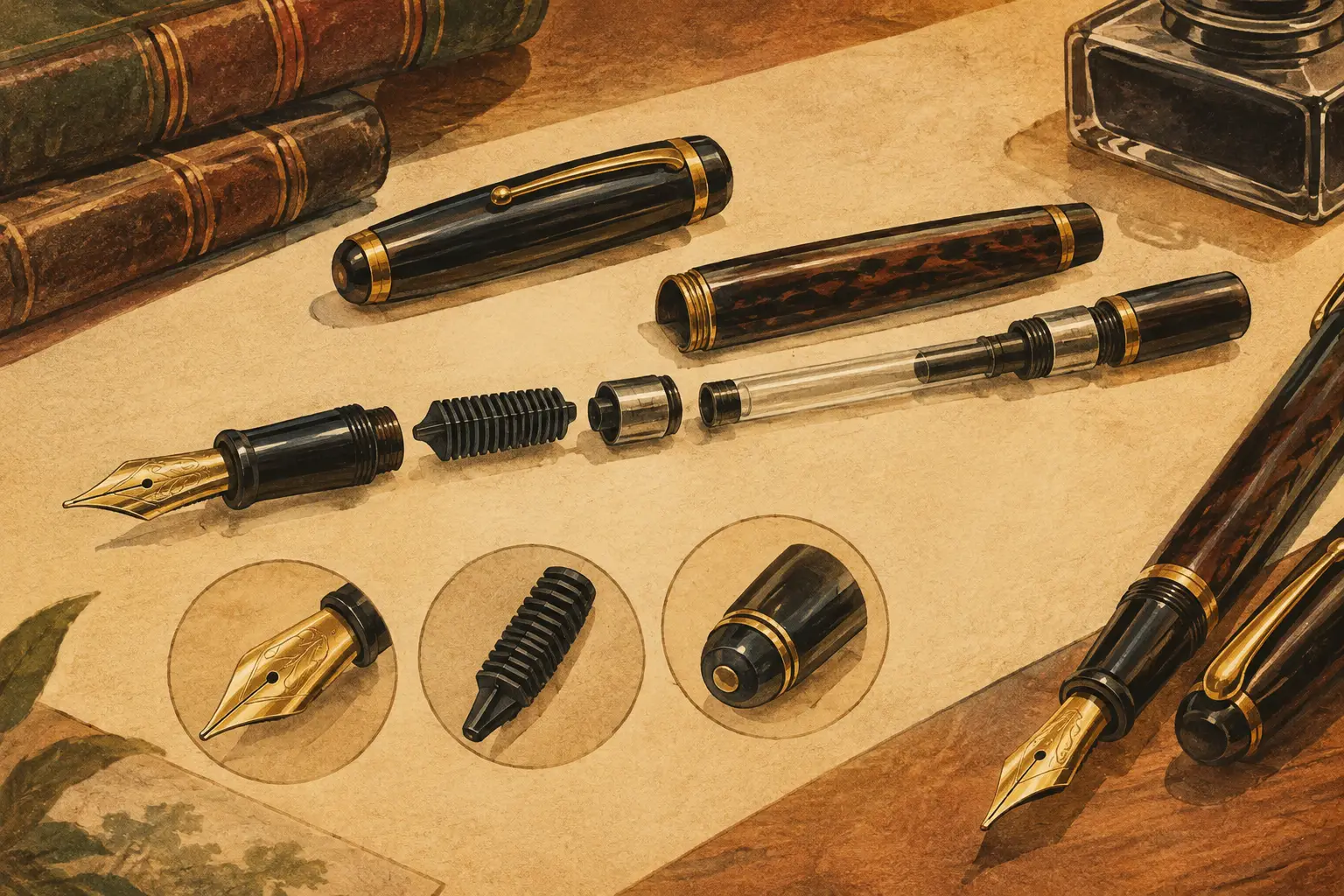
A vintage fountain pen can look beautifully simple in the hand: a cap, a barrel and a gleaming nib. Yet beneath that restrained exterior is a small mechanical system designed to control ink with remarkable precision. Fountain pen parts explained properly means looking beyond appearances, particularly when assessing an older pen for daily writing, collecting or restoration.
The names of the parts matter because they help you describe a fault accurately, compare models intelligently and understand what has been restored. A sound pen is not merely one that fills with ink. Its cap should protect the nib, its feed should deliver a reliable flow, and its filling system should hold ink without leaks or deterioration.
Fountain pen parts explained from nib to barrel
At the writing end sits the nib, usually made from steel or gold. This is the part that touches the paper, but it is not simply a pointed piece of metal. The nib has two tines separated by a narrow slit. Ink travels down that slit to the tip, where the rounded tipping material meets the page.
The small hole near the centre of the nib is the breather hole. It helps regulate the flex of the tines and, on many designs, assists the flow of ink. Its shape can be a useful identifying feature: Waterman often used a round hole, while other makers adopted heart, keyhole or crescent forms. Nib imprints also frequently provide the maker, gold content and sometimes the size or grade.
A nib may be described as fine, medium, broad, italic, oblique, flexible or semi-flexible. These descriptions are useful, but vintage nibs deserve to be tried rather than judged by a label alone. A fine British or European nib may be broader than expected, while decades of use can have altered the writing character. Flexibility is especially variable. A genuine flexible nib responds to light pressure, but forcing it can spring or crack the tines.
Immediately below the nib is the feed. Often made from hard rubber on early pens and plastic on later examples, the feed is the ink-management component. Its channels guide ink towards the nib and return air to the reservoir as ink is used. The fins underneath act as a temporary buffer, helping prevent blobs when temperature, pressure or writing speed changes.
The fit between nib and feed is crucial. If they are misaligned, poorly seated or blocked with old ink, the pen may write dryly, skip, flood or start only reluctantly. A clean-looking nib alone is no proof of a well-functioning pen.
The section, also known as the grip section, is the tapered area held between the fingers. It joins the nib assembly to the barrel and may be threaded, friction-fit or permanently secured depending on the model. On a vintage pen, section discolouration, shrinkage and cracks need careful inspection. Hard rubber sections may oxidise to a brownish olive tone after long exposure to light, while some plastics can craze or become brittle.
Behind the section is the barrel, the main body of the pen. It houses the ink supply or filling mechanism. Barrels are found in hard rubber, celluloid, acrylic, resin, metal and more unusual materials such as casein. Each has its own ageing characteristics. Celluloid can develop discolouration or crystallisation, while lever-filled barrels may show wear around the lever box. These details do not automatically make a pen unusable, but they affect value, stability and restoration choices.
The cap does more than complete the silhouette
The cap protects the nib from damage and slows ink evaporation. On many vintage pens, it is one of the first places where condition separates an attractive collectable from a practical writing instrument. A cap that does not seal well can lead to a dry nib after only a short period unused.
Most caps attach by threads, although slip caps and clutch caps are also common. The inner cap is a less obvious but important component. This small sleeve inside the cap surrounds the nib when closed, creating a better seal. A damaged or missing inner cap may cause persistent drying-out even when the outer cap appears sound.
The clip, cap band and trim are primarily decorative but also tell a great deal about a pen’s age and identity. Parker arrow clips, Sheaffer white dots, Conway Stewart cap bands and Waterman lever details are familiar examples. Loose clips, brassing on gold-filled trim and cap-lip cracks are all worth noting. Brassing is honest wear on plated or gold-filled surfaces, whereas a crack may affect usability and should never be dismissed as merely cosmetic.
Some pens have a blind cap at the end of the barrel. This covers a button, piston mechanism or other filling component. It may be threaded or friction-fit. On certain models, a blind cap that will not move is simply stuck with dried ink. On others, force can damage a valuable mechanism, so it is sensible to have an unfamiliar pen assessed before attempting to open it.
The filling system is the pen’s working heart
The reservoir and filling mechanism determine how a fountain pen takes in ink. This is where restoration expertise is particularly valuable, because rubber components and seals are consumable parts even when the rest of the pen is in excellent condition.
A lever filler has a small lever on the side of the barrel. Lifting it compresses an internal pressure bar, which squeezes the rubber ink sac. When the lever is lowered with the nib submerged in ink, the sac expands and draws ink into the pen. This was a widely used system in Waterman, Conway Stewart and many other vintage makes. A newly replaced sac and correctly fitted pressure bar can give dependable service, but an old sac may have hardened, perished or adhered to the barrel.
A button filler works on a similar sac-based principle, but the pressure bar is operated by pressing a button beneath the blind cap. Many classic Parker Duofolds use this arrangement. It is elegant and durable when properly restored, although the button, retaining thread and pressure bar all need to be in sound order.
A piston filler uses a screw-operated piston inside the barrel. Turning the piston knob moves a seal to draw ink directly into the barrel, giving generous ink capacity. Pelikan is particularly associated with the system, while Montblanc and others have used variants over many decades. Piston seals can require specialist servicing, especially in older pens where cork was used rather than synthetic material.
The vacumatic, aerometric, cartridge/converter and plunger systems each have their own advantages. Vacumatic pens use a diaphragm and offer high capacity, but the diaphragm is a specialist replacement part. Aerometric fillers use a squeeze bar over a sac or pli-glass reservoir and are often straightforward, long-lived users. Cartridge/converter pens are convenient, though not every vintage cartridge format remains readily available.
It depends on whether you want an everyday writer or a historically correct collection piece. A restored sac is generally expected in a usable lever filler. Replacing an original but failed component may be less appealing to a purist collector, yet it often makes the pen usable again without changing its outward character.
What to inspect before buying a vintage fountain pen
Condition descriptions should distinguish between a pen that is complete, a pen that is restored and a pen that is merely untested. “Untested” may mean the seller has not filled it, but it can also conceal a hardened sac, seized piston, blocked feed or cap seal problem. A specialist restoration is more than a quick rinse and polish.
Examine the nib for bent tines, cracks at the breather hole, uneven tipping and signs that the nib has been forced out of alignment. Look closely at the cap lip and barrel threads for hairline cracks. Check whether the lever, button or piston operates as it should, but avoid repeated operation of a mechanism that feels stiff. Old ink can be corrosive, and a reluctant mechanism may need careful cleaning rather than more pressure.
Originality also deserves a measured approach. A replacement clip, later nib or non-original cap may reduce collector value, especially on scarce models. For a pen bought principally to write with, however, sound restoration and comfortable performance can matter more than absolute factory specification. The best choice depends on the model, rarity, condition and your purpose for owning it.
Understanding the individual components turns a fountain pen from an attractive object into a piece of working design history. When browsing restored vintage pens, ask about the filling system, nib condition and restoration carried out. Heritage Collectables values that informed approach: the right pen should reward both close inspection and the simple pleasure of putting ink to paper.