
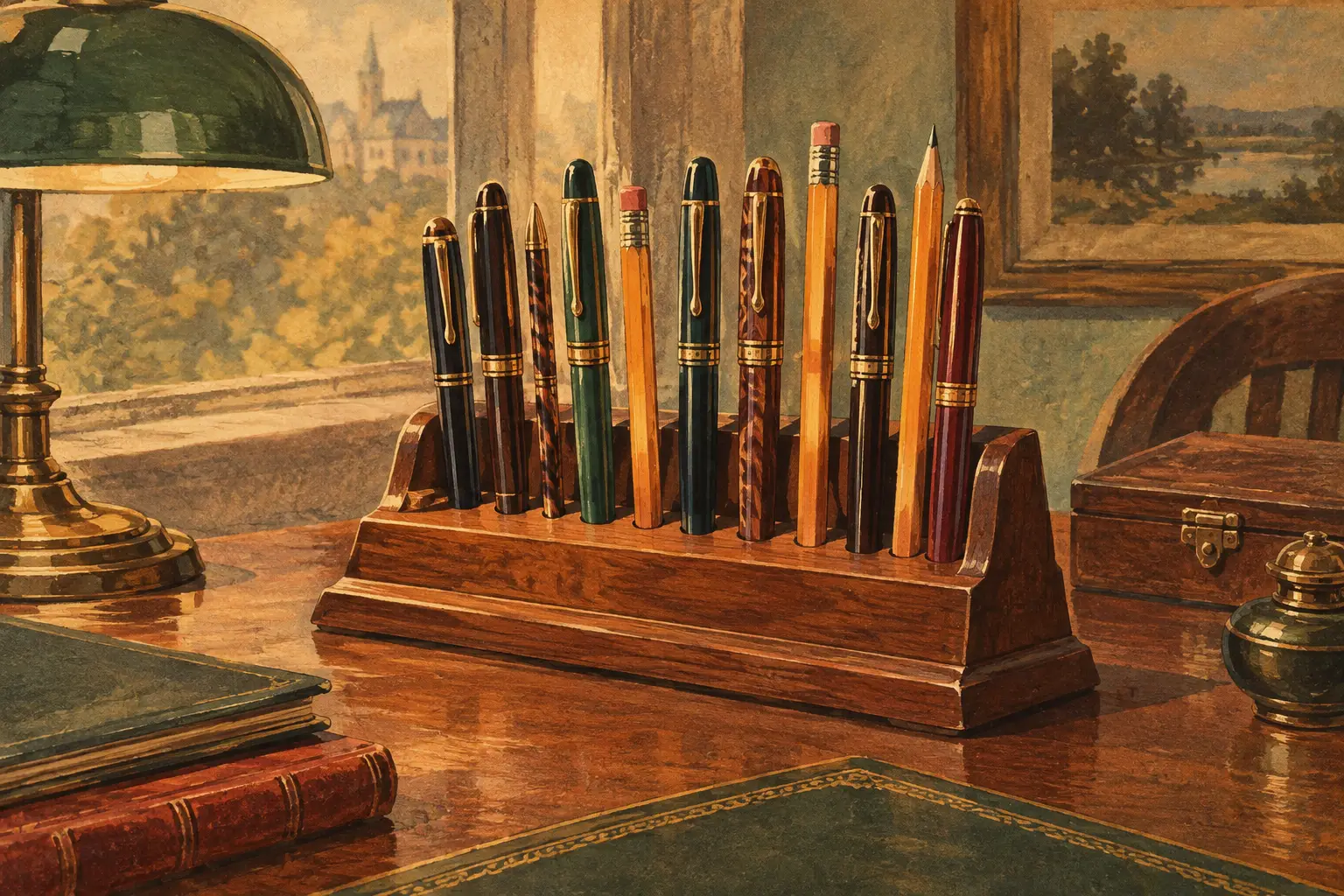
A restored fountain pen should not spend its idle hours rolling loose in a drawer, knocking against keys, clips and other hard objects. The right pen racks give a treasured Parker, Waterman or Conway Stewart a proper resting place between uses, while making a writing desk feel like a place where fine instruments are meant to be enjoyed.
For the collector, a rack is not merely desk furniture. It is part display, part practical storage and part protection. The best choice depends on whether the priority is daily access, a compact group of favourite pens, a broader collection, or a handsome gift presentation.
What a Good Pen Rack Should Do
A pen rack has a straightforward job: it should hold each instrument securely without putting pressure on the cap, barrel, clip or lever. Yet the detail matters. Vintage pens vary enormously in length, girth and balance. A slender 1920s hard-rubber Waterman may sit very differently from a broad 1950s Parker Duofold or a substantial Montblanc.
A well-made rack separates pens so that they do not rub together when one is lifted out. Its slots or rests should support the barrel rather than pinch it, and the surface should be clean and smooth. This is especially relevant for celluloid, lacquered finishes and chased hard rubber, all of which can be marked by careless storage or unsuitable materials.
For a working writing desk, visibility is equally valuable. When a pen is clearly presented, it is more likely to be used, cleaned and refilled regularly. A rack can also prevent the familiar problem of selecting a pen only to discover that it has been left uncapped in a crowded desk tray.
Choosing Pen Racks by Capacity and Use
The ideal number of places is not always the largest number available. A single-pen or two-pen rack suits a desk where one fountain pen and one pencil are in frequent use. It keeps the arrangement restrained and gives each instrument visual importance.
Three- and four-pen racks are often the most versatile choice for enthusiasts. They can hold a rotation of pens filled with different ink colours, or pair a fountain pen with its matching mechanical pencil or ballpoint. This size works particularly well on a home office desk, beside a writing slope, or near an inkwell.
Larger pen racks are best for collectors who want a selected display rather than permanent storage for an entire collection. A full rack can look impressive, but it also gathers dust and takes up useful writing space. If the pens will not be used regularly, a lined pen case or cabinet may provide more appropriate long-term protection.
Horizontal or Upright Storage?
Most traditional pen racks hold pens horizontally, and for good reason. The arrangement is gentle on clips and caps, makes individual instruments easy to inspect, and avoids putting a pen nib-down where ink might collect in the cap. For fountain pens that have been freshly filled, storing nib-up when not in use can reduce the chance of ink settling around the section. However, a horizontal rack is perfectly suitable for pens that are clean, sound and used as part of an ordinary writing routine.
Upright stands have a distinctive period appeal, particularly when paired with dip pens, nibs and an inkwell. They deserve a little more care. A stand designed for a dip pen is not necessarily suitable for a fountain pen, especially if the opening is narrow or if the pen’s clip is forced against the holder. Match the stand to the instrument rather than assuming that any old desk stand will do.
Materials That Suit a Collector’s Desk
Wooden pen racks remain a favourite because they sit naturally alongside vintage furniture, leather desk pads and traditional blotters. Walnut, oak, mahogany-toned finishes and other darker timbers can complement black hard-rubber pens, colourful celluloid and the gold trim of a classic Parker or Sheaffer. The quality of finish is more significant than the wood name alone: rough edges, loose varnish or exposed metal fittings have no place near valuable pens.
Acrylic and glass racks create a lighter, more contemporary display and can be useful where the pens themselves should take centre stage. They make it easier to see a full collection at a glance, although clear materials show dust and fingerprints quickly. They can also look out of place beside a strongly traditional Victorian writing set, so the surrounding desk matters.
Metal racks may be handsome, especially in Art Deco or mid-century styles, but check every contact point. Bare metal can scratch a barrel, and thin wire supports may not be kind to delicate clips. A vintage rack with felt, rubber or cork contact surfaces should be assessed carefully too. Old padding can harden, crumble or transfer residue over time.
Matching the Rack to Vintage Pens and Pencils
Measure the practical fit before falling for appearance. Long pens need adequate space at both ends, while oversized pens need rests wide enough to support the barrel without wedging it in place. A rack made for modern slim ballpoints may be unsuitable for a large vintage fountain pen.
Pay particular attention to clips. On a crowded rack, a clip can catch on the neighbouring pen as it is removed. This is a nuisance with any instrument, but it is an avoidable risk with an original clip that contributes greatly to a pen’s value and character. Leave enough room to lift each pen cleanly.
Pencils deserve the same consideration. Vintage propelling pencils often have fine points, delicate cones and mechanisms that can be bent by a fall from a desk. Keeping a matching pencil in a rack beside its companion pen not only looks right, but makes the pair more likely to be used together as intended.
If a pen has just been restored, or if it is a particularly scarce example, do not treat a rack as an alternative to sensible handling. Keep it away from direct sunlight, radiators, open windows and the edge of a busy desk. Bright light can fade sensitive materials, while heat and sudden temperature changes are unhelpful for old plastics, sac-filled pens and ink.
Placing a Pen Rack Well
The most attractive position is often not the safest one. A rack at the front edge of a desk is easy to admire but vulnerable to a sleeve, a notebook or a passing hand. Place it slightly back from the edge, on a stable and level surface, where it cannot be knocked when a drawer is opened.
Avoid placing a pen rack directly beneath strong sunlight. This matters for pens with vibrant celluloid, early plastics or delicate surface finishes. Likewise, keep ink bottles at a sensible distance. A well-positioned inkwell can look splendid beside a rack, but one careless reach should not put a full bottle of ink above a line of valuable pens.
A small desk pad beneath the rack can help define the area and protect the furniture from minor movement. Choose a clean, colourfast material. New leather, dyed felt and some rubber-backed mats may leave marks or react with finishes if pens are stored directly against them for long periods.
Caring for Racks and the Pens They Hold
Dust is more than a cosmetic issue. Fine grit can scratch polished surfaces when a pen is lifted or replaced. Wipe the rack gently with a soft, dry cloth and inspect the rests from time to time for debris, loose padding or roughness. Do not use furniture polish near the pens, as overspray and residue are easily transferred to barrels and caps.
If a fountain pen will be unused for an extended period, clean and empty it before placing it in long-term storage. A rack is excellent for a regular writing rotation, but a proper pen case is usually the wiser choice for instruments being put away for months. This is particularly true where ink, household dust, sunlight or changing room temperatures are concerns.
Collectors building a desk display should also resist overfilling it. A carefully chosen group of four or five pens is easier to appreciate than a crowded row in which no instrument can be safely removed. At Heritage Collectables, the pleasure of vintage writing has always been tied to use as much as display: a fine restored pen deserves to be picked up, filled and put to paper.
Choose a rack that suits the pens you genuinely reach for, give each one enough room, and let the arrangement invite a few more handwritten pages.