
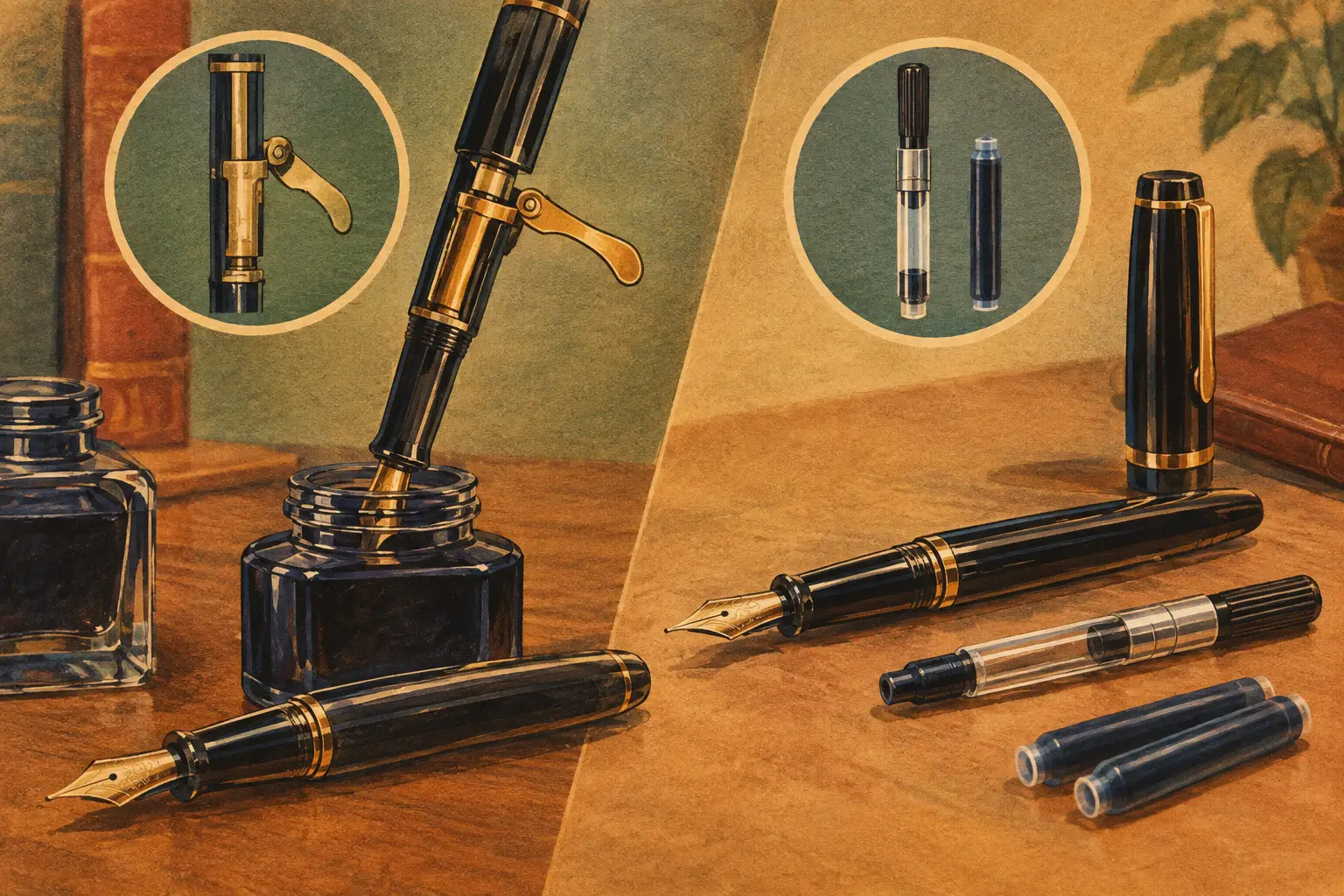
A lever filler versus cartridge converter comparison is really a question of what you want from a fountain pen. One system belongs to the classic age of Waterman, Conway Stewart, Esterbrook and many Parkers; the other suits the convenient, interchangeable habits of more modern writing. Both can give an excellent writing experience, but they ask different things of their owner.
For a collector who also writes regularly, the decision is not simply old against new. It concerns ink capacity, care, availability of parts, the character of the pen and whether you enjoy the small ritual of filling from a bottle. A properly restored lever-filled pen can be a remarkably practical daily writer. Equally, a cartridge/converter pen can make far more sense for travel, quick refills or a first step into bottled ink.
Lever Filler Versus Cartridge Converter: The Core Difference
A lever filler holds ink in a rubber sac inside the barrel. Raising the small metal lever on the side of the pen presses a pressure bar against the sac. With the nib immersed in ink, lowering the lever allows the sac to re-expand and draw ink into the pen. It is a simple mechanism, but one with a satisfying mechanical presence that has made it a favourite among vintage fountain pen enthusiasts.
A cartridge/converter pen has a removable ink reservoir behind the section. It can take a disposable cartridge, or a reusable converter that draws ink from a bottle, usually by piston, squeeze or push-button action. This system is common in later twentieth-century and contemporary fountain pens, although compatibility varies between manufacturers.
The distinction matters because a lever filler is generally a self-contained system. It was designed around its sac and pressure bar, not around replaceable cartridges. A cartridge/converter pen, by contrast, is built for flexibility and quick access to ink. Neither approach is inherently better. The right choice depends on how, where and why you write.
Why Lever Fillers Remain So Appealing
The lever filler is one of the defining mechanisms of the golden era of fountain pens. On a restored example, the lever should lift smoothly, return neatly to the barrel and create enough pressure to fill the sac without excessive force. That gentle resistance is part of the appeal: the pen feels like a purposeful object rather than a disposable accessory.
Many lever fillers also offer generous ink capacity. A larger pen with a healthy sac can hold enough ink for extended writing, making it a sensible choice for correspondence, journals and desk work. This is especially true of substantial models from makers such as Conway Stewart, Waterman and Esterbrook, where the barrel was designed to accommodate a useful reservoir.
There is also the matter of heritage. Filling a 1930s or 1950s pen from an ink bottle connects the writer to the ordinary rituals of its original owner. The pen is not merely displayed in a case; it is used in the manner for which it was made. For many collectors, that is where the real pleasure lies.
A lever filler does require sensible handling. Never force a lever that feels stuck, as an old or hardened sac may have failed inside the barrel. A pen offered as restored should have a correctly fitted new sac and a functioning pressure bar, but rubber is still a service item. Depending on use, storage conditions and ink choice, it will eventually need replacement. This is normal maintenance, not a defect in the design.
The Practical Case for Cartridge/Converter Pens
Cartridge/converter pens win on convenience. A cartridge can be changed in moments, usually without carrying a bottle or finding a safe place to fill the pen. For commuting, business travel or holidays, that simplicity has obvious value. A spare cartridge is cleaner and easier to pack than a glass ink bottle.
Converters provide a useful middle ground. They let the owner enjoy the breadth of bottled ink colours while retaining a removable filling unit that can be cleaned or replaced when necessary. If you like changing from blue-black to burgundy, green or a seasonal colour, a converter makes the process more straightforward than cleaning a fixed-sac pen.
The limitation is that cartridge standards are not universal. Parker cartridges fit Parker cartridge/converter models, while Waterman, Sheaffer and international-standard systems each have their own patterns and exceptions. Vintage pens can be particularly particular. Before buying cartridges or a replacement converter, identify the model rather than relying on the brand name alone.
Capacity can also be modest. Some converters carry considerably less ink than a full-sized lever filler, particularly slim piston converters. This may not trouble an occasional writer, but it is worth considering if you write several pages each day. A cartridge system is convenient, not automatically capacious.
Ink Choice and Cleaning
Both systems work best with well-behaved fountain pen ink, but lever fillers deserve a little more consideration. Because the sac remains inside the pen, thorough cleaning takes time. Flush with cool water until it runs clear, then allow the pen to dry with the nib down on absorbent tissue. Do not soak a vintage lever pen unnecessarily, particularly if its barrel, cap trim or imprint is delicate.
Conventional washable inks are usually the safest choice for a vintage sac-filled pen. Highly saturated, permanent, shimmering or pigment-heavy inks can be enjoyable in suitable modern pens, but they may demand more frequent cleaning and can be an avoidable risk in an older mechanism. A restrained blue, blue-black, black or traditional washable colour is often ideal for regular use.
Cartridge/converter pens are generally easier to flush because the converter can be removed and cleaned separately. That does not make them maintenance-free. Dried ink still blocks feeds, and cartridges left untouched for months can cause hard starts. The advantage is access: you can inspect the converter, rinse it and fit another if it has worn out.
If easy colour changes are central to your writing habits, a cartridge/converter system has the edge. If you settle on one dependable ink and enjoy a more deliberate filling routine, a lever filler is no hardship at all.
Which System Suits a First Vintage Pen?
For someone buying a first vintage fountain pen, a restored lever filler is often a better introduction than people expect. It is mechanically understandable, visually charming and usually straightforward to fill once shown the technique. There is no need to hunt for obsolete cartridges or wonder whether a modern converter will fit. All that is required is a suitable bottle of fountain pen ink and a light touch.
The key is to buy with confidence. A vintage pen may look excellent in photographs while hiding a perished sac, corroded pressure bar, cracked section or poorly adjusted nib. Restoration is not simply polishing a barrel. It involves assessing the mechanism, replacing consumable parts correctly, cleaning the feed and ensuring the pen is ready to write. Heritage Collectables selects restored writing instruments with that practical standard in mind.
A cartridge/converter model may be the wiser first purchase if the recipient wants a pen for occasional note-taking, office use or frequent travel. It is particularly suitable as a gift when the owner may not yet be comfortable filling from a bottle. Include compatible cartridges, and the pen can be used immediately.
The Collector’s View: Originality, Use and Long-Term Care
Collectors often favour lever fillers because the mechanism contributes to a pen’s identity. The lever, its imprint and its placement can help date a model and distinguish one manufacturer from another. On many classic pens, removing that system or attempting to convert it to cartridges would diminish both originality and charm.
That said, a pen should not be bought solely for its filling system. Nib condition, cap integrity, barrel clarity, chasing or colour, trim wear and provenance may matter more to a serious collector. A handsome lever filler with a tired nib is less compelling as a writer than a well-tuned cartridge/converter pen that suits your hand.
Long-term care is also a matter of honest expectations. A lever filler will need re-saccing from time to time. A converter may eventually crack, lose its seal or become difficult to source. Both are serviceable systems when treated properly. The difference is that lever-filler maintenance tends to require specialist work, while converter replacement is often a simple owner task.
Choosing Between Them
Choose a lever filler if you value period character, a generous ink supply and the pleasure of using a vintage pen as its maker intended. It is especially rewarding for home writing, letter writing and anyone who enjoys selecting a favourite bottled ink.
Choose a cartridge/converter pen if portability, rapid refilling and frequent ink changes are higher priorities. It is the practical companion for a busy bag, a desk drawer or a gift recipient who wants minimal ceremony.
The finest choice is often the one that makes you want to write. A restored lever filler invites a pause at the ink bottle; a cartridge/converter pen makes it easier to take good handwriting wherever the day leads.