
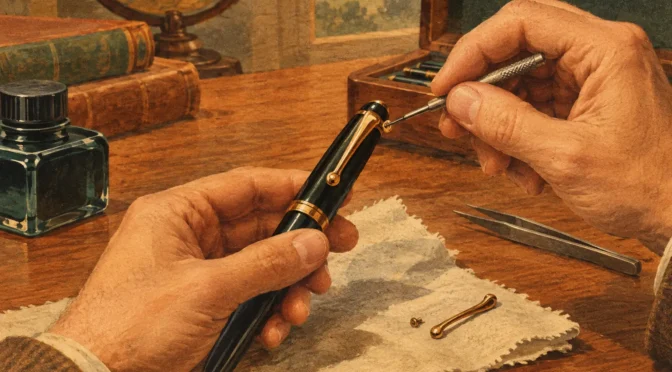
A loose clip can make an otherwise splendid vintage pen feel rather less secure in the hand. Before attempting to repair loose pen clip fittings, identify exactly what is moving. A clip that lifts away from the cap needs a different remedy from one that swivels at its fixing, catches on the cap lip, or has simply lost its spring tension.
On a modern pen, replacement may be straightforward. On a Parker Vacumatic, Waterman, Conway Stewart or other period instrument, the clip may be tied to a cap jewel, a threaded retaining assembly, a pressure-fitted washer or fragile plating. The aim is not merely to make it tight again. It is to preserve the original part, finish and character of the pen.
First, establish why the clip is loose
Clean the exterior gently with a soft, dry cloth so that old ink, polish or pocket residue does not disguise the fault. Then hold the cap rather than the barrel and test the clip with the lightest pressure. Avoid pulling it sharply upwards. That is the quickest way to turn a minor adjustment into a fractured cap lip or a bent clip.
A loose clip usually falls into one of four categories:
- The clip itself has lost its tension and no longer grips a pocket.
- The clip rocks from side to side because its retaining screw, nut or ring has loosened.
- The top fitting, cap jewel or washer has become loose, allowing the whole assembly to move.
- The cap has cracked around the clip fixing, making the hardware appear to be at fault.
The last of these matters most. A hairline crack can be almost invisible on black hard rubber, celluloid or early plastic, particularly beneath a cap band. Examine the cap under good light and use a loupe if available. If the material is splitting, do not tighten the fitting. Compression can extend the crack and make a sound repair much more involved.
Know the construction before applying force
Vintage clips were not made to one universal pattern. Some screw into the top of the cap. Others are held by an internal nut reached only after the cap liner or inner cap has been removed. A number of clips are retained by a rivet or folded tabs, while some are integral to a cap band assembly.
This construction determines whether the repair is sensible at home. A visible screw may suggest an easy job, but it can be decorative while the actual retaining mechanism sits inside the cap. Equally, a cap jewel that appears to unscrew may in fact be shellacked or threaded into aged, brittle material. If there is resistance, stop rather than assuming it simply needs more torque.
Repair a loose pen clip without damaging the cap
If the clip is only slightly open and the fixing is solid, restoring spring tension is often the least risky repair. Protect the clip with a thin piece of leather, card or masking tape, then make a minute adjustment at its widest point. The movement should be almost imperceptible. Test the clip against the fabric of a shirt pocket after each adjustment rather than trying to achieve the final tension in one bend.
Do not use bare pliers directly on plated metal. Their jaws leave marks, flatten crisp edges and can crack old gold plating. Smooth-jawed pliers with protection are preferable, but even these should be used with restraint. On sterling silver, gold-filled and plated clips, original surface condition is a large part of the pen’s appeal and value.
Where the clip rocks at its top fixing, the appropriate action depends on the hardware. A clearly accessible screw can sometimes be tightened with a correctly sized jeweller’s screwdriver. Keep the screwdriver square to the screw head and apply only enough pressure to take up the play. A damaged slot is difficult to disguise and considerably reduces the neatness of the finished cap.
If a nut or retaining ring is inside the cap, do not improvise with a screwdriver, knife blade or pointed tool. Inner caps can be a close friction fit, cemented in place, or made from material that has become fragile over decades. Removing one without the right support can distort the cap, chip a lip or scratch the interior. This is specialist work, especially on valuable examples.
A tiny amount of appropriate thread treatment may be used by a restorer on a known threaded assembly, but household glues are not the answer. Superglue can bloom on plastic, wick into moving parts and make a future proper repair far harder. Epoxy is similarly permanent in the wrong way: it can obscure original construction and prevent the hardware from being dismantled safely later.
When the cap jewel or washer is moving
A moving cap jewel often indicates that the clip assembly beneath it has slackened. This can be tempting because the fault looks so accessible. Yet jewels may be made from celluloid, casein, plastic or hard rubber, and they can crack when gripped or twisted. Their colour and profile are also difficult to match if replacement becomes necessary.
If the jewel turns easily by finger pressure and you know the model’s arrangement, it may be possible to remove and refit it correctly. For most collectors, however, this is the point at which professional attention is wiser. A trained repairer can dismantle the cap in the proper sequence, retain original washers and spacers, correct a distorted clip, and reassemble the parts without stressing the cap.
Materials that demand extra caution
Not every vintage cap tolerates the same handling. Celluloid can shrink around metal fittings and may crack if a clip assembly is tightened against it. Casein can be vulnerable to moisture, while early plastics and hard rubber can become brittle with age. On chased hard rubber, even slight tool marks are painfully obvious.
Gold-filled clips and cap bands introduce another consideration. They are usually more durable than thin plating, but repeated bending can still fatigue the metal at the clip’s shoulder. Once a clip has developed a crease or stress fracture, bending it back and forth is unlikely to provide a lasting solution. A sympathetic repair, or a period-correct replacement where appropriate, is the better route.
Collector value also affects the decision. A common user-grade pen with a loose clip may justify a careful functional adjustment. A scarce variant, an unusual colour, or a pen with crisp imprints and exceptional original finish deserves a more conservative approach. The best restoration is frequently the one that does the minimum necessary work.
Signs that a specialist should take over
Put the tools down if the cap is cracked, the clip is visibly creased, the top fitting will not move with gentle finger pressure, or the clip is attached by an unfamiliar rivet or internal mechanism. The same applies when the pen has sentimental value. A pen inherited from a family member should not become a learning exercise on metalwork.
Be wary, too, of a clip that has become loose after a drop. The impact may have damaged the cap threads, inner cap or barrel as well as the visible fitting. Check that the cap screws on smoothly and does not bind. On a fountain pen, inspect the nib and feed before use, as a knock can travel farther than expected.
At Heritage Collectables, restoration is approached as a balance of usability, originality and long-term care. A properly attended clip should sit straight, hold securely and look as though it has always belonged on the pen, rather than announcing the repair from across the desk.
Preventing a loose clip from returning
Once repaired, treat the clip as a convenience rather than a handle. Remove the pen from a pocket by supporting the cap, not by tugging the clip. Avoid clipping a vintage pen over thick denim, notebook covers or several layers of fabric, as this gradually spreads the spring and strains its fixing.
Store pens so clips are not pressed against one another in a crowded drawer. A pen case or rack prevents unnecessary rubbing and helps protect plated furniture from wear. If a cap begins to feel loose again, deal with it early. A small amount of movement is usually easier to correct than a distorted clip or split cap.
A vintage pen earns its place through both history and use. Give a loose clip the same measured attention you would give a filling mechanism or nib: examine first, adjust only when the construction is understood, and preserve the original workmanship wherever possible.