
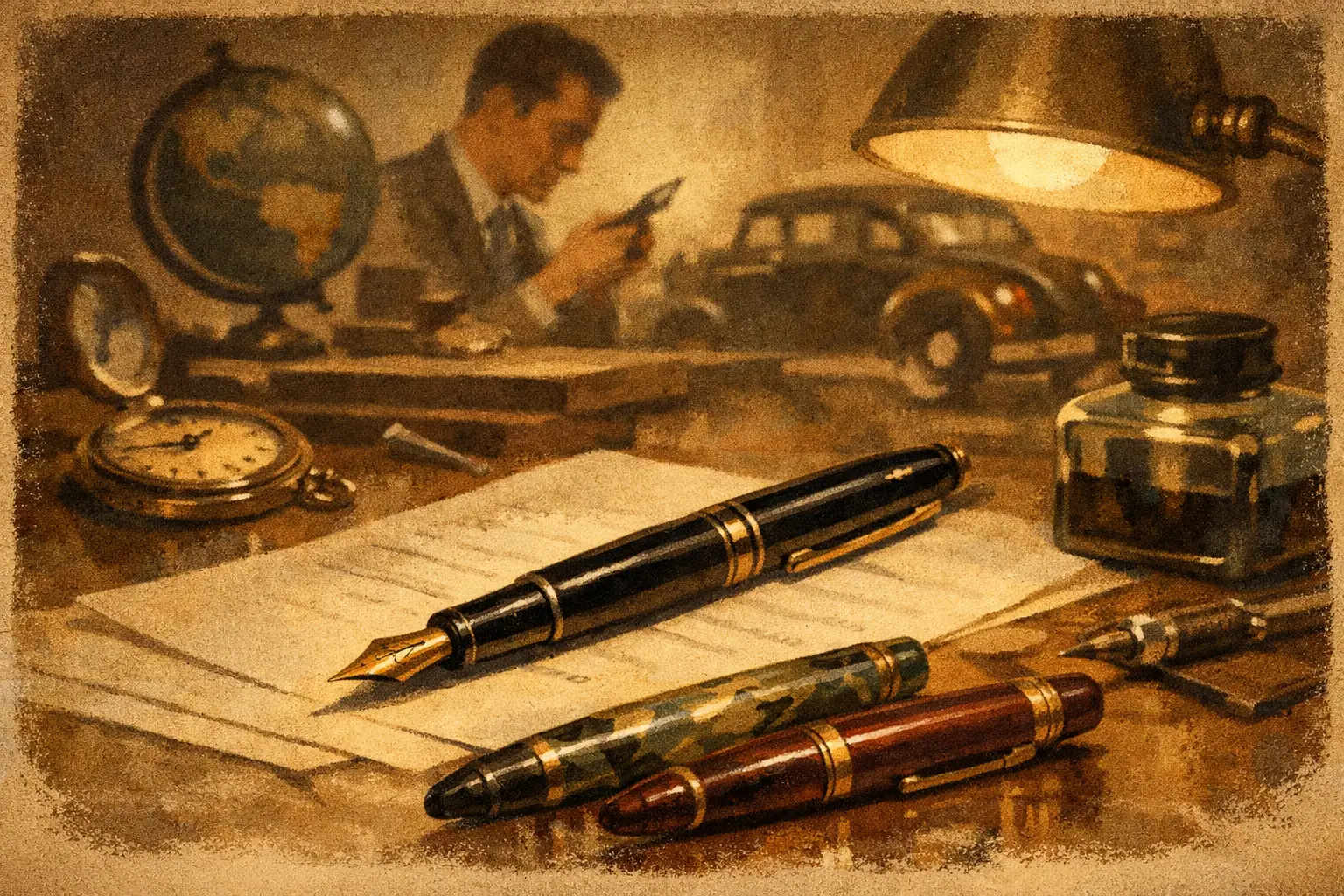
A 70-year-old fountain pen that starts first time, fills cleanly and writes a full page without complaint is not an unusual thing. Yet the question, “are vintage pens reliable”, deserves a more useful answer than a simple yes or no. A well-restored vintage pen can be an exceptionally dependable daily writer. An untouched example, however attractive in a display case, may need careful attention before it is ready to leave a mark on paper.
The difference is not merely age. It is condition, design, restoration standard and the way the pen will be used. Vintage writing instruments were built in an era when a good pen was expected to be repaired rather than discarded. That makes many of them remarkably long-lived, provided the right work has been done.
Are vintage pens reliable for everyday use?
Yes, provided they have been professionally assessed and restored where necessary. Many classic models from Parker, Waterman, Sheaffer, Conway Stewart, Pelikan and Montblanc were made with durable materials, serviceable mechanisms and nibs designed to last decades. Their continued popularity is not based on nostalgia alone. A good vintage pen offers a writing experience that remains entirely practical.
Reliability does depend on the filling system. A cartridge-converter pen is often straightforward to keep in service, while a lever filler, button filler, vacuum filler or piston mechanism brings more moving parts and seals into the picture. This does not make a traditional filling system unreliable. It means it should be correctly restored, tested and used with an understanding of its needs.
A vintage fountain pen is also different from a modern disposable object. It may reward an owner who flushes it occasionally, uses suitable ink and avoids leaving it unused with ink inside for months. For many enthusiasts, that small degree of care is part of the pleasure rather than a burden.
What professional restoration changes
The most common reason an older fountain pen fails is simple: the original rubber sac, cork seal or diaphragm has perished. Rubber hardens, cork dries out and seals lose their elasticity over time, even if a pen has spent years in a drawer. A pen can look immaculate externally while being unable to fill or retain ink.
Proper restoration addresses the parts that make the pen functional, not just its cosmetic appearance. Depending on the model, work may include fitting a new ink sac, renewing seals, servicing a piston or vacuum mechanism, cleaning the feed, setting the nib and checking for leaks. The instrument should then be filled and tested, not merely assumed to work because its mechanism moves.
This is why the source of a vintage pen matters as much as the pen itself. A low-priced example described as “working” may have received no more than a cursory dip test. A fully restored instrument has been prepared with regular writing in mind. At Heritage Collectables, restored pens are selected for both their collector appeal and their ability to be enjoyed as writing instruments, which is the distinction many first-time buyers overlook.
Restoration has sensible limits. Heavy polishing can soften crisp chasing, remove plating or erase the character that collectors value. Replacing every original part is not always desirable either. The best work preserves the pen’s identity while renewing the components that are expected to wear out.
The design of the pen matters
Some vintage pens are particularly reassuring choices for a buyer who wants dependable daily use. Parker’s aerometric fillers, for example, have a deserved reputation for durability when their pli-glass sacs remain sound. Parker 51s are admired because their hooded nibs, generous ink capacity and controlled ink flow make them practical workhorses rather than occasional curiosities.
Piston-fillers from Pelikan can be equally dependable, with a large ink supply and a mechanism that can be serviced by a capable specialist. Lever-filled Waterman and Conway Stewart pens are satisfying, simple designs, but their sacs are consumable components. A newly restored sac can give years of service, while an original one should never be trusted simply because it has survived this long.
Sheaffer’s Touchdown, Snorkel and Vac-Fill systems are ingenious and enjoyable, though more complex. They can be reliable after thorough restoration, but they are less suitable for anyone determined never to think about maintenance. Complexity is not a flaw. It is a trade-off between engineering interest, filling convenience and future servicing.
Nibs deserve equal attention. Gold nibs do not automatically write better than steel, and neither material guarantees reliability. What matters is alignment, tipping condition, feed performance and whether the nib suits the owner’s hand. A broad, flexible nib from the 1920s may be glorious on correspondence paper but less practical for quick notes on ordinary office pads. A firm medium nib from a later Parker or Sheaffer may be the better everyday companion.
Materials, wear and the risks worth checking
Celluloid, hard rubber, acrylic and metal each age differently. A reputable seller should identify significant condition issues clearly, because a vintage pen is not made more trustworthy by vague language.
Look for evidence of careful inspection in the cap, barrel, section and trim. Cracks around the lip of a cap or near a lever can worsen with use. A loose cap may cause the nib to dry out. Corrosion in metal trim, worn threads and damaged feeds can affect usability as well as appearance. With hard rubber pens, discolouration is often cosmetic, but oxidation and brittleness should be assessed honestly.
There are four practical questions worth asking before buying a vintage fountain pen:
- Has the filling system been restored and tested with water or ink?
- Are there any cracks, repairs or missing parts that affect use?
- Has the nib been checked for alignment, smoothness and ink flow?
- Which inks and filling method are appropriate for this particular model?
These questions are not fussy collector behaviour. They establish whether the pen is being offered as an untouched antique, a project for repair or a genuinely usable instrument. All three can be worthwhile purchases, but they should never be confused.
Reliability also depends on how you use it
A restored vintage pen will not benefit from being treated as indestructible. Avoid forcing a lever, over-tightening a cap or pressing hard enough to spread nib tines. Fountain pens work best with a light hand. If the pen is a lever filler or button filler, fill it as intended and do not repeatedly operate the mechanism when it is empty merely to see it move.
Ink choice has a real effect. Straightforward, fountain-pen-safe inks are generally the wisest choice for older pens. Highly saturated, shimmer or permanent inks can be enjoyable, but they demand more regular cleaning and may not suit a pen with an intricate feed or a sac-based filling system. When in doubt, choose a conventional ink and flush the pen with cool water between colours or before long storage.
If a pen will be carried daily, use a protective sleeve or case. Vintage caps and clips were made to be used, but an old pen can be damaged by loose keys, a crowded bag or a fall onto a hard floor. For home writing, correspondence or desk use, even a more delicate celluloid pen can provide reliable service for many years.
When a modern pen may be the better choice
There are occasions when reliability means choosing a modern instrument instead. If a pen must withstand rough commuting, frequent air travel, uncertain storage conditions or use by several people, a current cartridge pen may be the less anxious option. A vintage fountain pen is not ideal for someone who wants to leave the same ink in it for a year and expect it to work without cleaning.
Likewise, very rare pens, unusually fragile materials and examples with scarce original components may be better preserved for occasional writing or a collection. Their value lies partly in their survival. Using them carefully is possible, but the owner should decide whether the pleasure of regular use outweighs the risk of accidental damage.
For most buyers, the answer lies between these extremes. Choose a well-restored, established model with a sound cap, a properly serviced filling system and a nib matched to your writing style. Then use it often enough to appreciate why it has lasted. The most reliable vintage pen is rarely the newest-looking one. It is the one whose condition has been understood, whose mechanism has been respected and whose next owner is ready to write with it.