
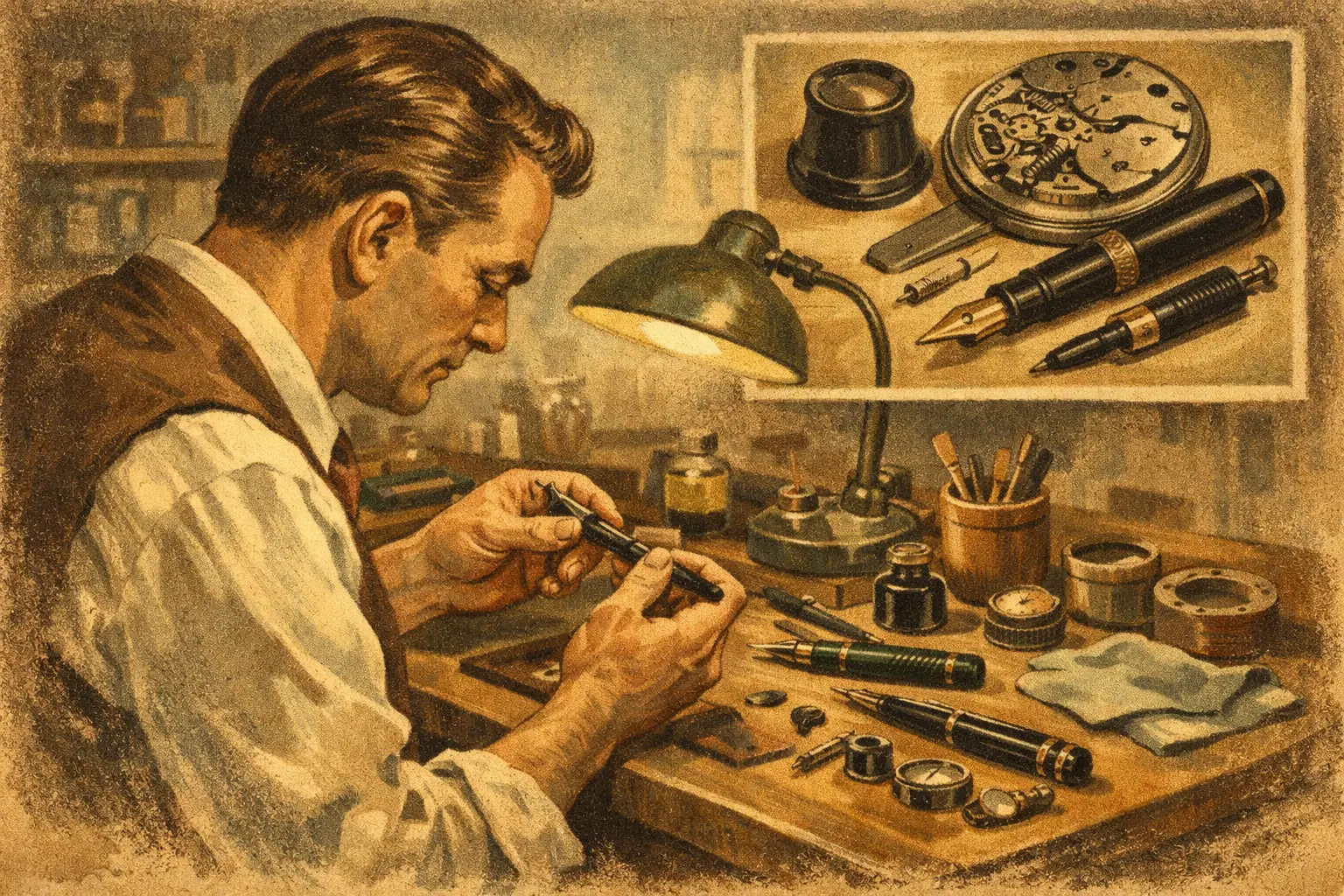
A Conway Stewart repair is rarely just a matter of fitting a new sac and sending the pen back into service. These are characterful British writing instruments, made in a wide range of plastics, patterns and filling systems across several decades. A proper repair respects the particular model in hand, restores dependable writing performance and avoids removing the small signs of age that give a vintage Conway Stewart its appeal.
For the collector, this balance matters. A pen can be beautifully polished yet wrong in its details, or mechanically sound while retaining damage that will worsen with use. The right approach depends on the pen’s age, material, condition and intended future: everyday writing, a carefully chosen gift, or a place in a specialist collection.
Why Conway Stewart Pens Need Specialist Attention
Conway Stewart produced pens in many forms, from modest everyday button-fillers to highly sought-after lever-fillers, patterned celluloid models and later cartridge or converter pens. Their materials are part of their charm, but they also create repair considerations that are not always apparent at first glance.
Early plastics can discolour, shrink or become brittle. Celluloid barrels and caps may show distortion, crazing or a distinctive camphor-like smell as the material ages. Casein pens need especially cautious handling, as water, heat and unsuitable polishing compounds can cause permanent damage. Even the familiar marbled and cracked-ice finishes deserve restraint: an over-restored surface can lose the crisp colour contrast and period character collectors value.
Mechanisms also vary. A worn pressure bar, perished ink sac or corroded lever is common in a lever-filling pen, but a repairer must first establish whether the lever box and barrel threads are sound enough for the work. On button-fillers, the button, retaining components and pressure bar need to be assessed together. For cartridge pens, the issue may lie with the converter, section seal or a nib that has been forced out of alignment.
A specialist will not assume that one remedy suits every Conway Stewart. That is particularly important where an apparently simple filling fault conceals a cracked section, a distorted barrel mouth or old adhesive from an earlier repair.
What a Conway Stewart Repair Should Include
The first stage is inspection. The cap, barrel, section, clip, trim, threads and filling system should be examined under magnification where needed. This identifies cracks, missing parts, corrosion, wear to the cap lip and signs that the pen has previously been opened or altered. It also allows the restorer to distinguish surface marks from deeper material deterioration.
The pen is then dismantled only as far as its condition permits. Vintage pens do not respond well to force. Heat, controlled humidity and patient technique may be needed to separate a section from a barrel safely. Some pens, especially those with compromised celluloid or casein, carry a real risk in dismantling. In such cases, preserving the pen may be wiser than pursuing a cosmetic or mechanical improvement that cannot be achieved safely.
For a conventional lever-filler, the repair commonly involves removing the old sac, cleaning out residue, inspecting the pressure bar and lever assembly, then fitting a correctly sized replacement sac. Size matters. A sac that is too large can strain the barrel; one that is too small may reduce ink capacity or fold awkwardly. The section must be sealed appropriately, without excess adhesive that could make later servicing difficult.
The nib deserves equal attention. Conway Stewart used a variety of nibs, including flexible and semi-flexible examples as well as firm everyday writers. A nib should be cleaned, checked for cracks and examined for tine alignment, tipping wear and correct seating in the section. Gentle adjustment can transform a scratchy or dry pen, but aggressive grinding or polishing can remove original tipping and permanently change its writing character.
A proper service ends with testing. The pen should fill, hold ink, write consistently and empty without trouble. It should also be checked for leaks around the section and filling mechanism. A vintage fountain pen is not a museum object that merely looks complete: it should be able to perform the task it was made for.
Cosmetic work: preservation before perfection
Cosmetic restoration calls for judgement. Light cleaning and careful polishing can revive a dull finish, improve clarity in translucent material and remove the residue of decades of handling. Yet polishing is not automatically beneficial. Deep scratches, tooth marks, brassing and uneven colour may be part of a pen’s history, and removing them can mean removing material.
Collector-grade work aims for sympathetic improvement rather than a falsely new appearance. Original engraving should remain sharp. Imprints should not be polished away. Gold-filled trim should not be treated as though it were solid gold, and plated components require particular care where wear has already exposed the base metal.
Replacement parts can be sensible when a pen cannot otherwise be used, but they should be represented honestly. An original clip, cap band or nib is generally more desirable than a modern substitute, even if the original shows age. If a part is scarce, it may be better to wait for the correct component than to fit something merely similar.
When Is Repair Worthwhile?
Many Conway Stewart pens are well worth restoring because their designs, materials and nibs offer a writing experience that modern pens often do not replicate. A soundly restored lever-filler can become a rewarding daily writer, while a patterned model in good original condition can retain strong collector interest.
However, value is not the only measure. A family pen may deserve careful repair regardless of market price. Conversely, an uncommon model with serious celluloid deterioration may be unsuitable for regular use even if it is valuable. Repair cannot halt every form of material ageing, and no responsible specialist should promise that it can.
The most favourable candidates usually have an intact barrel and section, usable threads, a complete filling mechanism and a nib with no major fracture. Perished sacs, dirty feeds, oxidised pressure bars and misaligned tines are generally repairable faults. More difficult cases include severe barrel shrinkage, unstable celluloid, crumbling casein, extensive cracks and heavily corroded trim that cannot be removed without causing further loss.
Before authorising work, consider how you intend to use the pen. A pen for occasional correspondence may need only a sound filling system and a pleasant, reliable nib. A pen intended as a collector’s piece may call for minimum intervention. If it is being bought as a gift, dependable filling and writing usually matter more than making every tiny sign of age disappear.
Caring for a Restored Conway Stewart
Once repaired, a Conway Stewart benefits from sensible use rather than elaborate ritual. Use a fountain-pen-friendly ink that is easy to clean, and avoid permanent, heavily saturated or shimmer inks in older filling systems. Flush the pen with cool water when changing ink colours and do not leave ink sitting in it for months.
Keep the pen away from direct sunlight, radiators and damp conditions. Do not soak a vintage pen, particularly if it has casein components or uncertain material stability. When filling a lever pen, use only gentle pressure. If the lever resists, stop rather than forcing it: a little investigation is far cheaper than a broken lever box or cracked barrel.
For valuable examples, store the pen in a stable environment and avoid tight clips or elastic loops that place pressure on the cap. A soft pen sleeve or suitable case provides better protection during travel. It is also worth retaining any notes about repairs, replacement parts and nib work. Good provenance is useful to future collectors and gives you a clearer record of the pen’s care.
Choosing a Repairer You Can Trust
A trustworthy repairer should be willing to explain what the pen needs, what it does not need, and where uncertainty remains. Ask whether original components can be retained, whether replacement parts will be disclosed, and whether the pen will be tested with ink after work is complete. Clear communication is especially valuable for rare Conway Stewart models, where an irreversible decision can affect both usability and collector interest.
At Heritage Collectables, restored vintage writing instruments are valued as working objects with history, not as ornaments to be made artificially pristine. Whether you are considering a well-loved family pen or looking for a fully restored Conway Stewart ready to write, the best result is one that honours the pen’s original craftsmanship and gives it a confident next chapter on paper.