
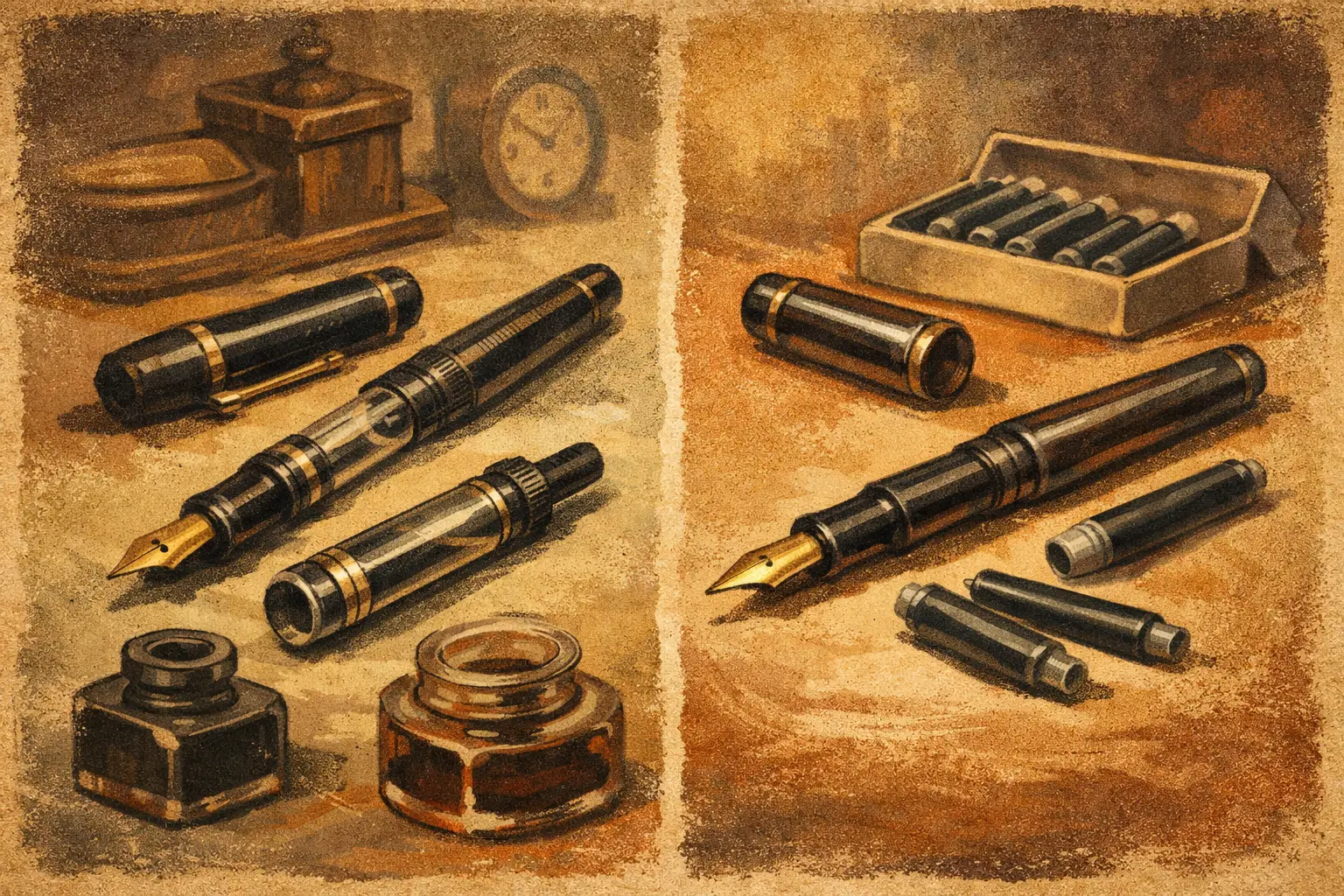
A fountain pen’s filling system changes more than the moment you add ink. It affects the colours you can use, how the pen travels, what restoration may involve and, in some cases, whether a sought-after vintage model is practical for regular writing. When considering piston versus cartridge pens, the better choice is rarely universal. It is the one that suits the pen, your writing habits and your appetite for hands-on ownership.
For a collector who writes with their pens, this distinction deserves proper attention. A well-restored piston filler can make bottled ink feel like part of the ritual. A cartridge pen can make an excellent daily companion, particularly when a fresh supply of ink is more valuable than a large reservoir. Both systems have produced important pens, and both reward informed buying.
Piston versus cartridge pens: how the systems differ
A piston-filling pen draws ink directly into its barrel. Usually, the user turns a knob at the end of the pen to move an internal piston. With the nib immersed in bottled ink, turning the mechanism one way expels air; turning it back draws ink through the feed and into the barrel. The ink sits inside the pen itself rather than in a separate cartridge.
This system is closely associated with many admired European fountain pens, including Pelikan and Montblanc models, although the precise mechanism varies by maker and era. Some vintage pens have cork piston seals, while later examples may use synthetic seals. The experience is satisfying, but the mechanism has genuine mechanical demands. A stiff piston, poor ink capacity or visible seepage should never be dismissed as a minor inconvenience when buying a vintage pen.
A cartridge pen uses a small pre-filled ink reservoir pushed on to a nipple inside the section. Once punctured, ink feeds from the cartridge to the nib. Many cartridge pens also accept a converter: a reusable reservoir that can be filled from a bottle, often by a piston, squeeze or aerometric action. That flexibility is one reason cartridge-and-converter pens remain so popular.
The crucial qualification is that cartridges are not interchangeable simply because they look similar. Vintage manufacturers frequently used proprietary formats, and a pen may require a cartridge that is difficult to source or no longer made. Before purchasing a vintage cartridge pen, establish exactly which cartridge it takes and whether a suitable converter is available. An empty compatible cartridge can sometimes be refilled carefully with a syringe, but this is a practical workaround rather than a substitute for proper compatibility.
Ink capacity is only part of the story
Piston fillers generally hold more ink than a standard international cartridge. For someone who writes long letters, keeps a journal or uses one pen for work throughout the week, that capacity is a meaningful advantage. Fewer refills also suit pens fitted with broad, wet or flexible nibs, which naturally use ink at a faster rate.
Yet a large ink supply is not always a benefit. If you enjoy changing colours regularly, a piston filler asks for a more thorough flush before the next fill. The barrel may retain a little of the previous colour, especially in pens with complex feeds or generous ink windows. A cartridge pen allows a quicker change, provided compatible cartridges are to hand.
Cartridges also make sensible travelling companions. A spare cartridge takes little room in a case, and fitting one is straightforward. They are useful for gift recipients or newer fountain pen users who want dependable writing without immediately learning about bottles, converters and cleaning routines. For many people, convenience is not a compromise in taste. It is what keeps a fine pen in regular use.
Bottled ink, however, opens a far broader field of colour and character. With a piston filler, the choice is almost limitless: traditional blue-black for correspondence, a restrained burgundy for notes, or a carefully selected shading ink that brings a vintage nib to life. The right ink can also alter the feel of a pen on paper. Collectors who value that freedom will often accept the extra care that a piston mechanism requires.
Maintenance matters more with vintage pens
Every fountain pen benefits from sensible cleaning, particularly before a long period in storage or a change of ink. Piston fillers need repeated flushing with clean water until it runs clear. The process is simple when the piston works freely, but it depends on the seal and mechanism being in sound order.
On an unrestored vintage example, a piston may be difficult to turn because old lubricant has hardened, a seal has deteriorated or internal components need attention. Forcing the mechanism can cause damage. This is why expert restoration matters: the pen should not merely look impressive in a display case, but operate as its maker intended.
Cartridge pens have fewer moving parts in the filling system, which can make routine ownership feel more straightforward. Still, they are not maintenance-free. Dried ink in the feed, a cracked section, corrosion around metal components or a damaged cartridge nipple can prevent reliable filling. With an older cartridge pen, the condition of the feed and section is just as relevant as the availability of cartridges.
There is also a distinction between a pen that can be made to write and one that has been restored for continued use. A properly assessed vintage fountain pen should fill securely, deliver ink consistently and be cleaned without anxiety. At Heritage Collectables, restoration is approached with that practical standard in mind, because a classic pen deserves to be used as well as admired.
Which system suits the way you write?
Choose a piston filler if you enjoy the ceremony of bottled ink, write enough to appreciate higher capacity and are prepared to flush the pen carefully. It is especially appealing if the pen itself is the main event: a striped Pelikan barrel, a finely balanced Montblanc or a model whose original filling mechanism is central to its design and collectability.
Choose a cartridge pen if convenience, portability and quick colour changes rank higher. It can be the more relaxed option for meetings, travel and everyday note-taking. A converter-compatible pen offers a useful middle course, giving access to bottled ink without committing every fill to a built-in system.
For gifts, think about the recipient rather than the perceived prestige of the mechanism. A first fountain pen should be inviting, not demanding. A handsome cartridge pen with readily available supplies may become a treasured daily writer, whereas an elaborate piston filler may suit an established enthusiast who already enjoys caring for vintage instruments.
Collector value and originality
From a collector’s perspective, the filling system is part of a pen’s identity. It can help date a model, distinguish one production period from another and reveal the ingenuity of a manufacturer. An original working piston mechanism can add considerable appeal, particularly where the system is distinctive to a brand or model.
That does not mean cartridge pens are secondary collectibles. Their significance may lie in a manufacturer’s transition to modern filling methods, an unusual cartridge design, a particular trim or a desirable nib. Some are also exceptionally good writers, with the added advantage that their format makes them easy to take out of the cabinet and into daily life.
Condition remains decisive. Look beyond attractive celluloid, plated trim or a famous name on the cap. Ask whether the pen fills as intended, whether its seals and section are sound, whether the correct cartridge format is known and whether the nib has been properly aligned and tested. A restored pen with a clear description is a much safer proposition than a supposedly rare example with an uncertain mechanism.
A practical way to decide
Start with the pen you are considering, not an abstract preference. If it is a piston filler, assess the smoothness of its operation, the integrity of the barrel and the quality of the restoration. If it is a cartridge pen, confirm the cartridge type before falling for the colour or the nib. Then consider how often you write, whether you prefer bottled inks and how willing you are to clean a pen between fills.
The finest choice is often the pen that makes you reach for paper. A reliable cartridge pen can turn a hurried note into a pleasure, while a beautifully restored piston filler can make the filling ritual a reason to write one more page.