Before and After Pen Restoration Explained

A vintage fountain pen can look presentable in a cabinet yet be entirely incapable of holding ink. Equally, a pen with a dull cap, tarnished trim and a stained barrel may conceal a superb nib and a mechanism worth saving. That is why before and after pen restoration is more than a visual comparison. It is evidence of careful diagnosis, sympathetic repair and the return of a writing instrument to useful life.

For collectors, writers and gift buyers, the most satisfying restoration does not make an old pen look factory-new. It respects the age, design and character that made the pen desirable in the first place, while dealing properly with the faults that prevent it being enjoyed.

What Before and After Pen Restoration Should Show

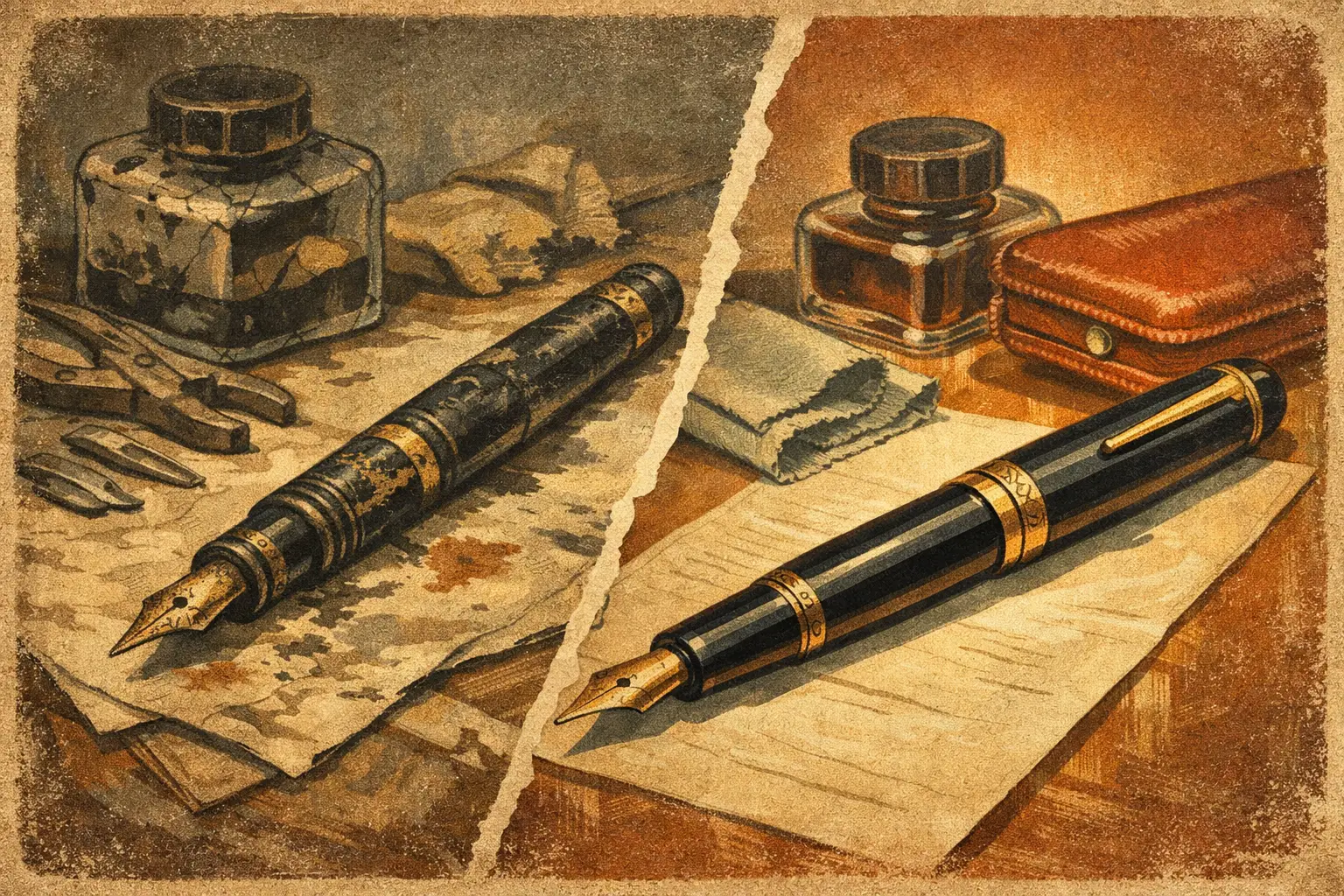
The “before” condition tells an honest story. A pen may have accumulated decades of ink residue, surface grime, oxidation and light scratching. Its original ink sac may have hardened into fragments, a piston seal may have failed, or a lever may no longer move freely. These are common faults, not necessarily reasons to dismiss an otherwise excellent Parker, Waterman, Conway Stewart, Sheaffer or Pelikan.

The “after” condition should show that the pen has been made sound and usable without removing its identity. The barrel should retain its correct colour and crisp chasing where applicable. Imprints should remain legible. Trim should be cleaned and carefully polished rather than aggressively plated over. Most importantly, the pen should fill, retain ink and write as its maker intended.

A dramatic cosmetic transformation can be appealing, but it is only part of the job. A glossy photograph tells little about whether a filling system has been serviced, a feed has been cleared, or a nib has been aligned and tested. The real value of professional work lies in the details that cannot always be seen at first glance.

The First Stage Is Assessment, Not Polishing

Every restoration begins with an inspection. Vintage pens were made in different materials and with very different mechanisms, so one treatment does not suit every example. Early hard rubber, celluloid, casein and modern plastics all react differently to moisture, heat, polishing compounds and exposure to light.

A restorer will examine the body for cracks, shrinkage, warping, missing parts and previous repairs. Cap threads must be checked, as worn or damaged threads can turn an otherwise handsome pen into an impractical one. On a lever filler, attention turns to the lever box, pressure bar and ink sac. On a piston filler, the piston assembly, seals and cork or synthetic components need proper assessment. Vacuum-fillers, button-fillers and cartridge-converter pens each bring their own set of considerations.

The nib deserves equally close attention. A nib may appear straight until it is viewed under magnification. Misaligned tines, an uneven tipping surface, dried ink in the feed or a damaged breather hole can affect flow and feel on paper. In many cases, the best result comes from gentle adjustment and thorough cleaning, rather than reshaping the nib beyond recognition.

Cleaning Without Erasing History

Cleaning is where judgement matters most. Decades of dirt can obscure a pen’s original finish, while over-cleaning can permanently reduce collector appeal. A faded barrel cannot always be restored to its original richness, and trying to force that result may do more harm than good.

For example, oxidation on black hard rubber can leave a brownish or olive cast. Some improvement may be possible through controlled cleaning and careful finishing, but it is not always wise to remove material simply to achieve a darker appearance. The same principle applies to brassing on gold-filled trim. Brassing is wear to the surface, not dirt, and it should be described honestly rather than disguised.

Celluloid requires particular restraint. It can have extraordinary colour and depth, whether in pearlescent green, marble red or striped grey, but it can also be sensitive to solvents, heat and excessive buffing. A thoughtful restoration brings out its remaining lustre while preserving the crisp edges, transparency and pattern that establish the pen’s originality.

Restoring the Filling System for Everyday Writing

A pen is not fully restored merely because it looks better. If it is sold as a usable fountain pen, its filling system must be capable of doing its job reliably.

Many vintage lever-fillers need a new ink sac. The old sac may have perished, become rigid or stuck to the inside of the barrel. Replacing it involves more than fitting a new rubber component. The restorer must select an appropriate size, inspect the pressure bar, ensure the section has been correctly sealed and allow the assembly to cure properly before testing.

Piston pens may need new seals, lubrication or repair to the turning mechanism. A failed seal can mean a pen draws no ink at all, while a stiff piston can place unnecessary stress on an aged barrel. The aim is smooth operation, not excessive force.

After reassembly, the pen should be tested with water and then ink where appropriate. It should draw fluid properly, avoid leaks around the section and fill mechanism, and write with consistent flow. This practical testing is one of the clearest distinctions between a decorative antique and a restored writing instrument ready for regular use.

Nib Work Is About Feel as Well as Function

The nib is where the pen meets the page, and it often determines whether a vintage piece becomes a favourite writer or remains in its case. A well-restored nib should start without hesitation, maintain a sensible ink flow and feel appropriate to its design.

That does not mean every nib should be made glassy smooth. Some collectors prefer the gentle feedback of a fine English nib; others seek the soft, expressive line of a flexible gold Waterman or Swan. Broad nibs can be wonderfully generous with ink, but they may not suit cheap paper or small handwriting. A properly adjusted nib preserves its character while removing faults such as snagging, skipping or uncomfortable sharpness.

There are limits. A cracked nib, missing tipping or severe corrosion may require specialist repair or replacement, and replacement can affect originality. Where a repair is visible or a component is non-original, clear description matters. Collector confidence depends on knowing exactly what has been done.

When Patina Should Stay

Not every sign of age is a defect. A little dullness on sterling silver, light marks from decades of use, or a discreet owner’s inscription can add to a pen’s story. Removing every trace of age can make a piece look sterile, or worse, can compromise material that cannot be replaced.

The right degree of restoration depends on the pen and its intended owner. A rare early model with scarce original parts may call for conservation-led work, where stabilising and preserving take priority. A common but handsome daily writer may justify a more comprehensive service, particularly if the intention is to use it regularly or present it as a gift.

This is also why photographs should be accompanied by a proper condition description. Buyers should be able to distinguish between light wear consistent with age, a repaired crack, brassing, replacement parts and a fully serviced filling system. Transparency is not an extra – it is part of responsible dealing in vintage instruments.

How to Judge a Restored Vintage Pen

When comparing before-and-after results, look beyond the shine. Ask whether the cap fits securely, whether the imprint remains clear, whether the filling system has been serviced and whether the nib has been tested. Consider whether the finish looks sympathetic to the pen’s age rather than unnaturally over-polished.

It is also worth considering what you want from the instrument. A collector seeking an original example may accept honest cosmetic wear in exchange for untouched detail. A writer may value a fresh sac, reliable flow and a carefully tuned nib above minor marks on the barrel. A gift buyer will often want both: a pen with visible heritage that performs confidently from its first fill.

At Heritage Collectables, restored vintage pens are valued not simply for how they appear after workshop attention, but for the pleasure of putting them back into service. The finest result is a pen that still looks like it has lived a life, yet feels ready to write the next chapter.
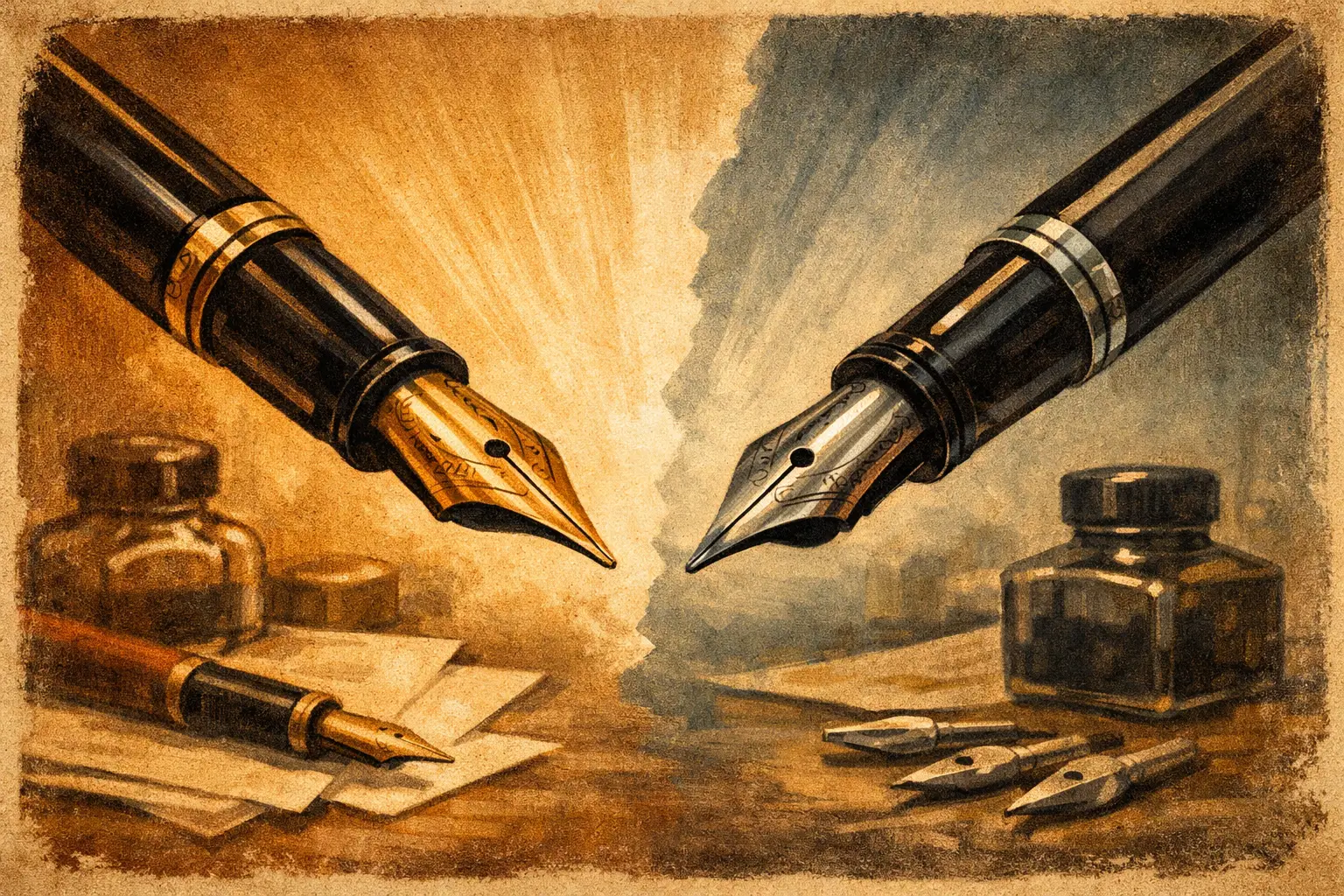
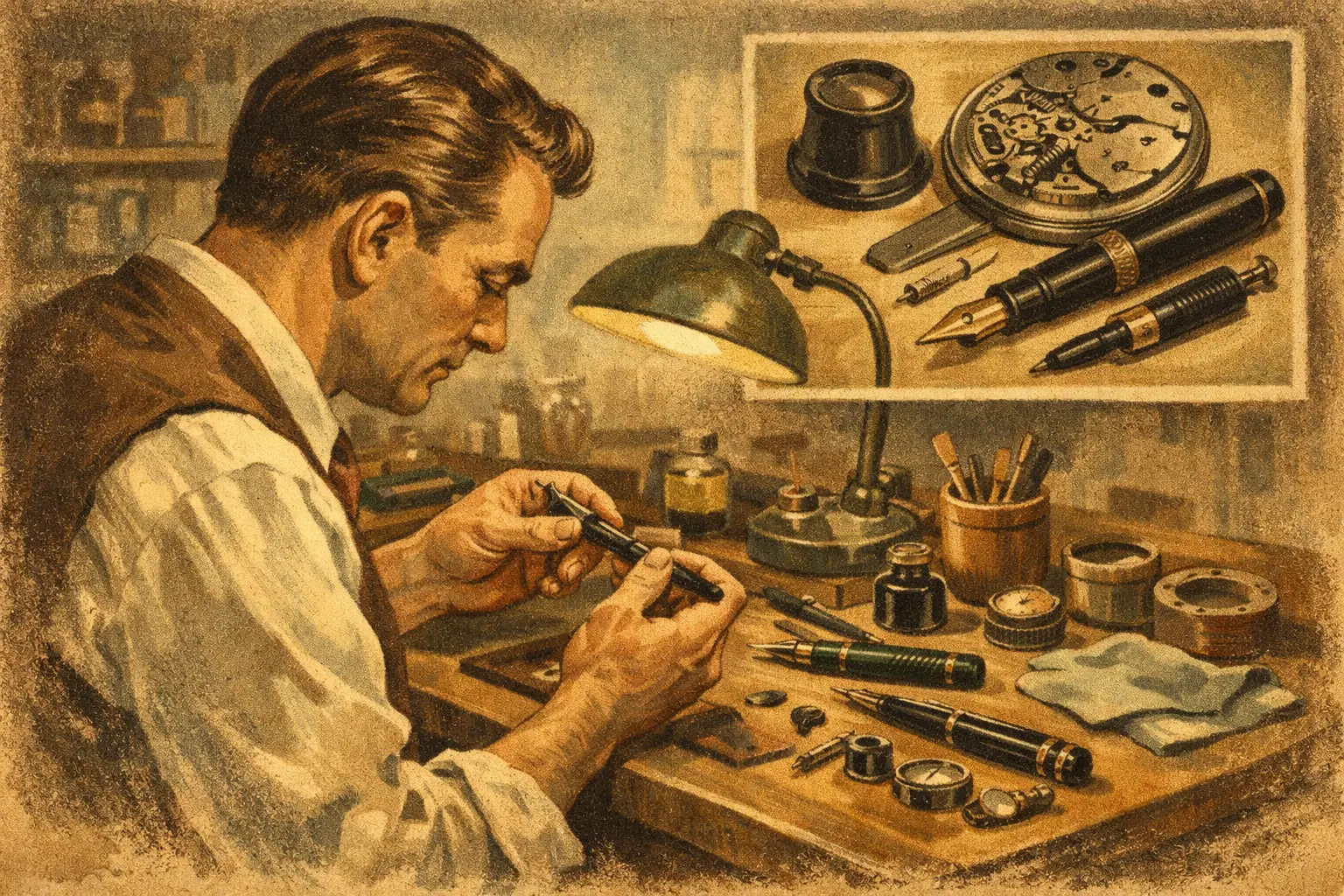
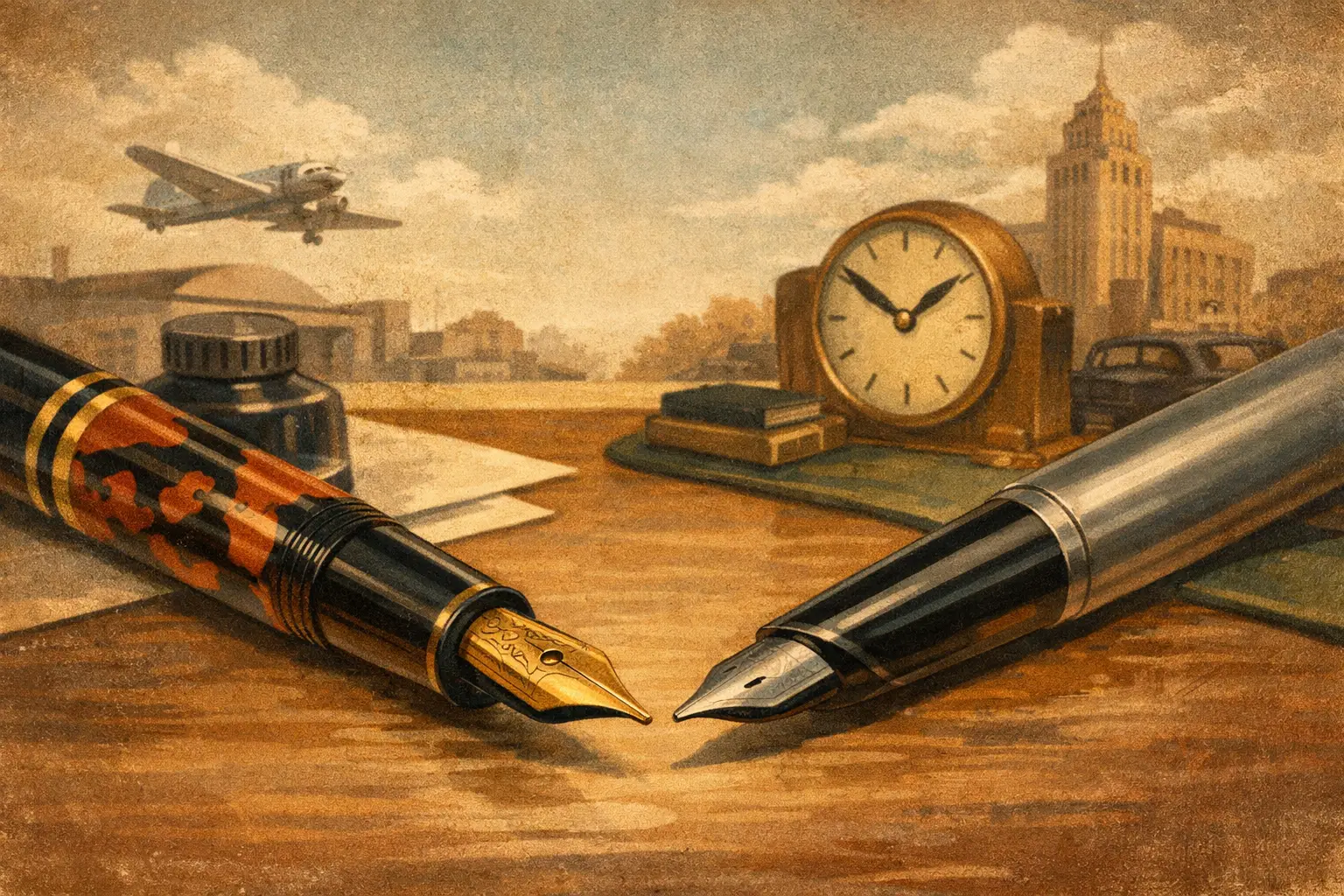
Gold Nib Versus Steel Nib – Which Suits You?

A fountain pen nib is not simply the point that puts ink on paper. It is the working heart of the instrument, and the gold nib versus steel nib question is really a question about the writing feel you want, the pen you are considering, and the condition in which it has survived. A well-restored vintage pen with either material can be a superb daily writer. Equally, an expensive gold nib in poor condition will not reward its owner.

For collectors, the appeal also reaches beyond performance. Nib material can reveal a great deal about a pen’s original market position, its maker’s design choices and the era in which it was made. Understanding the difference helps when selecting a practical writer, assessing a potential restoration, or choosing a gift with genuine heritage.

Gold nib versus steel nib: the real difference

Gold is naturally resistant to corrosion, which made it particularly desirable in the early fountain pen era. Traditional gold nibs are usually marked 14ct, 18ct or occasionally another gold content. The gold itself is alloyed with other metals to give it the strength required for writing, then tipped with a very hard wear-resistant material.

Steel nibs are commonly stainless steel, though vintage examples may be made from plated steel or more basic alloys. A quality steel nib is durable, capable of excellent ink flow and often pleasantly firm. It should not be dismissed as an inferior substitute simply because it is not gold.

The material affects the potential character of a nib, but it does not decide everything. Shape, thickness, temper, tipping, feed design and decades of use can matter more than the metal alone. Two 14ct gold nibs from different makers may feel completely different, while a carefully made steel nib can outperform a neglected gold one.

Writing feel: softness is not the same as flex

The most common assumption is that gold nibs are soft and steel nibs are hard. There is some truth in this, but it is an oversimplification that can lead to disappointing purchases.

Gold can be made into a nib with a more yielding feel because of the metal’s properties. Many vintage gold nibs offer a gentle, cushioned response that makes ordinary handwriting feel more expressive. This does not mean they are flexible nibs. A soft nib may give slightly under normal pressure, whereas a true flex nib opens its tines significantly to create noticeable line variation.

Flex depends on the nib’s geometry and temper: long tines, narrow shoulders, cut-outs and careful shaping all play a part. Some vintage Waterman and Conway Stewart gold nibs are celebrated for their responsive writing qualities, but there are also firm gold nibs designed for everyday business writing. Parker’s later gold nibs, for example, are often controlled and firm rather than dramatically flexible.

Steel generally has a firmer, more immediate feel. For many writers, this is a virtue. A firm nib provides consistency for note-taking, signatures and quick writing, and it is often more forgiving for someone still learning to use a fountain pen with a light touch. Certain vintage steel nibs, particularly from respected European makers, can be smooth, characterful and surprisingly springy.

A buyer seeking calligraphic line variation should look for a nib described specifically as flexible or semi-flex, not merely gold. A buyer who wants a dependable everyday pen may be better served by a smooth medium steel nib than by a soft gold nib that requires a gentler hand.

Gold, steel and vintage durability

Gold’s corrosion resistance is especially valuable in a vintage instrument. Old inks could be harsh, and pens were sometimes left inked for years. A gold nib often emerges from decades of storage in remarkably sound condition, even when the pen around it needs significant work.

However, gold is not invulnerable. It can be bent, creased, cracked at the breather hole or worn through misuse. Its softness means that a previous owner may have forced the tines apart or attempted an unsuitable repair. Gold nib restoration requires a practised hand because small adjustments can transform the writing quality or cause permanent damage.

Steel is more prone to corrosion where plating has failed or where old ink and moisture have been left unattended. Yet stainless steel nibs are highly practical and can remain in excellent condition for many decades. Their relative stiffness also makes them resistant to the accidental over-flexing that damages many fine gold nibs.

Condition is therefore more useful than material as a first measure of durability. Examine whether the tines are aligned, whether the tipping is present and even, and whether the nib writes smoothly with reliable flow. On a vintage pen, the feed, filling system and cap seal deserve just as much attention. A nib cannot perform properly if the pen cannot supply ink consistently.

Value is more than the price of the metal

A gold nib usually adds value, particularly when it is original to a desirable model and remains in fine condition. Collectors may seek the correct nib imprint, gold content and period styling as carefully as they seek the right cap band or clip. On certain Waterman, Sheaffer, Pelikan and Montblanc models, the nib is central to both identity and value.

That said, a gold nib does not automatically make a pen a better purchase. The premium can reflect gold content, prestige and collector demand, rather than a meaningful advantage for the individual writer. A restored steel-nibbed Parker 51, for instance, can offer one of the most comfortable and dependable writing experiences available, often at a more approachable price than a comparable gold-nibbed pen.

Steel nibs also make sense for pens intended for regular carrying, work or travel. If the pen is likely to be used heavily rather than kept as a display piece, a well-restored steel nib can offer reassurance without sacrificing enjoyment. The best choice is the one that encourages you to write.

How restoration changes the decision

With vintage fountain pens, restoration quality can matter more than the gold-versus-steel distinction. A proper restoration addresses the filling mechanism, seals, sac or diaphragm where appropriate, feed cleanliness and nib alignment. It should preserve original parts wherever possible rather than disguise faults with cosmetic shortcuts.

Nib work is particularly significant. A skilled restorer can correct slight tine misalignment, remove old ink residue, improve flow and assess whether a nib is suitable for normal use. This is not the same as grinding away character or turning every nib into a generic smooth medium. A fine original nib, a broad italic or a softly responsive semi-flex nib should retain the qualities that make it worth owning.

When buying online, clear descriptions are useful, but so are sensible questions. Ask about nib grade, writing condition, any known repairs and whether the pen has been tested after restoration. If you have a preference for a wet writer, a fine line, a left-handed writing angle or a little softness, say so. A specialist can often steer you towards the right instrument more accurately than a material label can.

Choosing the nib for the way you write

A gold nib may suit you if you enjoy a more tactile, yielding response, appreciate traditional craftsmanship, or are drawn to a particular higher-grade vintage model. It is also the natural choice where the pen’s historical specification matters to your collection.

A steel nib may suit you if you prefer a firmer line, want a dependable regular-use pen, or would rather put more of your budget into condition and restoration than precious metal. It can also be the wiser choice for a first vintage fountain pen, where comfort and reliability should take priority over assumptions about status.

There is no need to regard steel as a compromise or gold as a guarantee. Both have earned their place in fountain pen history, from modest school pens to handsome mid-century classics. At Heritage Collectables, the most satisfying restored pens are not defined by a single hallmark: they are the ones whose nib, feed and filling system work together as their maker intended.

If possible, choose with your hand rather than your expectations. A nib that feels natural after a page of writing will remain a pleasure long after the attraction of its material has become familiar.

Conway Stewart Repair: What a Proper Service Involves

A Conway Stewart repair is rarely just a matter of fitting a new sac and sending the pen back into service. These are characterful British writing instruments, made in a wide range of plastics, patterns and filling systems across several decades. A proper repair respects the particular model in hand, restores dependable writing performance and avoids removing the small signs of age that give a vintage Conway Stewart its appeal.

For the collector, this balance matters. A pen can be beautifully polished yet wrong in its details, or mechanically sound while retaining damage that will worsen with use. The right approach depends on the pen’s age, material, condition and intended future: everyday writing, a carefully chosen gift, or a place in a specialist collection.

Why Conway Stewart Pens Need Specialist Attention

Conway Stewart produced pens in many forms, from modest everyday button-fillers to highly sought-after lever-fillers, patterned celluloid models and later cartridge or converter pens. Their materials are part of their charm, but they also create repair considerations that are not always apparent at first glance.

Early plastics can discolour, shrink or become brittle. Celluloid barrels and caps may show distortion, crazing or a distinctive camphor-like smell as the material ages. Casein pens need especially cautious handling, as water, heat and unsuitable polishing compounds can cause permanent damage. Even the familiar marbled and cracked-ice finishes deserve restraint: an over-restored surface can lose the crisp colour contrast and period character collectors value.

Mechanisms also vary. A worn pressure bar, perished ink sac or corroded lever is common in a lever-filling pen, but a repairer must first establish whether the lever box and barrel threads are sound enough for the work. On button-fillers, the button, retaining components and pressure bar need to be assessed together. For cartridge pens, the issue may lie with the converter, section seal or a nib that has been forced out of alignment.

A specialist will not assume that one remedy suits every Conway Stewart. That is particularly important where an apparently simple filling fault conceals a cracked section, a distorted barrel mouth or old adhesive from an earlier repair.

What a Conway Stewart Repair Should Include

The first stage is inspection. The cap, barrel, section, clip, trim, threads and filling system should be examined under magnification where needed. This identifies cracks, missing parts, corrosion, wear to the cap lip and signs that the pen has previously been opened or altered. It also allows the restorer to distinguish surface marks from deeper material deterioration.

The pen is then dismantled only as far as its condition permits. Vintage pens do not respond well to force. Heat, controlled humidity and patient technique may be needed to separate a section from a barrel safely. Some pens, especially those with compromised celluloid or casein, carry a real risk in dismantling. In such cases, preserving the pen may be wiser than pursuing a cosmetic or mechanical improvement that cannot be achieved safely.

For a conventional lever-filler, the repair commonly involves removing the old sac, cleaning out residue, inspecting the pressure bar and lever assembly, then fitting a correctly sized replacement sac. Size matters. A sac that is too large can strain the barrel; one that is too small may reduce ink capacity or fold awkwardly. The section must be sealed appropriately, without excess adhesive that could make later servicing difficult.

The nib deserves equal attention. Conway Stewart used a variety of nibs, including flexible and semi-flexible examples as well as firm everyday writers. A nib should be cleaned, checked for cracks and examined for tine alignment, tipping wear and correct seating in the section. Gentle adjustment can transform a scratchy or dry pen, but aggressive grinding or polishing can remove original tipping and permanently change its writing character.

A proper service ends with testing. The pen should fill, hold ink, write consistently and empty without trouble. It should also be checked for leaks around the section and filling mechanism. A vintage fountain pen is not a museum object that merely looks complete: it should be able to perform the task it was made for.

Cosmetic work: preservation before perfection

Cosmetic restoration calls for judgement. Light cleaning and careful polishing can revive a dull finish, improve clarity in translucent material and remove the residue of decades of handling. Yet polishing is not automatically beneficial. Deep scratches, tooth marks, brassing and uneven colour may be part of a pen’s history, and removing them can mean removing material.

Collector-grade work aims for sympathetic improvement rather than a falsely new appearance. Original engraving should remain sharp. Imprints should not be polished away. Gold-filled trim should not be treated as though it were solid gold, and plated components require particular care where wear has already exposed the base metal.

Replacement parts can be sensible when a pen cannot otherwise be used, but they should be represented honestly. An original clip, cap band or nib is generally more desirable than a modern substitute, even if the original shows age. If a part is scarce, it may be better to wait for the correct component than to fit something merely similar.

When Is Repair Worthwhile?

Many Conway Stewart pens are well worth restoring because their designs, materials and nibs offer a writing experience that modern pens often do not replicate. A soundly restored lever-filler can become a rewarding daily writer, while a patterned model in good original condition can retain strong collector interest.

However, value is not the only measure. A family pen may deserve careful repair regardless of market price. Conversely, an uncommon model with serious celluloid deterioration may be unsuitable for regular use even if it is valuable. Repair cannot halt every form of material ageing, and no responsible specialist should promise that it can.

The most favourable candidates usually have an intact barrel and section, usable threads, a complete filling mechanism and a nib with no major fracture. Perished sacs, dirty feeds, oxidised pressure bars and misaligned tines are generally repairable faults. More difficult cases include severe barrel shrinkage, unstable celluloid, crumbling casein, extensive cracks and heavily corroded trim that cannot be removed without causing further loss.

Before authorising work, consider how you intend to use the pen. A pen for occasional correspondence may need only a sound filling system and a pleasant, reliable nib. A pen intended as a collector’s piece may call for minimum intervention. If it is being bought as a gift, dependable filling and writing usually matter more than making every tiny sign of age disappear.

Caring for a Restored Conway Stewart

Once repaired, a Conway Stewart benefits from sensible use rather than elaborate ritual. Use a fountain-pen-friendly ink that is easy to clean, and avoid permanent, heavily saturated or shimmer inks in older filling systems. Flush the pen with cool water when changing ink colours and do not leave ink sitting in it for months.

Keep the pen away from direct sunlight, radiators and damp conditions. Do not soak a vintage pen, particularly if it has casein components or uncertain material stability. When filling a lever pen, use only gentle pressure. If the lever resists, stop rather than forcing it: a little investigation is far cheaper than a broken lever box or cracked barrel.

For valuable examples, store the pen in a stable environment and avoid tight clips or elastic loops that place pressure on the cap. A soft pen sleeve or suitable case provides better protection during travel. It is also worth retaining any notes about repairs, replacement parts and nib work. Good provenance is useful to future collectors and gives you a clearer record of the pen’s care.

Choosing a Repairer You Can Trust

A trustworthy repairer should be willing to explain what the pen needs, what it does not need, and where uncertainty remains. Ask whether original components can be retained, whether replacement parts will be disclosed, and whether the pen will be tested with ink after work is complete. Clear communication is especially valuable for rare Conway Stewart models, where an irreversible decision can affect both usability and collector interest.

At Heritage Collectables, restored vintage writing instruments are valued as working objects with history, not as ornaments to be made artificially pristine. Whether you are considering a well-loved family pen or looking for a fully restored Conway Stewart ready to write, the best result is one that honours the pen’s original craftsmanship and gives it a confident next chapter on paper.

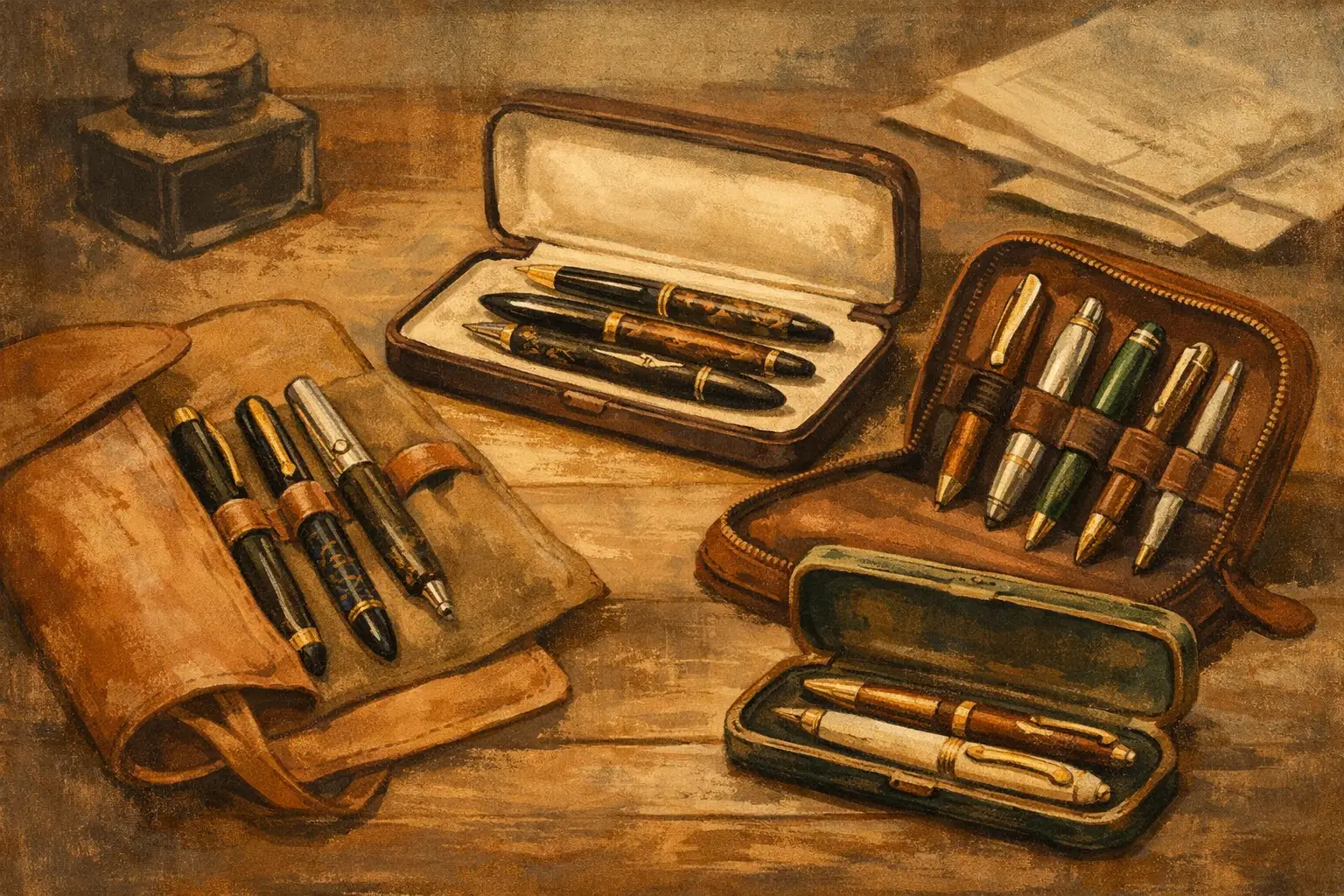
Best Pen Cases for Vintage Pens and Pencils

A fine vintage fountain pen should not spend its life loose in a desk drawer beside paper clips, coins and a forgotten key. The best pen cases do more than make a collection look orderly: they prevent scratches, protect delicate clips and levers, and make it far easier to choose the right instrument for the day.

For a collector, the right case also has a quieter role. It keeps restored pens stable between uses, separates materials that could mark one another, and offers a sensible way to transport a prized Parker Duofold, Waterman, Conway Stewart or Pelikan without treating it like an ordinary biro. The ideal choice depends on whether you need storage at home, protection in a briefcase, or a presentation-worthy case for a special acquisition.

What makes a pen case genuinely protective?

The first question is not how many pens a case holds. It is whether each instrument is held securely without being compressed. Vintage pens vary considerably in length and girth. A slim 1930s Waterman may sit comfortably in a narrow elastic loop, while an oversized modern fountain pen or a large vintage lever filler can be pinched, marked or difficult to remove from the same arrangement.

Look for individual slots, loops or padded channels that stop pens touching. A case with a soft internal lining, such as suede, velvet or a smooth synthetic fabric, is usually preferable to bare wood, hard plastic or coarse felt. The lining should be clean and colourfast. A vivid dyed material may look attractive, but it is not worth risking colour transfer onto a pale celluloid barrel or a chased hard-rubber pen.

Protection also means avoiding unnecessary movement. A pen that slides around inside a loose pouch can suffer more harm than one carried carefully in a well-fitted single-pen sleeve. For travel, a firm outer shell and a secure closure matter more than a large capacity.

Avoid pressure on clips and fragile finishes

Clips are among the most vulnerable features on vintage writing instruments. They can catch on elastic, bend against a hard lid, or rub against another pen during transport. Choose loops that accommodate the barrel rather than forcing the clip into a tight gap. If a case closes with a rigid top, check that there is sufficient depth above the pen cap.

This is especially relevant for pens with raised decorative bands, chased patterns, lacquered surfaces or delicate overlays. A case should support the instrument, not press its details flat against the lining.

The best pen cases for different purposes

There is no single best option for every collection. A collector with twenty restored pens ready for regular rotation needs something different from a gift buyer selecting a handsome case for one treasured fountain pen.

Single-pen sleeves for everyday carrying

A single-pen sleeve is often the most sensible choice for daily use. It takes up little room in a jacket pocket, bag or pen tray, and it ensures that a fountain pen does not share space with keys or other hard objects. Leather sleeves are popular for their durability and traditional appearance, while fabric sleeves can provide a lighter, softer alternative.

The trade-off is access. A snug sleeve is excellent for protection but may be less convenient when you want to remove and replace the pen repeatedly during the day. Make sure the sleeve is long enough for the pen when capped and does not catch on the cap lip or clip.

Two- and three-pen cases for a working set

For many enthusiasts, a compact case for two or three pens is the sweet spot. It allows a practical selection: perhaps a fine nib for notes, a broader nib for correspondence, and a pencil or ballpoint for forms and annotations. It is also ideal for travelling with a small, dependable rotation rather than taking a whole collection.

A zip case offers good all-round containment, but inspect its construction carefully. The zip should sit away from the pens and be protected by a fabric guard. A press-stud or flap closure can be gentler and more elegant, although it may offer less protection if the case is dropped or packed tightly.

Larger rolls and zip cases for regular collectors

Pen rolls and multi-pen zip cases suit collectors who like to keep a sizeable group visible and ready to use. A roll is particularly useful when space is limited. It can be laid flat to display the contents, then rolled up for storage, often holding ten or more pens without requiring a large cabinet.

That convenience comes with a caution. If the roll is overfilled or wound too tightly, pens may press against one another. This is not the best choice for exceptionally fragile instruments, oversized pens or valuable examples with sensitive finishes. A structured multi-pen case, with separated padded compartments, provides greater protection for transport and for more substantial pens.

Display cases for a collection at home

A display case makes sense when the pleasure of ownership includes seeing the collection. Glass-topped boxes, wooden cases and drawer organisers can turn a group of pens into an attractive focal point, especially when arranged by maker, period, colour or filling system.

For long-term home storage, however, appearance should not override condition. Keep display cases away from direct sunlight, radiators and damp rooms. Sunlight can fade materials and discolour some plastics, while excessive heat may affect sacs, seals and older adhesives. A cabinet in a stable, dry room is generally far kinder than a sunny windowsill or an attic with fluctuating temperatures.

Choosing materials: leather, fabric, wood or hard shell

Leather cases have lasting appeal for collectors. A well-made leather exterior develops character and gives a vintage pen an appropriately traditional setting. It is best paired with a soft lining and careful stitching, with no exposed rough edges near the pens. Leather can be excellent for carrying cases, but it should be kept dry and allowed to air occasionally.

Fabric cases are lighter and often offer generous padding. They are practical for travel and can be a good value choice for a working collection. Their weakness is that they offer less crush resistance, particularly in a packed bag. A fabric roll is best carried in a protected compartment rather than loose beside chargers and notebooks.

Wooden cases are most at home on a desk or in a cabinet. They offer attractive display and a sense of permanence, but they are not automatically safer than a soft case. Bare timber, ill-fitting trays and hard dividers can mark pens. Choose a properly lined interior with compartments that fit the instruments you actually own.

Hard-shell cases provide the strongest defence against knocks. They are sensible for air travel, events, pen club meetings or transporting pens for appraisal or repair. The drawback is bulk, and a rigid case that is poorly fitted can still permit movement. Internal padding and individual retention are more important than the shell alone.

Fit matters more than stated capacity

Case descriptions often state a number of pens, but capacity figures can be misleading. Ten slim vintage pencils will occupy a very different amount of room from ten broad fountain pens. Before buying, measure the longest and widest pen you intend to store, including its clip. Then compare those dimensions with the individual slot size, not just the case’s exterior measurements.

A little room around the barrel is desirable. Enough room for the pen to shift and collide with its neighbour is not. If you own a mixture of slender and oversized instruments, consider separate cases rather than trying to make one layout work for everything. It may feel less efficient, but it is safer and makes the collection easier to manage.

Storage habits that protect restored pens

Even the finest case cannot compensate for poor storage habits. Fountain pens should normally be emptied and cleaned before prolonged storage, particularly if they contain traditional dye-based ink that may dry in the feed. Keep them capped, store them away from extremes of temperature, and inspect them occasionally rather than leaving them untouched for years.

For pens filled for regular use, a case is still valuable, but consider the orientation during travel. A fountain pen carried nib-up is less likely to deposit ink into its cap; a pen that is freshly filled or known to run wet deserves particular care. Do not rely on any pen case to prevent leaks caused by changes in air pressure or a faulty seal.

If a treasured pen is going into storage after restoration, it is worth giving it its own clean, padded space. Heritage Collectables sees many fine instruments whose condition has been preserved not by elaborate display, but by owners who understood that careful storage is part of good stewardship.

A pen case is a modest purchase beside a collectible fountain pen, yet it can protect years of careful collecting and skilled restoration. Choose the format that matches how you write, carry and display your instruments, then give each pen enough room to remain exactly as it should be: ready for the next page.

How to Fill Eyedropper Pens Without a Mess

A true eyedropper fountain pen offers one of the most direct connections between writer, ink and paper. There is no cartridge, converter or filling lever between them – simply a barrel filled with ink and a carefully fitted section. Learning how to fill eyedropper pens properly is straightforward, but it deserves a little patience, particularly when the pen is vintage, made from hard rubber or fitted with a precious original nib.

The reward is considerable: generous ink capacity, an uncluttered mechanism and the pleasure of using a filling system from the earliest years of fountain pen history. The risks are equally clear. Ink in the wrong place can stain a cap, find a hairline crack or seep through an imperfect section joint. A clean filling routine is the difference between a satisfying writing instrument and an avoidable restoration problem.

First, establish whether the pen is an eyedropper

Not every fountain pen with an empty barrel should be filled directly with a pipette. Many vintage models were designed for a rubber sac, a button filler, a lever filler, a vacuum mechanism or a captive converter. Filling one of these directly can flood the barrel, damage the internal filling system or leave ink where it cannot be properly cleaned.

An original eyedropper usually has a hollow barrel with no internal mechanism and a section that unscrews from the barrel. Early Waterman safety pens, some Mabie Todd models and a range of early Continental instruments may use variations on this principle, but construction varies considerably by maker and era. A modern pen converted to eyedropper use is a separate matter. Such conversions are only suitable when the manufacturer has specifically designed the barrel, section threads and materials for direct filling.

With a vintage pen, do not rely on appearance alone. Check for a sac nipple inside the section, a pressure bar in the barrel, traces of an old sac, a threaded blind cap or a mechanism at the rear. Any of these is a sign to pause. A properly restored lever or button filler should be filled through its intended system, not treated as an eyedropper.

What you need before filling

Prepare a protected work surface before opening the pen. Fountain pen ink is wonderfully persistent on fingertips, cotton shirts and unfinished wood. A folded paper towel or absorbent cloth, a clean eyedropper or blunt syringe, a bottle of suitable fountain pen ink and a small container of water are normally enough.

Choose conventional fountain pen ink from a reputable maker. Highly saturated permanent inks, heavily pigmented inks, iron gall formulations and shimmer inks can be excellent in the right pen, but they demand more from the writer and the pen. For a vintage eyedropper, a well-behaved, washable ink is usually the sensible starting point. It is easier to flush, less likely to leave stubborn staining and kinder to older feeds and seals.

Inspect the section threads and barrel lip under good light. They should be clean, dry and free from obvious cracks. If the pen has hard rubber or ebonite components, remember that age, heat and previous use may have changed the material. Never force a resistant section. A pen that needs attention should be examined before it is put into service.

How to fill eyedropper pens step by step

The central rule is simple: keep ink below the threads, and keep the threads clean.

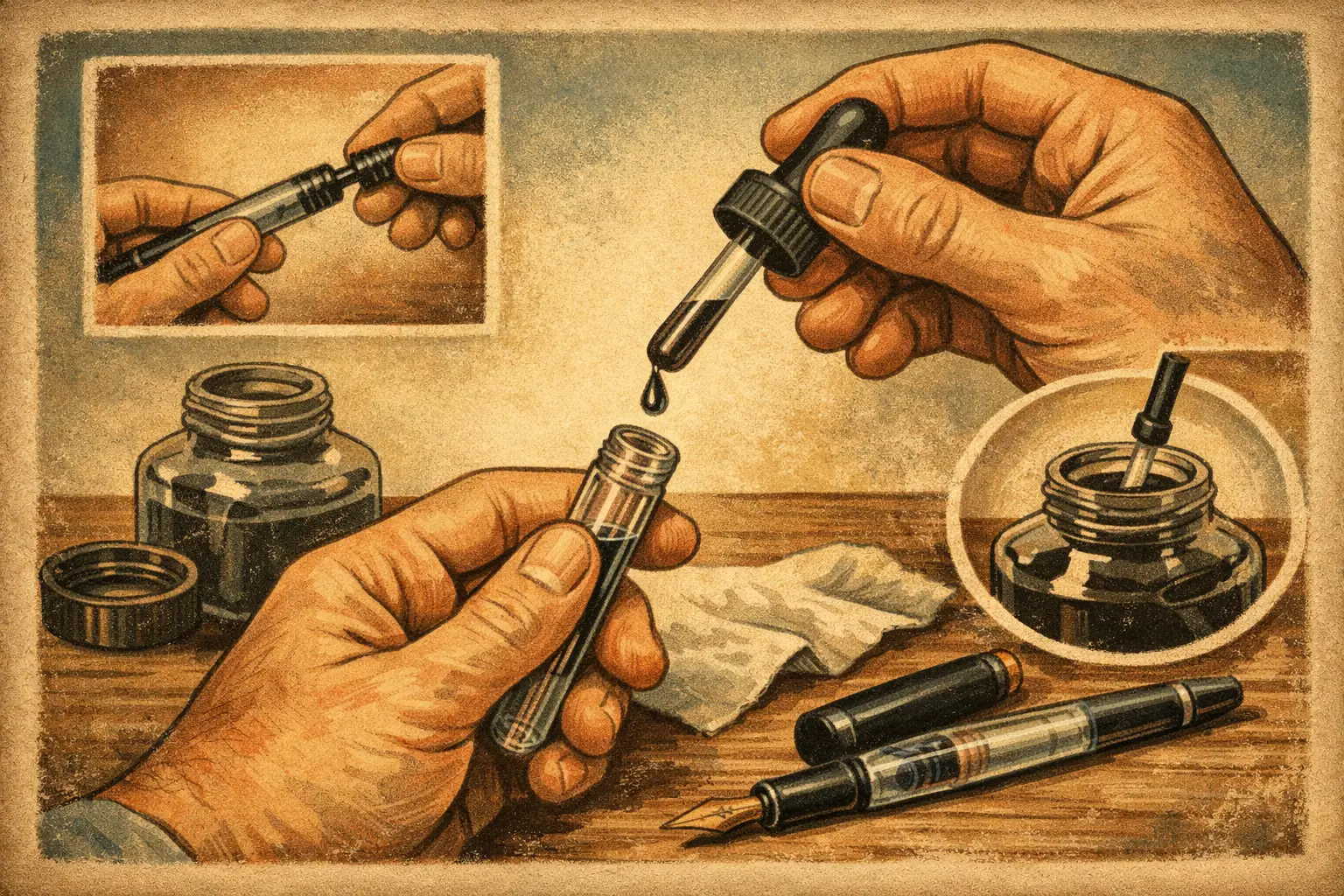
  1. Unscrew the section carefully. Hold the barrel in one hand and the section in the other, turning only as much as required. Avoid gripping a delicate nib or twisting a section that feels seized. Set the cap aside well away from the ink bottle.
  1. Draw ink into the eyedropper or syringe. A blunt syringe gives the best control, especially with a narrow barrel opening. Draw a little less than the barrel appears to hold. Overfilling leaves no room for thermal expansion and makes it much easier to contaminate the threads.
  1. Fill the barrel slowly. Keep the barrel upright and introduce the ink in a steady stream. Stop at roughly 80 to 90 per cent full, leaving a visible air space at the top. This space is not wasted capacity. It helps manage pressure changes and reduces the chance of ink being pushed into the cap when the pen warms in a pocket or hand.
  1. Clean the threads before reassembly. Wipe the barrel threads, the section threads and the edge of the opening with a clean paper towel. This small step prevents ink from being carried into the joint, where it can cause staining and make a leak look worse than it is.
  1. Reassemble without overtightening. Screw the section back into place until it is snug. Do not tighten it as though sealing a jar. Older plastics and hard rubber can crack under unnecessary pressure, while a well-made joint should not need brute force to remain secure.
  1. Wipe, test and let the feed settle. Clean the exterior, hold the pen nib-down over a towel for a moment and then write a few lines. The feed may need a little time to become fully saturated. If ink appears around the section joint, stop using the pen and investigate before placing the cap on.

Do you need silicone grease or sealant?

This depends entirely on the pen. Some modern pens intended for eyedropper conversion benefit from a tiny amount of pure silicone grease on their section threads. It improves the seal without permanently altering the pen. A very small amount is sufficient – excess grease can migrate into the ink and make cleaning more difficult.

For a historic instrument, caution is the better course. Never apply grease, shellac, thread tape, glue or sealant simply because an online filling guide recommends it. A leak in a vintage eyedropper may indicate damaged threads, distortion, a missing sealing surface or an earlier repair that needs specialist correction. Masking the symptom can complicate a proper restoration later.

Silicone grease should also be kept away from the feed, nib and ink channels. Its role, where appropriate, is confined to the threads. If you are uncertain whether a particular pen was designed for direct filling, it is safer not to experiment with a valuable barrel.

Managing leaks, burps and changing temperature

An eyedropper pen has a large reservoir of ink and air. As the pen warms in the hand, the air expands. As the ink level falls, there is more air inside the barrel and a greater chance of a sudden heavy flow, often called burping. This is not always a fault. It is a characteristic of the filling system that can be managed with sensible use.

Keep the pen nib-up when carrying it, especially during warm weather or air travel. Avoid leaving it in a hot car, near a radiator or in direct sunlight. Before writing with a partly empty pen, allow it to rest nib-up for a moment, then make a few gentle strokes on scrap paper. If the pen tends to run very wet when the barrel is low, refill it rather than trying to use the final few drops.

A leaking joint, however, is different from normal burping. Ink emerging consistently from the section threads, barrel end or a crack in the barrel calls for immediate cleaning and assessment. Empty the pen, rinse it with cool water and do not leave ink sitting in a compromised instrument. Vintage hard rubber and early celluloid deserve particular care, as staining and structural damage can be difficult to reverse.

Cleaning an eyedropper between fills

One advantage of the system is that cleaning is uncomplicated. Empty the remaining ink into an appropriate container, then flush the barrel and section with cool water until it runs clear. Do not soak hard rubber, casein or unknown vintage materials for long periods, and do not use hot water. It can distort components, damage old adhesives and affect fragile finishes.

Drying matters as much as flushing. Leave the section and barrel apart on an absorbent cloth, with airflow around both pieces. A little residual water will only dilute the next fill, but trapped moisture over a prolonged period is never ideal for an older pen. If you are changing from a dark or strongly coloured ink, take extra time to clean the feed thoroughly.

Treat the barrel as part of the pen’s history

A large ink reservoir is appealing, but it should not tempt you to leave a pen filled for months. Regular use is ideal. If the pen is going back into a display case, drawer or collection cabinet, empty and clean it first. This is especially worthwhile with collectible instruments, where original material, clarity of imprint and condition of finish remain part of their value.

The best routine is calm rather than clever: use a suitable ink, leave air space in the barrel, clean the threads and respond quickly to any sign of a leak. Filled with care, an eyedropper pen is not merely an early filling system. It is a remarkably immediate way to enjoy a restored writing instrument exactly as it was meant to be used.

How to Test a Pen Sac Before You Fill It

A newly acquired vintage fountain pen can look immaculate and still conceal a failed rubber sac. The section may shine, the nib may be original, and the lever may move freely, yet a hardened or perforated sac can release ink into the barrel at the first fill. Knowing how to test a pen sac before introducing ink is one of the simplest ways to protect both the pen and your hands.

A sac is the flexible rubber reservoir used in many lever-fillers, button-fillers and some other vintage fountain pens. Its job is uncomplicated: it compresses when the filling mechanism is operated, then expands to draw ink through the feed. After decades of use, storage and changing temperatures, however, rubber eventually loses its elasticity. Testing should be calm and methodical. A little pressure is useful; force is not.

What a pen sac test can tell you

A sound sac should be soft, flexible and capable of holding liquid without weeping. A failed one may be brittle, sticky, shrunken, split, or reduced to flakes inside the barrel. Occasionally, a sac appears acceptable until it is compressed, which is why a visual inspection alone cannot provide complete reassurance.

Testing also reveals problems beyond the sac. If the lever feels unusually stiff, the pressure bar may be corroded or displaced. If water emerges around the section rather than the nib, the section seal may need attention. These are different faults, but discovering them before using ink makes cleaning and repair far more straightforward.

How to test a pen sac safely

Before starting, use clean, cool water, a soft cloth and a small glass. Avoid hot water, detergents and household cleaning fluids. They can damage delicate materials, dull finishes or create problems that have nothing to do with the sac itself. Do not test an unknown vintage pen with ink first – old ink residue can hide a leak, and fresh ink makes the evidence much harder to clean away.

First, establish the filling system

This method applies to pens that genuinely use a rubber sac. A lever-filling Waterman, Conway Stewart or Parker Duofold is a likely candidate. A button-filler may also have a sac, although its mechanism is operated from the end of the barrel rather than by a side lever.

It does not apply in the same way to a cartridge/converter pen, a piston-filler, a vacuum-filler or an eyedropper. Those pens have different reservoirs and different testing points. Never operate a lever simply because a pen looks old: some levers are decorative features, and a misplaced attempt can damage a rare component.

Inspect the pen before operating it

With the cap removed, examine the nib, feed, section and barrel under good light. Look closely at the joint where the section meets the barrel. Dried ink around this area can indicate an old leak, though it may also be residue from a previous filling. Check that the barrel has no obvious cracks, particularly near the lever box, threads and cap lip.

Operate the lever or button only very gently at first. A healthy mechanism should offer controlled resistance. Stop immediately if it feels seized, gritty or requires significant force. A rigid sac can prevent the pressure bar from moving properly, and forcing the mechanism may bend the pressure bar or split an already fragile barrel.

If the pen has a translucent ink-view window, inspect it for crumbling rubber or dark staining. With opaque barrels, you may hear a faint rattle from loose sac fragments. That is usually a clear sign that the sac has reached the end of its service life and should be replaced before any wet test is attempted.

Check for flexibility without dismantling

A sac should not normally be removed merely to test it. On many vintage pens, the section is friction-fit and may be firmly seated after years in place. Pulling it without the right technique risks cracking the section, distorting the feed or damaging chased hard rubber.

Instead, use the filling mechanism as your first indication. With the nib pointed upwards and away from you, lift the lever slowly or depress the button once. A supple sac often produces a soft, cushioned resistance as it compresses. A hard sac may offer little movement, an abrupt crunching sensation, or no meaningful resistance at all.

This is only an indication, not a verdict. A pressure bar can still move against a deteriorated sac, while a good sac may feel firmer in a compact pen with limited internal space. The water test provides more useful evidence.

Perform a clean-water filling test

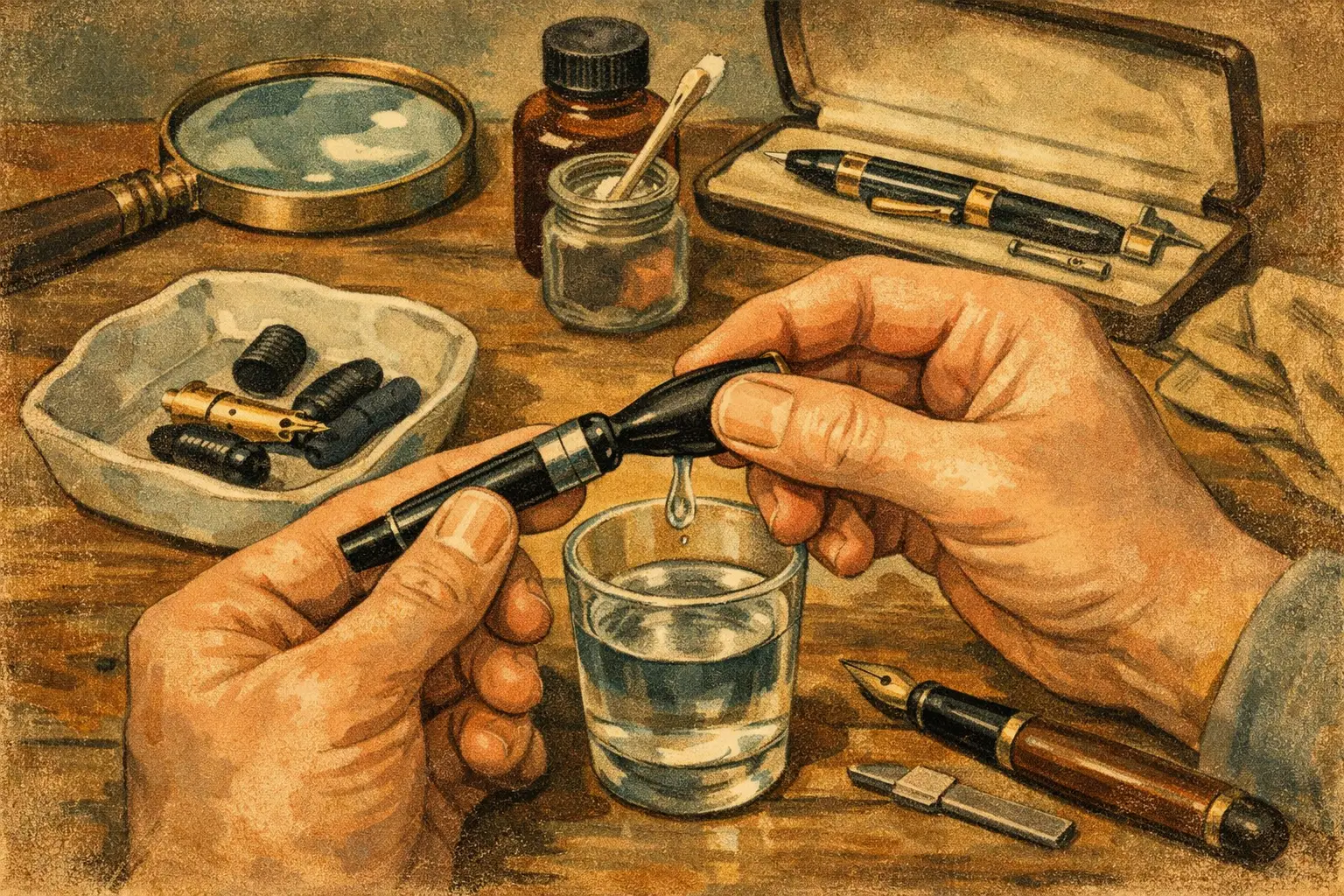
Place the nib and feed into a glass of cool, clean water. Operate the lever or button slowly, then return it to its resting position. Keep the nib submerged for several seconds while the sac expands. This gives the pen time to draw water through the feed.

Remove the pen from the glass with the nib pointing upwards and wipe the exterior carefully. Do not shake it. Watch the section-to-barrel joint, the lever box and the end of the barrel for moisture. Then hold the pen nib-down over the glass and allow a few drops of water to leave the nib. If it has drawn water and releases it normally, the sac is at least functioning at that moment.

Next, wrap the barrel lightly in a dry tissue and leave the pen nib-up for five to ten minutes. Any damp patch around the lever, barrel seam or section deserves investigation. A pinhole leak may not show instantly, especially if the sac has only been partially filled, so repeat the test once if the first result is unclear.

Do not squeeze the barrel to force a result. Most sac pens are not designed to be squeezed, and pressure can crack celluloid or compromise a loose section. Let the mechanism do the work it was designed to do.

Give a doubtful pen time

Some sacs fail only after they have been wetted and allowed to expand. If the pen appears sound after the first water fill, dry its exterior and rest it upright in a glass or pen stand for half an hour. Inspect it again for seepage and check whether the water level has dropped unusually quickly.

A pen that passes this short test is a better candidate for ink, but it is still sensible to use a washable fountain pen ink for the first few fills. Avoid highly saturated, permanent or shimmer inks in an unfamiliar vintage sac pen. They complicate cleaning and can stain a barrel if a fault reveals itself later.

Reading the results of your test

A clean draw of water, normal release through the nib and a completely dry barrel are encouraging signs. If the pen holds water for a short period without leakage, the sac is probably serviceable. Nevertheless, rubber sacs are consumable parts. A pen that works today may still need replacement soon if the sac is old and its history is unknown.

Water emerging from the lever slot commonly points to a split sac or a leak near the pressure bar. Moisture at the section joint can mean that the sac has detached from its nipple, although a loose section is also possible. If the pen does not draw water at all, the sac may be hardened, the pressure bar may not be reaching it, or dried ink may be obstructing the feed.

A strong rubber smell, tacky residue or black fragments inside the barrel are all reasons to stop testing. They indicate deterioration rather than a condition that further filling will improve.

When a pen sac should be replaced

Replacement is the right answer when a sac leaks, has hardened, has broken into pieces, or cannot fill consistently. It is also sensible when restoring a pen with an unknown service history, particularly if it is intended for regular writing rather than display.

The correct sac size and material matter. A sac that is too large can rub against the barrel or pressure bar; one that is too small reduces the ink capacity and may not operate reliably. Certain pens also require particular materials, such as silicone or PVC sacs, rather than conventional latex. The choice depends on the model, the barrel material and the filling system.

For a common user-grade pen, an experienced enthusiast may be comfortable replacing a sac with appropriate tools and knowledge. For a valuable, rare or delicate instrument, professional restoration is usually the safer course. A proper repair should respect the original components and leave the pen ready to write, not merely ready to display. This is the standard collectors should expect from a specialist-restored vintage pen, including those prepared by Heritage Collectables.

A final check before using ink

Once a pen has passed its water test, empty it fully and flush it several times with fresh water until the water runs clear. Leave it uncapped, nib-down in a suitable holder or resting on an absorbent cloth, until it is thoroughly dry. Water left in the feed will dilute the first fill, which is harmless but can make the ink appear pale.

The reward for this small amount of care is confidence. A vintage fountain pen was made to put ink on paper, but it deserves to be filled only after its hidden working parts have earned that trust.

Parker Duofold versus 51: Which Pen Wins?

A bright red Parker Duofold on a desk attracts attention before its nib ever reaches paper. A Parker 51, by contrast, tends to earn affection after the first page: quiet, controlled and unusually capable with everyday ink. The question of Parker Duofold versus 51 is therefore not simply which model is better. It is a choice between two very different ideas of what a great fountain pen should be.

The Duofold is Parker’s great extrovert, a family of pens with a long history, broad shoulders and strong collector appeal. The 51 is the modernist workhorse, designed to make fountain-pen writing cleaner, more dependable and less intimidating. Both can be exceptional users when properly restored. Both deserve careful buying. Their appeal simply lies in different places.

Parker Duofold versus 51: the essential difference

The first complication is that a Duofold is not one pen. Parker used the name from the 1920s onwards, covering the famous hard-rubber Big Red button fillers, the streamlined Vacumatic-filling Duofolds of the 1930s, and numerous later British and American models. A comparison with the Parker 51 needs a little precision, because a 1920s Duofold Senior has a very different character from a post-war Duofold AF or NS.

Nevertheless, the broad distinction remains useful. Most vintage Duofolds offer a conventional, open nib and a more visibly traditional fountain-pen experience. Their nibs are on show; their materials and colours are often central to their attraction; and their larger models have a commanding presence in the hand.

The Parker 51, introduced in 1941, took the opposite route. Its nib is largely enclosed beneath a tapered hood, leaving only a small writing point visible. The result is a pen that looks restrained, writes with remarkable control and keeps the wet, vulnerable part of the nib protected. It was a thoroughly modern design for its period and remains one of the most practical vintage fountain pens to use regularly.

Design, presence and collecting appeal

A Duofold is generally the better choice for the buyer who wants their pen to feel unmistakably vintage. The early red hard-rubber models have an enduring authority, particularly when their chasing, imprint and colour have survived well. Later marbled celluloid and striped Duofolds bring a different sort of appeal: more streamlined than the original Big Red, but still rich in material and distinctly of their era.

Condition matters greatly. Hard rubber can oxidise and darken, discolouration can soften the vividness of early red pens, and celluloid can shrink or craze. These are not necessarily reasons to dismiss a pen, but they should be reflected in its value and described honestly. Crisp imprints, sound cap threads, original clips and good colour are all details collectors watch closely.

The Parker 51 has a more discreet elegance. Its cigar-shaped barrel, hooded nib and metal cap make it look almost contemporary, even eight decades after launch. Colours such as black, burgundy, cedar blue, cocoa and Nassau green reward closer inspection, while the range of cap styles gives collectors plenty to pursue. The early “double jewel” examples, distinctive cap finishes and matching pencils all have their following.

For a gift, the 51 is often the safer visual choice if the recipient prefers understated objects. A well-chosen Duofold is more personal and more theatrical. It announces itself, especially in red, jade or a lively marbled finish.

Size is more important than the catalogue name

Neither model should be bought by name alone. Early Duofolds range from compact Ladies and Junior versions to the substantial Senior and Maxima formats. Likewise, Parker 51s come in differing lengths and cap arrangements, with the later aerometric models often feeling particularly balanced in daily use.

If possible, compare dimensions rather than relying on photographs. A large Duofold can be superb for a writer who prefers a full barrel and a posted cap, but a smaller version may feel cramped. The 51 usually suits a wide range of hands, though some writers accustomed to oversize pens may find it modest.

Nibs and the writing experience

This is where many buyers make their decision. The exposed nib of a Duofold gives more visual drama and, depending on the specific pen, may offer a more expressive feel. Early Parker nibs can be firm yet responsive, with a touch of spring that makes ordinary handwriting look a little livelier. Broad, medium and fine examples exist, but vintage grading is never perfectly standard. A nib marked “medium” may write finer than a modern medium, particularly if it was made for the British market.

A Duofold rewards a writer who enjoys seeing the nib at work and who appreciates feedback from the paper. It can be an involving, characterful experience, especially with a well-tuned gold nib. That does not mean every Duofold is flexible or soft. Many are deliberately firm, and condition, previous use and restoration quality have far more bearing on performance than the model name alone.

The Parker 51 nib is usually smoother, more controlled and less showy. Its hood encourages a consistent writing angle and the collector nib is notably resistant to drying. This makes it particularly useful for notes, correspondence and longer sessions where one wants the pen to behave without ceremony. Fine and extra-fine 51 nibs can be excellent for small handwriting, while a good medium provides an easy, generous line without becoming untidy.

The trade-off is personality. Some writers find the 51 beautifully precise; others find its partly hidden nib slightly detached compared with an open-nib Duofold. Neither reaction is wrong. The better pen is the one that makes you want to write another page.

Filling systems and practical ownership

Early Duofolds generally use a button-filling mechanism with a rubber sac. It is simple, effective and satisfying, but the sac is a consumable part. A properly restored example should fill reliably and hold a useful amount of ink, yet it will eventually need replacement after years of use. This is normal vintage pen maintenance, not a defect.

Some later Duofolds use other systems, including the Vacumatic diaphragm mechanism. These can hold considerable ink and are fascinating pieces of engineering, but they require knowledgeable restoration. A pen that appears to fill is not automatically a pen that should be trusted with ink. The diaphragm, breather tube, seals and clarity of the barrel all deserve inspection.

Parker 51 filling systems divide broadly into Vacumatic and aerometric types. Vacumatic 51s are highly regarded, often with excellent ink capacity, but their restoration is specialised. Aerometric 51s have a metal squeeze bar beneath a pli-glass sac and are widely valued for their durability and straightforward practicality. Many have worked for decades with only sensible care, though any vintage filling system should be examined rather than assumed sound.

The later cartridge/converter Parker 51 is a different proposition and is usually less sought after by collectors than the earlier versions. It may still be a pleasant pen, but it does not offer quite the same engineering character as the Vacumatic or aerometric models.

For either pen, use a fountain-pen-friendly ink and avoid leaving it unused with ink inside for months. The Parker 51’s hood can conceal dried residue, while old sacs and diaphragms in Duofolds should not be exposed to harsh or heavily saturated inks without care. A restored pen deserves sensible habits.

Restoration is part of the comparison

A clean exterior tells only half the story. With a Duofold, the critical work may include replacing the sac or diaphragm, correcting nib alignment, checking cap threads and ensuring the lever or button mechanism operates as it should. With a Parker 51, restoration may involve cleaning the collector, setting the nib correctly beneath the hood, attending to the breather tube and making certain the filling system is sound.

The 51 can be deceptively easy to underestimate because it often looks tidy even when it needs attention. A misaligned nib, damaged hood or compromised collector can spoil the writing experience. Equally, a bright Duofold with heavy oxidation, a brittle section or a poorly fitted sac may be better regarded as a display piece than a daily writer.

This is why restored examples from a specialist are so valuable. At Heritage Collectables, the aim is not merely to present an attractive vintage pen, but to offer an instrument whose condition and practical potential have been properly considered. For a collector intending to write, that reassurance is worth more than an untested bargain.

Which should you choose?

Choose a Duofold if you are drawn to classic Parker history, visible gold nibs and materials with real visual warmth. It is the stronger choice for someone building a period-focused collection, for a writer who enjoys traditional fountain-pen character, or for a gift buyer seeking something immediately recognisable as a special vintage object.

Choose a Parker 51 if regular use is the priority. It is hard to better for controlled everyday writing, tidy ink behaviour and a design that remains practical rather than precious. An aerometric 51, properly restored with a sound hood and well-adjusted nib, is often one of the most confidence-inspiring entry points into vintage fountain pens.

There is also a sensible collector’s answer: own one of each. A Duofold offers the occasion, colour and history; a Parker 51 offers the dependable pen you reach for when there is a letter to write. Start with the one that suits your hand and your habits, then let the next pen follow the curiosity the first one creates.

Are Vintage Pens Reliable? What Matters Most

A 70-year-old fountain pen that starts first time, fills cleanly and writes a full page without complaint is not an unusual thing. Yet the question, “are vintage pens reliable”, deserves a more useful answer than a simple yes or no. A well-restored vintage pen can be an exceptionally dependable daily writer. An untouched example, however attractive in a display case, may need careful attention before it is ready to leave a mark on paper.

The difference is not merely age. It is condition, design, restoration standard and the way the pen will be used. Vintage writing instruments were built in an era when a good pen was expected to be repaired rather than discarded. That makes many of them remarkably long-lived, provided the right work has been done.

Are vintage pens reliable for everyday use?

Yes, provided they have been professionally assessed and restored where necessary. Many classic models from Parker, Waterman, Sheaffer, Conway Stewart, Pelikan and Montblanc were made with durable materials, serviceable mechanisms and nibs designed to last decades. Their continued popularity is not based on nostalgia alone. A good vintage pen offers a writing experience that remains entirely practical.

Reliability does depend on the filling system. A cartridge-converter pen is often straightforward to keep in service, while a lever filler, button filler, vacuum filler or piston mechanism brings more moving parts and seals into the picture. This does not make a traditional filling system unreliable. It means it should be correctly restored, tested and used with an understanding of its needs.

A vintage fountain pen is also different from a modern disposable object. It may reward an owner who flushes it occasionally, uses suitable ink and avoids leaving it unused with ink inside for months. For many enthusiasts, that small degree of care is part of the pleasure rather than a burden.

What professional restoration changes

The most common reason an older fountain pen fails is simple: the original rubber sac, cork seal or diaphragm has perished. Rubber hardens, cork dries out and seals lose their elasticity over time, even if a pen has spent years in a drawer. A pen can look immaculate externally while being unable to fill or retain ink.

Proper restoration addresses the parts that make the pen functional, not just its cosmetic appearance. Depending on the model, work may include fitting a new ink sac, renewing seals, servicing a piston or vacuum mechanism, cleaning the feed, setting the nib and checking for leaks. The instrument should then be filled and tested, not merely assumed to work because its mechanism moves.

This is why the source of a vintage pen matters as much as the pen itself. A low-priced example described as “working” may have received no more than a cursory dip test. A fully restored instrument has been prepared with regular writing in mind. At Heritage Collectables, restored pens are selected for both their collector appeal and their ability to be enjoyed as writing instruments, which is the distinction many first-time buyers overlook.

Restoration has sensible limits. Heavy polishing can soften crisp chasing, remove plating or erase the character that collectors value. Replacing every original part is not always desirable either. The best work preserves the pen’s identity while renewing the components that are expected to wear out.

The design of the pen matters

Some vintage pens are particularly reassuring choices for a buyer who wants dependable daily use. Parker’s aerometric fillers, for example, have a deserved reputation for durability when their pli-glass sacs remain sound. Parker 51s are admired because their hooded nibs, generous ink capacity and controlled ink flow make them practical workhorses rather than occasional curiosities.

Piston-fillers from Pelikan can be equally dependable, with a large ink supply and a mechanism that can be serviced by a capable specialist. Lever-filled Waterman and Conway Stewart pens are satisfying, simple designs, but their sacs are consumable components. A newly restored sac can give years of service, while an original one should never be trusted simply because it has survived this long.

Sheaffer’s Touchdown, Snorkel and Vac-Fill systems are ingenious and enjoyable, though more complex. They can be reliable after thorough restoration, but they are less suitable for anyone determined never to think about maintenance. Complexity is not a flaw. It is a trade-off between engineering interest, filling convenience and future servicing.

Nibs deserve equal attention. Gold nibs do not automatically write better than steel, and neither material guarantees reliability. What matters is alignment, tipping condition, feed performance and whether the nib suits the owner’s hand. A broad, flexible nib from the 1920s may be glorious on correspondence paper but less practical for quick notes on ordinary office pads. A firm medium nib from a later Parker or Sheaffer may be the better everyday companion.

Materials, wear and the risks worth checking

Celluloid, hard rubber, acrylic and metal each age differently. A reputable seller should identify significant condition issues clearly, because a vintage pen is not made more trustworthy by vague language.

Look for evidence of careful inspection in the cap, barrel, section and trim. Cracks around the lip of a cap or near a lever can worsen with use. A loose cap may cause the nib to dry out. Corrosion in metal trim, worn threads and damaged feeds can affect usability as well as appearance. With hard rubber pens, discolouration is often cosmetic, but oxidation and brittleness should be assessed honestly.

There are four practical questions worth asking before buying a vintage fountain pen:

  • Has the filling system been restored and tested with water or ink?
  • Are there any cracks, repairs or missing parts that affect use?
  • Has the nib been checked for alignment, smoothness and ink flow?
  • Which inks and filling method are appropriate for this particular model?

These questions are not fussy collector behaviour. They establish whether the pen is being offered as an untouched antique, a project for repair or a genuinely usable instrument. All three can be worthwhile purchases, but they should never be confused.

Reliability also depends on how you use it

A restored vintage pen will not benefit from being treated as indestructible. Avoid forcing a lever, over-tightening a cap or pressing hard enough to spread nib tines. Fountain pens work best with a light hand. If the pen is a lever filler or button filler, fill it as intended and do not repeatedly operate the mechanism when it is empty merely to see it move.

Ink choice has a real effect. Straightforward, fountain-pen-safe inks are generally the wisest choice for older pens. Highly saturated, shimmer or permanent inks can be enjoyable, but they demand more regular cleaning and may not suit a pen with an intricate feed or a sac-based filling system. When in doubt, choose a conventional ink and flush the pen with cool water between colours or before long storage.

If a pen will be carried daily, use a protective sleeve or case. Vintage caps and clips were made to be used, but an old pen can be damaged by loose keys, a crowded bag or a fall onto a hard floor. For home writing, correspondence or desk use, even a more delicate celluloid pen can provide reliable service for many years.

When a modern pen may be the better choice

There are occasions when reliability means choosing a modern instrument instead. If a pen must withstand rough commuting, frequent air travel, uncertain storage conditions or use by several people, a current cartridge pen may be the less anxious option. A vintage fountain pen is not ideal for someone who wants to leave the same ink in it for a year and expect it to work without cleaning.

Likewise, very rare pens, unusually fragile materials and examples with scarce original components may be better preserved for occasional writing or a collection. Their value lies partly in their survival. Using them carefully is possible, but the owner should decide whether the pleasure of regular use outweighs the risk of accidental damage.

For most buyers, the answer lies between these extremes. Choose a well-restored, established model with a sound cap, a properly serviced filling system and a nib matched to your writing style. Then use it often enough to appreciate why it has lasted. The most reliable vintage pen is rarely the newest-looking one. It is the one whose condition has been understood, whose mechanism has been respected and whose next owner is ready to write with it.

Parker Vacumatic Restoration Example Explained

A good Parker Vacumatic restoration example begins before a tool touches the pen. A striped Vacumatic may look handsome even when its filling system has failed, but its value lies in more than the celluloid pattern. The condition of the barrel, clarity of the imprint, originality of the nib and integrity of the filling mechanism all deserve careful attention. Restoring one properly is not simply a matter of making it write again. It is about returning a remarkable 1930s or 1940s fountain pen to dependable use while preserving the evidence of its age.

The Vacumatic remains one of Parker’s most recognisable designs. Its laminated celluloid barrel, pearlescent striped finish and distinctive filling system gave it a technical and visual confidence that still feels special in the hand. For collectors, the appeal is partly historical. For writers, it is the generous ink capacity and balanced feel that often make the difference.

What arrives on the bench

Consider a representative example: a Pearl and Black Parker Vacumatic Major from the 1940s. The barrel has retained good colour, with a little expected darkening around the cap lip. Its cap bands are present and secure, the clip has not been distorted, and the imprint remains readable. The gold nib is original, though it has dried ink beneath the feed and writes with a hesitant, scratchy line.

The obvious fault is at the blind cap. The plunger moves with little resistance, and the pen will not draw water when tested. This is a familiar symptom of a perished diaphragm. The diaphragm is the flexible rubber sac within the Vacumatic’s filling unit. When it has hardened, split or turned to fragments, the impressive pump mechanism cannot do its job.

That diagnosis is only the starting point. Before restoration, the pen should be examined for barrel cracks, cap lip damage, loose trim, corrosion around the filler, damaged threads and signs that a previous repair has altered the original construction. A Vacumatic can survive decades in a drawer, but it can also have been opened incorrectly once and weakened for good.

A Parker Vacumatic restoration example, step by step

The first stage is a gentle external clean. Dust, old ink and surface grime can disguise both condition and faults. The celluloid is cleaned cautiously, avoiding aggressive polishing that can round crisp edges, blur an imprint or leave a deceptively bright but unnatural finish. Light wear is part of a vintage pen’s character. Deep scratches and serious discolouration are different matters, but neither should be hidden behind a hurried cosmetic treatment.

The filling unit is then removed using the correct method for the particular Vacumatic version. Parker produced several variations, including Lockdown, Speedline and later plastic plunger fillers. Their details differ, and forcing the wrong component in the wrong direction is an expensive mistake. The striped celluloid barrel is attractive but not indestructible, particularly around threads and thinner sections.

Once the unit is out, the old diaphragm is assessed and cleared away. In many unrestored pens, it has become a brittle black residue. The filler assembly must be cleaned carefully so that old material does not obstruct movement or compromise the new diaphragm. Any corrosion, bent components or damaged seals must be dealt with before reassembly, rather than being concealed by a replacement part.

A correctly sized diaphragm is fitted to the pellet cup and secured with appropriate materials. This is the heart of the repair. Too large, too small, twisted or poorly seated, and it may fill weakly, fail early or leave the mechanism under strain. A small amount of pure talc is traditionally used to prevent the diaphragm from sticking to itself during operation. It is a detail that cannot be seen once the pen is assembled, but it affects whether the pen works as Parker intended.

The filler is reinstalled only after the diaphragm has been allowed to settle correctly. The plunger should move smoothly and positively, not loosely and not with excessive force. A professional restoration favours patience here. A pen that needs persuading is telling the restorer something.

The breather tube and why filling capacity matters

The Vacumatic is not merely a sac pen with an unusual button. Its pump filling system works with a breather tube at the feed. This arrangement allows air to escape while ink is drawn into the barrel, enabling repeated strokes to produce an unusually full fill.

A damaged or shortened breather tube may leave a Vacumatic apparently functional while reducing its capacity considerably. It may take in a little ink, then appear to stop. That is not always a diaphragm problem. On a worthwhile restoration, the breather tube should be checked for blockage, splitting and correct length, then replaced where necessary with a suitable component.

This is one reason a pen should be tested repeatedly rather than dipped once and declared restored. A Vacumatic should demonstrate a meaningful fill, a clean release of pressure and consistent ink delivery afterwards. A satisfying repair is measurable at the writing desk, not just at the workbench.

Restoring the nib without erasing its character

With the filling system working, attention turns to the writing end. Decades of dried ink can restrict flow, especially in the collector’s favourite finer grades. The nib and feed are cleaned thoroughly but sympathetically. The aim is to remove old ink from the channels, not to overwork hard rubber or disturb a sound original fit.

The nib in this example has slightly misaligned tines and a small rough point on the right tine. It does not need replacing, nor does it need to be ground into a modern broad nib. Careful alignment and minimal smoothing return it to a controlled fine-medium line with gentle feedback. That is often the better outcome for a period Parker nib: pleasant, reliable writing that still feels like the pen it has always been.

Nib work is where restoration and alteration can become confused. A specialist may adjust flow, alignment and smoothness, but a highly original nib should not be reshaped casually for fashion. A custom italic or extra-fine grind can be enjoyable, yet it changes the instrument and may reduce its appeal to a future collector. The right choice depends on whether the pen is being bought primarily to write with, collect or give as a meaningful gift.

Testing is part of the restoration, not an afterthought

The restored Vacumatic is filled with a fountain pen-safe ink and left to stand nib down for a short period, then nib up. It is tested for seepage around the filler, section and nib unit. It is also written with over several pages to confirm flow, starting behaviour and consistency after pauses.

The blind cap should operate securely, the cap should post without stressing the barrel, and the clip should remain firm enough for a jacket pocket or pen case. These practical checks matter. A vintage pen can be beautiful in a display tray, but a properly restored example should also earn the confidence of someone who intends to use it.

It is worth being realistic about what restoration does not mean. It does not make a pen factory-new, remove every mark or guarantee that seventy-year-old celluloid will be immune to future damage. It does mean that known mechanical faults have been addressed properly, the writing performance has been evaluated and the pen is ready for sensible ownership.

What to look for when buying a restored Vacumatic

A seller’s description should distinguish between cosmetic condition and mechanical restoration. Phrases such as restored filler, new diaphragm, tested filling system and tuned nib give useful reassurance when they are supported by accurate photographs and clear condition notes. Equally, collectors should ask whether trim, nib and major components are original, especially where a particular date code, colour or size is important.

Do not assume that the shiniest pen is the best buy. A lightly worn Vacumatic with a clear imprint, original nib and correctly rebuilt filling system can be far more desirable than an over-polished example with uncertain repairs. The best choice also depends on how it will be used. A larger Major or Maxima suits many regular writers, while a smaller Debutante may appeal to those who value compact proportions and an elegant handbag or pocket pen.

At Heritage Collectables, restored vintage pens are selected with that balance in mind: collector interest, honest condition and practical usability. A Vacumatic deserves to be described as an individual piece, not treated as another generic vintage fountain pen.

For a new owner, the most helpful habit is simple. Use a well-behaved fountain pen ink, avoid leaving ink in the pen for months, and flush it with cool water before putting it away. A Parker Vacumatic that has been restored with care can bring its striped celluloid, clever engineering and distinctive writing character back to everyday life – exactly where a fine vintage pen is most rewarding.

Waterman Ideal Repair for Collectors and Writers

A Waterman Ideal can arrive looking deceptively simple: black hard rubber, a chased pattern softened by decades of handling, perhaps a worn lever and an imprint that needs close inspection. Yet a proper Waterman Ideal repair is rarely a simple matter of fitting a new sac and polishing the barrel. These are historic writing instruments, often more than a century old, and their value lies as much in original material, crisp detail and sound workmanship as in their ability to write again.

For the collector who wants an authentic example, and the writer who wants a dependable daily pen, the right restoration balances preservation with practical use. The best result is not a pen that looks newly manufactured. It is a pen that remains recognisably itself, functions as it should, and has not lost the features that make an Ideal worth owning.

What a Waterman Ideal Repair Should Preserve

The Ideal name covers a broad family of Waterman pens made over many years, from early eyedroppers to lever-fillers in chased hard rubber, decorative overlays and later celluloid models. Exact identification matters before repair begins. A repair suitable for a 1920s lever-filler may be entirely inappropriate for an earlier safety pen or an overlay with a fragile hard-rubber base.

The first responsibility is to preserve original components wherever they can safely remain. A hard-rubber barrel with honest oxidation tells part of the pen’s story. Heavy polishing may make it appear darker for a short time, but can round the chasing, weaken the imprint and leave an artificial finish. Equally, a cap with a fine hairline crack should not be disguised under a thick coating that alters its appearance and makes future assessment harder.

A carefully restored Ideal should retain its correct profile, trim and filling arrangement. Replacement parts can sometimes be justified, particularly where a sac, pressure bar or inner seal has failed beyond use. They should be chosen for fit, function and period sympathy rather than convenience alone.

Diagnosis Comes Before Dismantling

Before a Waterman Ideal is taken apart, its condition needs to be assessed as a whole. That means examining the cap and barrel for cracks, checking the cap threads, testing whether the lever moves freely, inspecting the nib for alignment and looking closely at the feed. The imprint, chasing, clip and any decorative bands also provide useful clues to model, age and originality.

This initial examination often reveals why a pen has been put away. A stiff lever may point to a fossilised ink sac, but it can also indicate corrosion around the pressure bar or a distorted lever box. Forcing it risks cracking the barrel wall. A dry nib may simply need cleaning, although poor flow can also result from a blocked feed channel, incorrect nib seating or damage hidden beneath old ink.

There is a difference between a pen that is dirty and a pen that is structurally unsound. Old ink residue can usually be dealt with patiently. A split cap lip, damaged threads or a badly corroded internal component calls for a more measured decision about the extent of repair. In some cases, retaining a scarce original part and accepting limited use is wiser than making an invasive alteration.

Common Problems Found in Waterman Ideals

The most familiar issue in a lever-filling Ideal is sac failure. Rubber sacs harden, shrink and eventually break down. The debris can adhere to the inside of the barrel and, if neglected, may affect the pressure bar and lever assembly. Replacing the sac is standard restoration work, but correct sizing is essential. A sac that is too large can place unnecessary strain on the barrel; one that is too small reduces ink capacity and may fill poorly.

Hard rubber presents its own challenges. It can oxidise from deep black to brown or olive, particularly where it has seen sunlight. It may also become brittle, with shrinkage around cap openings or threaded areas. Light cleaning is often appropriate, but aggressive restoration is not. Once chased detail and imprints have been worn away, they cannot be convincingly returned.

Caps demand particular care. A loose cap may arise from wear, shrinkage, thread damage or an earlier poorly judged repair. A crack at the lip is common on pens that have been repeatedly posted or overtightened. The temptation is to make every fault disappear, but a sympathetic stabilisation may be better than a conspicuous repair that changes the cap’s dimensions.

The nib is another area where appearances can mislead. Waterman’s gold nibs are admired for their responsive writing character, but tine misalignment, a bent tip or old corrosion around the breather hole can spoil performance. A nib should not be straightened casually. Gold is forgiving only to a point, and repeated bending can create a weakness that was not there before.

Materials and Methods Matter

A sound repair uses materials compatible with the pen and reversible where possible. The sac should be correctly fitted and secured without excess adhesive. Internal metalwork should be cleaned or replaced only when its condition demands it. A pressure bar that has lost its spring may need replacement, but the installation must not scrape or stress the barrel from within.

Cleaning needs restraint. Ink deposits around the feed and section may require time rather than force. Heat can be useful in experienced hands, yet it is one of the quickest ways to damage a vintage pen when misapplied. Hard rubber, celluloid and early ebonite feeds do not all respond in the same way, and a repairer must understand the material in front of them rather than apply one method to every pen.

Polishing is equally selective. Metal trim can benefit from careful cleaning, but removing every trace of age is not automatically an improvement. The softened lustre of an original clip or band can be more desirable than a bright surface with its plating thinned away. The same principle applies to barrel finish: preservation is usually more valuable than cosmetic overcorrection.

Restoring the Writing Experience

Once the filling system is dependable, attention turns to the writing end. The feed needs to deliver ink consistently without flooding, while the nib must be clean, aligned and properly seated. A correctly adjusted Waterman Ideal can offer a wonderfully expressive line, from a firm fine point suited to correspondence to a flexible nib capable of subtle variation.

Not every nib should be made wetter or smoother to modern preferences. A very fine original point may have been intended to write with precision, and a flexible nib should not be pressed hard in pursuit of dramatic line variation. The aim is to restore the nib’s intended character, not impose a generic feel on it.

For regular use, sensible ink choice also protects the repair. A conventional, fountain-pen-safe ink is generally the sensible option for a vintage sac-filler. Highly saturated, permanent or shimmer inks can be demanding to clean from old feeds and should be approached with caution. Regular flushing and avoiding prolonged storage with ink inside will do more for a restored pen than any cosmetic treatment.

Collector Value and Usability Are Not Opposites

A Waterman Ideal need not be locked in a display case to retain collector appeal. In fact, a well-restored, correctly functioning pen often has greater practical appeal than an untouched example with a perished sac and clogged feed. The distinction is between careful servicing and alteration that erases evidence of originality.

It depends on the particular pen. A common black chased hard-rubber lever-filler with a sound body may be an excellent candidate for full functional restoration and regular writing. A scarce overlay, unusual colour, rare nib or example with exceptional provenance may call for a lighter touch. Buyers should expect a specialist to explain those trade-offs clearly rather than treating every Ideal as identical.

At Heritage Collectables, the appeal of vintage Waterman pens lies in this combination of history and use. A properly assessed instrument gives the next owner confidence that it has been restored with respect for its period construction, not merely made presentable for a photograph.

When Specialist Repair Is the Better Choice

A new sac alone can seem straightforward, but the surrounding risks are not always visible. Seek experienced repair work where the lever is seized, the cap or barrel has cracks, the nib is bent or split, the section will not release, or the pen has evidence of prior adhesive-heavy repair. These are the moments when patience and the right tools protect both the pen and its value.

Ask what work is proposed and why. A good repairer will be able to distinguish necessary replacement from optional cosmetic improvement, identify uncertainty where it exists, and explain any limitations remaining after restoration. That openness is especially valuable with pens that have survived a century of use, storage and earlier interventions.

The reward for getting it right is more than a functioning filling system. It is the quiet pleasure of writing with a Waterman Ideal that still carries its original character in the hand, on the page and in every small detail that time has left behind.

Fully Restored Vintage Writing Instruments